U.S. Army is scheduled to detonate lead azide near Middletown, elevating risk for lead in air
Nov 18, 2026 | 3:46 pm ET
Description
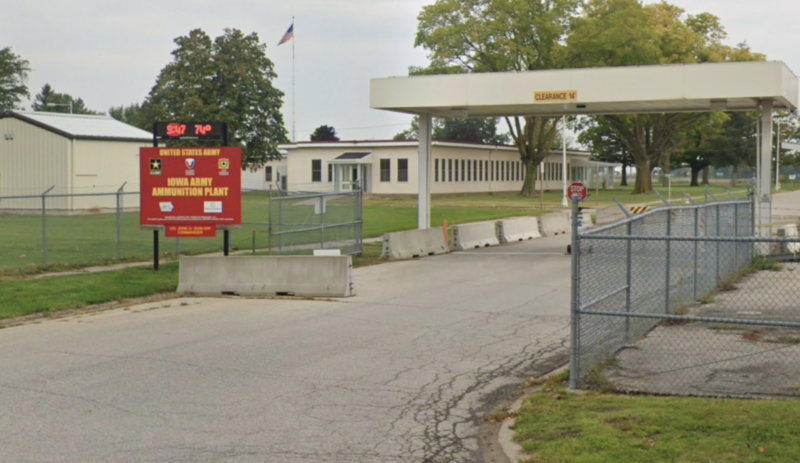
Iowa Army Ammunition Plant in Middletown. (Photo via Google Earth)
Iowans have expressed concern about the potential effects from the detonation of lead azide at the Iowa Army Ammunition Plant that is scheduled for Friday, but officials say the intentional detonation is the best way to manage the concerns.
Iowa Army Ammunition Plant informed residents of Middletown and surrounding areas that on Friday, around noon, the U.S. Army will intentionally detonate 68 drums of deteriorated lead azide — an explosive — on site, causing a plume of air “with some lead-containing particles” which could spread close to 100 miles from the site and leave lead-particle-containing dust in a 40-mile range.
Justine Barati, a public and congressional affairs specialist with the Army Sustainment Command, said the decision to detonate the materials in the controlled and scheduled matter, comes from an “abundance of caution.”
The U.S. Environmental Protection Agency, which approved an emergency permit for the detonation, said the “explosion risk” of the degraded lead azide presented an “imminent and substantial threat to human health and the environment.”
The intentional detonation instead allows the Army to plan based on best conditions, inform the public ahead of time and work to contain as much of the heavy metals as possible.
Barati said the Friday detonation will be surrounded by large sand piles and that technicians will be spraying the area and surrounding soil with water to “minimize the amount of lead that’s going to be dispersed.”
Barati said this detonation is an “extra-ordinary event.”
“This is an emergency operation to get rid of a chemical that could detonate on its own,” Barati said.
Potential risks and precautions
Iowa Army Ammunition Plant held an open house in mid October for Middletown residents and provided information about the developing plans to detonate the material.
One neighborhood of Middletown, is being asked to temporarily vacate the area from 8 a.m. to 2 p.m. on Friday. Barati said this request is “out of an abundance of caution” in case the detonation causes old, or large format windows to shatter. The Armed Forces Reserve Center in Middletown is open to residents who need a place to go during the detonation.
The lead dust is anticipated to “linger for no more than an hour” according to public documents from IAAP. The army has released modeling, and plans to update the maps frequently leading up to detonation, of areas that will potentially be exposed to “toxic lead dust” through air dispersion and surface deposition.
Most recent modeling, which changes depending on wind and weather conditions, shows the dust could spread through the air about 100 miles northeast of the detonation site, traveling up past Muscatine and toward Maquoketa. Lead dust could settle on surfaces in areas northeast of the detonation site for about 40 miles, according to the map which shows areas outside of Wapello and New Boston, Illinois in the potential exposure area. Updated maps will be available online.
According to the EPA, lead is toxic to humans and animals and there is “no safe level of lead in children that has been identified.” Barati said pregnant women and children under 10-years old are most at risk in this instance.
The issue has gained significant attention on social media, with influential content creators outside of Iowa expressing concern for the health impacts of the detonation and lead particles in the air.
According to information released by the Army, folks in the area for potential air dispersion should avoid being outdoors during the detonation time Friday, switch their heating and cooling systems to recirculate, and keep windows and doors closed. Additionally, the army says impacted residents should “consider cleaning indoor and outdoor surfaces such as play surfaces for children and windowsills” after the air exposure period has ended.
“What we’re asking people to do if they’re concerned is to hose down the area around their house that they’re concerned about, and if they hose it off, it should be safe,” Barati said.
EPA granted the Army an emergency permit, on Nov. 13, for the treatment and storage of lead azide for the operation. The permit requires public notifications before and after the detonation, a cleanup process and certain reporting, including samples taken before, during and after the detonation.
Kellen Ashford, a press officer for EPA Region 7, said in an email: “Treatment of the lead azide under the Emergency Permit helps ensure maximal control of the conditions leading up to the detonation, including prior public notification of exposure risks that may result from this treatment activity.”
Ashford said the Army had previously provided EPA with documentation of the recrystallization of the stored lead azide which “created a risk of spontaneous explosion due to the material’s sensitivity to friction and shock.”
“The Army, which has unparalleled expertise in matters concerning explosives safety, concluded that this material cannot safely be handled or moved and therefore, cannot be treated by any method other than in-place detonation,” Ashford wrote.
EPA has created a webpage that Ashford said will be updated with additional information on the site.
An FAQ document from the Army to residents explained that the heat of the explosion, when done properly, “incinerates” the lead azide. Active air monitoring and post-detonation sampling will be conducted to “identify material that may need to be cleaned up.”
The document also notes that residents concerned about environmental impacts on their property should sign up for voluntary sampling. Additionally, the Army is responsible for cleaning up potential lead found in the soil if it “exceeds regulatory thresholds.”
On Tuesday, Iowa Environmental Council expressed concern about the detonation and its potential impacts on human and environmental health. The group called on federal and state leaders to “provide more transparency” on the situation.
“Coordination and leadership are critical at this moment for local officials trying to make well-informed emergency response and public health decisions, such as keeping schools open, evacuating communities, and providing assistance to vulnerable populations including pregnant women, seniors with mobility issues, and children,” Iowa Environmental Council wrote in a news release.
Several local school districts have decided to close on Friday because of the detonation, including West Burlington Independent, and Mediapolis Community.
Barati, when asked if the Army was working with state or local partners, said “we’re notifying the states about what the issues are and the concerns.”
A spokesperson with the Office of the Governor said the state became aware of the IAAP’s plans to detonate the lead azide “on Monday after a public advisory was issued by the U.S. Army.”
“Members of the governor’s staff and state agencies contacted both organizations and have since been meeting about the situation,” the spokesperson said in an email. “All planning and permitting for this event have been managed at the federal level by the Army with the U.S. Environmental Protection Agency. The Army engaged local public health and emergency management officials to assist with community awareness efforts.”
Des Moines, IA