Unearthing North Carolina’s past while planning for its newest monument
Oct 14, 2026 | 3:01 pm ET
Description
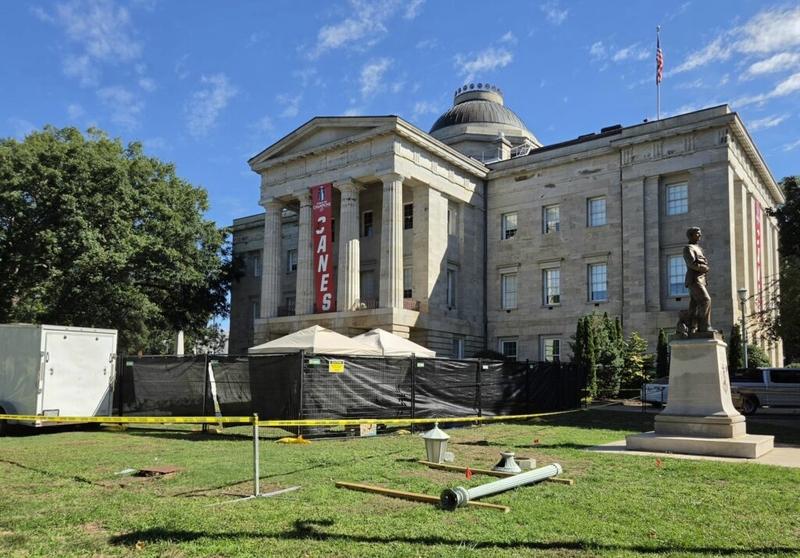
State archaeologists with the Department of Natural and Cultural Resources examined the grounds of the Capitol Oct. 13 for historical artifacts. (Photo: Clayton Henkel/NC Newsline)
At first glance, you might mistake the freshly dug hole on the State Capitol grounds in Raleigh for a shallow grave, especially so close to Halloween. But David Cranfield, an assistant state archaeologist with the Department of Natural and Cultural Resources, assured passersby Tuesday it was nothing so ghoulish.
Cranfield and a team from the North Carolina Office of State Archaeology were looking for any archaeological material under a small parcel of the capitol grounds prior to the installation of a new Revolutionary War monument.
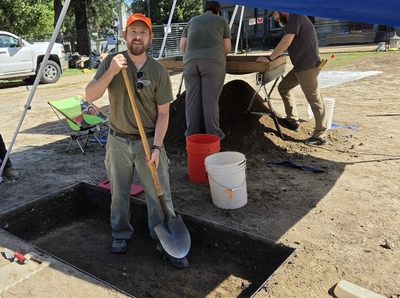
“A few weeks ago, we came out here and conducted a ground-penetrating radar survey of this area because this portion of the grounds has had very little previous archaeological investigation,” Cranfield explained. “The results indicated that there was an anomaly that we couldn’t explain.”
The original capitol building at Union Square was destroyed by fire in 1831. The state legislature approved construction of the Greek Revival design that opened in 1840. It serves today as the office for North Carolina’s governor and houses the state’s historic legislative chambers.
“We know from historical documents and maps that this ground has been in use both around the time that the capitol was being built and even before then,” he said.
On the southwest corner of the square, there was an armory at one point.
“There were buildings down here that workers and potentially enslaved people who were in charge of either the construction or the daily maintenance of the capitol would have been using on this back side of the property,” Cranfield said. “We are out here hopefully identifying any remains that may be undisturbed.”
Most of what the archaeology team found Tuesday had been heavily disturbed by previous construction projects where workers were not so careful.
“This morning we found two pieces of wire-frame glass lenses,” said Cranfield. “It’s the same style that Benjamin Franklin wore. It does speak to very early activity in this part of the grounds.”
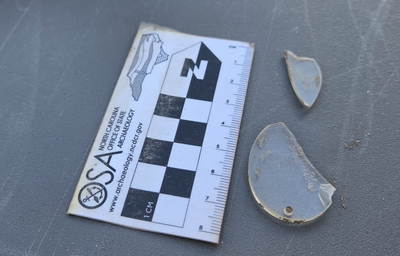
Pieces of pottery and rusty nails from a bygone era emerged as buckets of earth were carefully shifted through a quarter-inch mesh screen.
“We are finding some artifacts that date to that early 19th-century, late 18th-century time horizon,” said Cranfield.
All the recovered treasures will go back to the state’s archaeology lab on Lane Street to be cleaned, cataloged and analyzed. The state maintains a repository of more than seven million artifacts for the state of North Carolina.
Cranfield says it’s a common misconception that the archaeologists are studying dinosaur bones. That work belongs to paleontologists.
In this case, it’s the small things, even the broken things, that seem so precious.
“We are always interested in learning from what people left behind,” said Cranfield.
The archaeologists will finish their work by Thursday. After that, the hole will be filled in to make way for a future Revolutionary War monument. The General Assembly earmarked $15.5 million in the recent state budget for planning and improvements to the building and grounds of the old State Capitol.


Raleigh, NC