Trucking industry doubts Trump’s diesel order will dial down fuel prices
Oct 12, 2026 | 5:00 am ET
Description
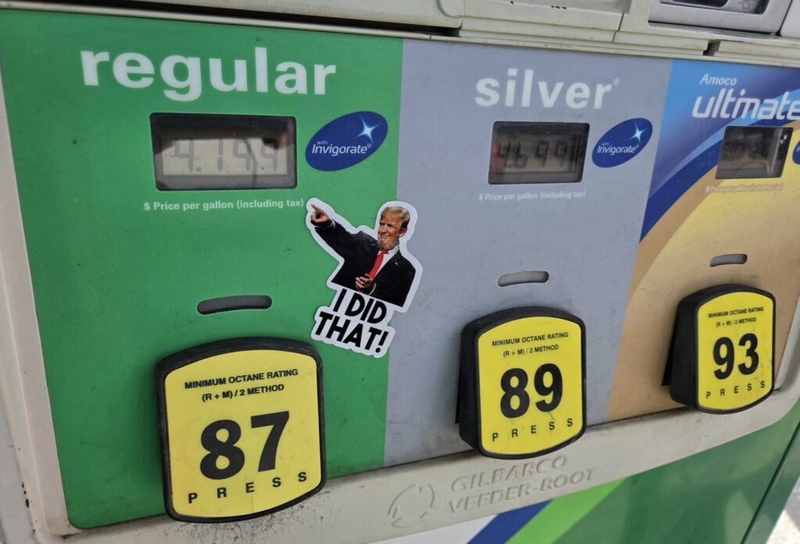
A sticker affixed to a gas pump in North Carolina blames President Donald Trump for the high prices. (Photo by Clayton Henkel/NC Newsline)
In response to record diesel prices, President Donald Trump signed an executive order a week ago to make the tax-free version of the fuel — typically reserved for off-road vehicles, heavy equipment and farm use — available to anyone. But there are doubts within the transportation industry, which by far relies on diesel the most, and among analysts over whether the order will have any impact on their bottom line.
Heading into the weekend, the average U.S. highway-use diesel price was $6.20 per gallon, up nearly $2.50 from a year ago, according to the U.S. Energy Information Administration. The Louisiana average sat at $5.81 per gallon, based on AAA tracking.
Soon after Trump signed his executive order last Monday during a visit to Nebraska, there were questions about whether truckers and other fleet operators might eventually have to pay taxes on the off-road diesel they buy through the end of the year, when the president’s edict expires. Language in the order directs the U.S. Treasury secretary to “defer certain diesel fuel tax payment obligations,” stopping well short of waiving the 24.4 cents per gallon it collects.
The Nebraska Trucking Association, representing roughly 900 companies, cautioned members and partners not to fill up with the untaxed, tinted diesel fuel, the Nebraska Examiner reported.
“We’re being very clear,” president and CEO Kent Grisham said. “Do not put dyed diesel in your tanks — at least not yet.”
Todd Bates, president of the Mississippi Trucking Association, sent an email to its 300 members Wednesday suggesting they set aside 24 cents for every gallon of off-road diesel they buy.
“Treasury has not yet said who owes it, or when, and the order only asks Treasury to look for a way to forgive it,” Bates wrote. “Plan as if you’ll owe it.”
Henry Hanscom, chief policy and public affairs officer for the American Trucking Association, said in an interview with his group’s news service that he’s awaiting more information about how the order will lower costs for its members.
“The practical details here matter,” Hanscom said. “The (executive order) directs temporary penalty relief and potential tax deferral, not outright tax forgiveness. We look forward to carefully reviewing the IRS’ implementing guidance once it is available to better understand how this relief will work in practice. Carriers need clear federal and state guidance on eligibility, reporting and any taxes that remain payable.”
Road diesel users don’t necessarily have easy access to the tax-free fuel made available to farmers. It’s not typically offered at the truck stops where 18-wheelers and most fleet vehicles fill up their tanks.
Patrick DeHaan, GasBuddy’s top petroleum analyst, said the president’s order could backfire if there’s a surge in demand for the tax-free diesel that’s dyed red so that law enforcement can detect its unauthorized use by truckers and others.
“The two fuels are the same, and there’s no mystery surge of dyed diesel inventory available, but there is a smaller distribution system, meaning that selling significantly more may negatively impact availability,” DeHaan wrote in his latest Substack entry.
Roughly three-quarters of the diesel fuel available in the United States is used for transportation, according to the U.S Energy Information Administration. That includes 18-wheelers, rail lines, passenger buses, delivery trucks and other fleet vehicles.
The agriculture industry, the primary users of dyed diesel, consumes less than 10%.
In Louisiana, Gov. Jeff Landry issued his own executive order last month that permits dyed diesel use for the road vehicles that farmers and the timber industry use. The president’s order is a more expansive version, with no limitation on who can buy and use it.
Karl Means owns Razorback Rentals, an aggregate hauling business with 10 trucks based in St. Helena Parish. He said he doesn’t intend to fuel his fleet with dyed diesel because he would eventually have to eat the cost to clean it from his trucks’ tanks.
“Whenever this ends, because it’s not going to be forever, I’ve got dyed fuel now in my fuel tanks that I have to clear out,” Means said. “I have to make sure it’s cleared out so that I don’t get fined down the line whenever this ends.”
Louisiana punishes dyed diesel violations with a fine of $10 for every gallon, based on a truck’s tank size. Louisiana State Police and the state transportation department assist the IRS with dyed diesel enforcement, but none of the agencies could provide data on how many violations they have logged.
As long as diesel prices remain elevated, the fuel surcharge Means adds to customer bills for each load of material his trucks carry covers less of his costs. The surcharge usually accounts for 90% of his fuel expenses. It’s now down to 75%, forcing him to eat the remaining 25%, he said.
“It’s taking money out of our profits, and then that actually hurts my employees,” Means said. “We’re not able to provide some of the bonuses, the conveniences, the extras we give drivers.”
Means has also noticed higher fuel surcharges on the bills he receives, such as when he needs to have parts shipped to him to maintain his trucks.
“It’s the price of doing business now,” Means said. “Most customers are accustomed to the fact that there’s a fuel surcharge.”
Trump announced Friday afternoon he had struck a deal with President Vladimir Putin for Russia to supply more than 4 million tons of diesel to the global market, with Trump suggesting the U.S. could buy some of that supply. Doing so would lift an American ban on Russian petroleum imports that’s been in place since 2022 over Putin’s invasion of Ukraine.
The quantity Trump said Russia has pledged is equal to roughly 30 million barrels of fuel. U.S. refineries produce around the same amount of distillate, which includes diesel and heating oil, every six days, based on federal data.
Russia’s ability to export that quantity of diesel is uncertain, as Ukraine has targeted its fuel refineries as a countermeasure for Putin’s continued military incursions.

Baton Rouge, LA