Tiffany says he’ll cut taxes while increasing spending on schools, healthcare
May 26, 2026 | 5:15 pm ET
Description
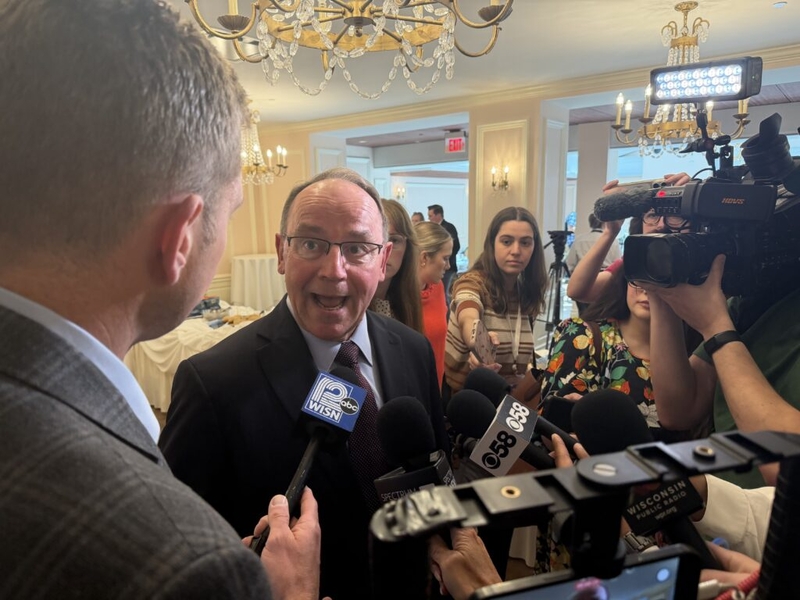
U.S. Rep. Tom Tiffany speaks to reporters after his May 26 appearance at a WisPolitics.com event. (Henry Redman | Wisconsin Examiner)
U.S. Rep. Tom Tiffany said at an event Tuesday in Madison that if elected governor he’d return the state’s current budget surplus to taxpayers while also cutting property taxes, eliminating taxes on tips and overtime and overturning Gov. Tony Evers’ 400-year school funding increase while also increasing the rate at which public schools are reimbursed for special education services.
Tiffany said he’d do all of that even though he has not “penciled out in detail” how he’d pay for it all. At the event Tuesday hosted at the Madison Club by WisPolitics.com, Tiffany repeatedly lamented “Madison math” that makes people ask what will be cut from the state budget if lawmakers cut taxes, reducing state revenue.
Several times during the moderated interview and to reporters after the event, Tiffany compared the state budget process to household budgeting.
“Families figure out what their priorities are, and then they spend accordingly,” he said. “Education is going to be one of my priorities. Transportation will be a priority. Healthcare is going to be a priority. Those things take first call on the budget, and then when we get down to the wants, if some of them fall off, so be it. We’re going to make sure that we take care of the basics first.”
Tiffany is running for governor during a midterm election cycle in which Democrats are planning for the possibility that they can hold trifecta control of Wisconsin’s government for the first time in more than 15 years. President Donald Trump’s declining approval rating, the national political landscape and new voting maps that could end years of Republican legislative control mean that Tiffany is campaigning against the political current.
Repeating a line from his speech at the Republican Party of Wisconsin convention earlier this month, Tiffany said he was running for governor rather than continuing to hold his safe Republican seat in Congress because he wants to reverse what he sees as a “state in decline.”
Loyalty
Tiffany, who was first elected to the Legislature in 2010 and then elected to represent northern Wisconsin’s 7th Congressional District in 2020, said “people who know” him know that he’s always been loyal first to the people of Wisconsin rather than the Republican executives — former Gov. Scott Walker and Trump — he’s worked with.
Tiffany is a member of the right-wing House Freedom Caucus and has rarely broken from Trump while in Congress. Following the 2020 presidential election, Tiffany joined Republican efforts to overturn Trump’s loss. Last week, he told reporters he still had concerns about “improprieties” in the administration of the 2020 election.
On Tuesday, Tiffany wouldn’t say that former President Joe Biden won the 2020 election, only that Biden was the president from 2021 until 2025. He said that he had concerns about the administration of the election in “a number of states.”
“We should make sure that those things that were done wrong did not unduly damage that election,” he said. “On January 6 of 2021 it was decided by the Congress that Joe Biden won the presidency, and he became president … and I accepted that. I referred to him as President Biden, and, but I gotta tell you, it was a bad time for the United States of America when you had 10 million people that came in illegally, when we lost our energy independence, when we tucked tail and ran in Afghanistan … it was not a good period of time, but he was president for those four years.”
Tiffany said he was still “studying the details” of the U.S. Department of Justice’s $1.776 billion slush fund for compensating people who stormed the U.S. Capitol on Jan. 6. But he said he didn’t think people who assaulted law enforcement officers should receive any of that money.
Asked to point to other examples in which he disagrees with Trump, he said he didn’t believe the federal government should allow more Chinese students to attend American public universities such as the University of Wisconsin.
During the audience question portion of the event, Tiffany was asked about the undocumented workers who make up a large portion of the state’s dairy workforce. Tiffany responded by criticizing Biden-era immigration policy, attacking “sanctuary” policies and claiming that the national decline in violent crime is because of Trump’s crackdown on immigration.
But Tiffany wouldn’t say if Immigration and Customs Enforcement went too far during its occupation of the Democratic-run cities Chicago, Minnesota and Los Angeles.
“The President made a decision that he thought that things should be done differently after what happened in Minneapolis, and I think that decision will be born out here as we go forward,” he said. “But remember, Minnesota was an anomaly, Immigration and Customs Enforcement works very closely with law enforcement. Here’s what I would do: I would make sure that local, county and state law enforcement works closely with Immigration and Customs Enforcement and coordinate their efforts to make sure what happened in Minnesota does not happen in Wisconsin.”
Madison issues
Tiffany also weighed in on a number of issues that lawmakers in Madison have taken up this year, including the Knowles-Nelson Stewardship Grant program, the legalization of online sports betting and the growth of hyperscale data centers in the state.
On the stewardship program, which is set to expire at the end of June after legislators failed to reach a deal on extending it past 2026, Tiffany said he’d sign a bill to re-authorize the program if it focuses on maintaining “what we have” rather than acquiring new state land. Tiffany in recent years has often joined Republican state lawmakers in opposing land conservation projects in the northern part of the state through the program.
Earlier this year, lawmakers enacted a law that would allow the state’s Native American tribes to begin operating online sports betting operations. The bill will require the state’s gambling compacts with the tribes to be re-negotiated.
Tiffany said he doesn’t support expanding gambling opportunities in the state but that he’d “have to review the details” of the law to weigh in on the compact negotiations.
Over the past year, the construction of massive AI data centers has become one of the most potent political issues in the state. Tiffany said that the controversial data centers in Port Washington, Mount Pleasant and Beaver Dam have taught the state lessons on how to move forward. He said he would repeal a provision included in the 2023-25 state budget that exempted data center construction costs from the state sales tax, prevent data centers from being built on “productive farmland,” work to keep utility rates stable and prevent the tech companies building the data centers from making local governments sign non-disclosure agreements.
However he wouldn’t say if legislation would be required to achieve those goals, only saying that “my Public Service Commission” would handle it.
Madison, WI