With their new legislative majorities, NH Democrats eye education changes
Nov 16, 2026 | 5:00 am ET
Description
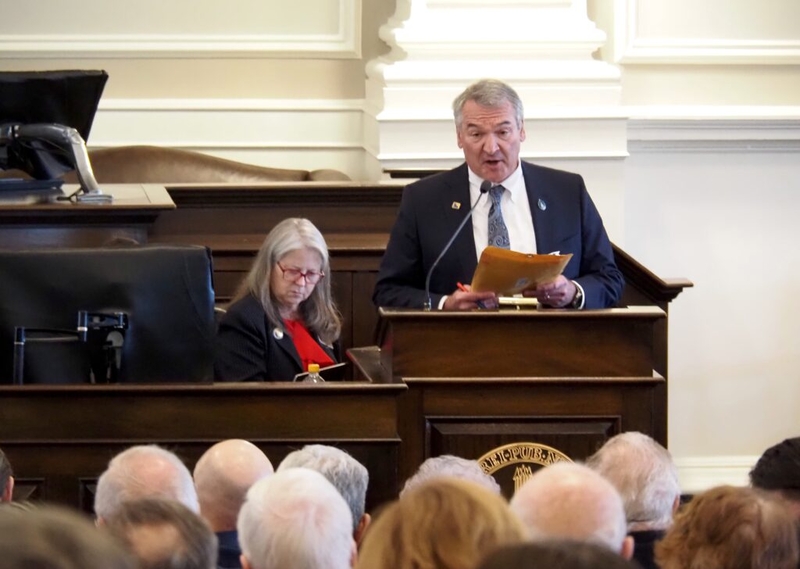
Rep. Dave Luneau, a Hopkinton Democrat, is among the Democrats who will be proposing several changes to education in New Hampshire. Here, Luneau addresses the House on Jan. 7, 2026. (Photo by Ethan DeWitt/New Hampshire Bulletin)
When the New Hampshire Supreme Court found New Hampshire’s school funding unconstitutionally low in 2025, its directive to lawmakers was clear. “We urge the legislative and executive branches to act expeditiously to ensure that all the children in public schools in New Hampshire receive a State funded, constitutionally adequate education,” wrote Justice James Bassett.
Over the following two years, legislators made few changes to the state’s school funding formula.
But in January, 292 House and 15 Senate Democrats will be seated in the state’s 400-member House — pending any changes from recounts. And some Democrats are proposing major changes to education.
Many of the most ambitious ideas could get vetoed by Republican Gov. Kelly Ayotte, who maintained the corner office. And any changes that would increase taxes are sure to attract the criticism of Republicans eager to win the Legislature back in two years.
But as concerns about property taxes have increased, Democrats say they are hoping to capitalize.
“New Hampshire is dead last in the country when it comes to the state share of funding public schools,” said Hopkinton Rep. Dave Luneau, the ranking Democrat on the House Education Funding Committee.
Here’s what to watch in the 2027 legislative session affecting education.
Repealing education freedom accounts
Some Democrats will seek to repeal the education freedom accounts program, which was created in 2021 and allows families to take the per-pupil amount given to public schools and use it toward private or home school education costs. In 2025, Ayotte and Republicans removed remaining income limits on the program; the program currently has a 12,500-student cap and is projected to cost about $68 million for the coming school year.
But other Democrats are proposing a number of less dramatic changes that would tweak the EFA program. Rep. Jonah Wheeler, of Peterborough, is seeking to require private schools accepting EFAs to maintain the same admissions standards as public schools.
Luneau raised other potential approaches from Democrats, like restoring an income eligibility limit; instituting audits against the nonprofit organization that administers the program, Children’s Scholarship Fund; introducing anti-fraud protections against people misusing EFAs; and gradually winding down the program with a sunset clause that would allow current families to keep using their EFAs.
Increasing state funding to public schools
Many Democrats are interested in increasing the amount of state funding to public schools, arguing the measure is necessary to help reduce property taxes. But lawmakers have a wide array of ways to do it.
Luneau plans to reintroduce his proposal for “opportunity grants,” in which New Hampshire’s per-pupil school funding would no longer be uniform, but would instead be based on specific factors: a district’s poverty levels, special education needs, teacher-salary costs, and other factors, such as enrollment size and population density.
He also supported exploring homestead property tax exemptions, which would allow New Hampshire property owners to receive exemptions up to a certain threshold, such as the first $300,000 of their home’s assessed value.
Rep. Mark Vallone, an Epping Democrat, wants to reverse cuts to the state’s business taxes instituted by Republicans in 2015. Vallone is planning to reintroduce House Bill 1708, which the House killed this year without debate. That bill would restore the business profits tax rate from 7.5% to 8.5% — its level before the 2015 tax cuts began — and would use some of those tax increases to lower the total amount of statewide property taxes the state requires municipalities to collect, by about $90 million per year.
In an interview, Vallone called the proposal a “small-ball bill” in the grander scheme of school funding. But he argued by pairing business tax increases with property tax reductions, Democrats could win over constituents who might ordinarily oppose such increases. “This one actually gives tangible reductions in a bill that people need,” he said.
Republican lawmakers passed a law that also temporarily reduced the total amount collected by the statewide education property tax, or SWEPT, in 2021, bringing down the total number from $363 million per year to $263 million per year for one year. At the time, critics argued the approach was poorly targeted because it benefitted property-wealthy towns more than property-poor towns.
Some of the most sweeping proposals come from a Republican lawmaker. Rep. Walter Spilsbury, of Charlestown, says he plans to reintroduce a trio of bills he has attempted in recent years that could radically change the state’s relationship to property taxes.
Spilsbury’s first bill would require towns that collect more statewide education property taxes than they need to fund their own schools to send that extra revenue to the state, which could then redistribute it to property-poor towns. That concept, which is echoed in other bills by Democrats for next year, would restore an earlier “donor town” version of the SWEPT repealed in 2011.
The second of Spilsbury’s bills would recreate last session’s House Bill 1800. That bill required all cities and towns to collect $5 per $1,000 in property taxes — up from the current average of $1 — and send the excess to the state, with up to 40% reductions available to people who are over 65, have no children in the public school system and who are living in their primary residence.
Spilsbury’s third bill would create a study committee to explore alternative revenue sources.
Spilsbury said he opposes an income tax, but could be open to a limited form of sales tax — provided it had guardrails and was designed to collect only enough revenue to replace the current amount sent to schools.
But he said he is open to any creative solution.
“If we could completely eliminate any funding of schools from property tax, I think that’d be best,” he said.
To the New Hampshire School Funding Fairness Project, which has assisted in one of the recent lawsuits brought against the state’s education funding formula, the new Democratic majorities create an opportunity for creative proposals to change the state’s school funding model.
“There’s still a significant shortage, in our opinion, in the amount of funding provided by the state,” said Zack Sheehan, the organization’s executive director. The solutions, Sheehan argued, lie in taking a look at reversing Republican cuts to business taxes and the elimination of the interest and dividends tax.
“We’ve invested billions in this tax strategy, in theory for a benefit to us as citizens, and there’s no evidence of it,” Sheehan said.
New Hampshire Republicans have pointed to large majorities of voters opting for tax caps over their school districts on Election Day as evidence that New Hampshire residents support limits on school funding, even as they voted in Democrats to power.
“I see no evidence that voters issued a mandate for higher taxes, nor do I believe Republicans should abandon the principles of fiscal restraint and educational freedom that we’ve consistently advocated,” said Rep. Ross Berry, a Weare Republican who lost his reelection on Nov. 3, in comments to InDepthNH.
In a press release, Rep. Jason Osborne, an Auburn Republican recently chosen to be House Republican leader in the 2027-2028 session, castigated Democratic Rep. Eileen Kelly for filing a bill that would repeal the tax cap ballot question law. “Just four days ago, Granite Staters overwhelmingly said they wanted a property tax cap,” Osborne wrote on Nov. 6. “Now, the first order of business for the new majority seems to be ripping away the property tax cap their voters themselves enacted.”
But Sheehan argued the majority support for ballot question 2 proves only that most Granite Staters are tired of paying more for property taxes. Democrats should use that message, he argued.
“I do think that there’s a lot more of an appetite nationally and locally to talk about how government invests in things that people care about,” he said.
Smaller changes in past two years
Any Democratic proposals may crash against a longstanding political reality: New Hampshire’s school funding is often very slow to change.
In the last legislative biennium, lawmakers did not make major changes to the formula, despite the Supreme Court directive. The “base” per-student adequacy payments sent to public schools rose by the statutorily required 2% per year.
The Legislature appropriated $32 million more toward special education costs in the two-year budget passed in 2025. It reintroduced a targeted funding approach to give more state funding to towns with less property wealth, known as “fiscal capacity disparity aid.”
Republican lawmakers also removed income limits from the education freedom accounts program, and passed House Bill 1815, which sought to nullify the Claremont and Contoocook Valley School District Supreme Court school funding decisions by declaring “adequate” education funding to be a joint responsibility of the state and municipalities.
Other education changes
The volume of school-related bills has expanded so rapidly that in 2025, the New Hampshire House and Senate split their education committee into two committees, to separate education funding from education policy matters.
And lawmakers have plenty of education bills that are not related to school funding.
Sen. Donovan Fenton, a Keene Democrat, has filed legislation to provide free lunches in schools. Rep. John Cloutier, of Claremont, has filed a bill to repeal HB 1815, and restore the state’s statutory accountability to the Supreme Court decisions. And Rep. Wayne Burton, a Durham Democrat, is seeking to repeal “all prohibitions of diversity, equity and inclusion within state agencies and in public schools.”
Some Republicans are looking for smaller measures that might get bipartisan support.
Sen. Daryl Abbas, a Salem Republican, is introducing legislation that might earn the support of public schools. In June, Ayotte signed House Bill 1817, which allows education freedom account students to attend classes and programs offered by their local public schools without needing to pay extra — as long as the EFA recipients do not exceed 50% of the public school’s instructional class time.
Public school advocates argued the bill would short them by requiring them to take EFA students but providing no compensation. Abbas will introduce a bill that would require the state to send school districts 15% of per pupil adequacy aid for each course that an EFA student takes, which amounts to about $653 per full-credit course. That reimbursement formula has long been used for non-EFA home-schooled students who use public school resources.
Abbas said he supports the intent of HB 1817: “A home-school student is a home-school student; whether they’re EFA or not EFA should not matter,” she said.
But, he added, his bill is aimed at making the process fairer for districts.
“Since we made the law say that the schools cannot exclude the home-schooled EFAs, then they at the very least should get the (15%) adequacy funding,” he said.
Concord, NH