Super PAC Could Herald Aggressive New Approach to Albany Lobbying
Oct 08, 2026 | 5:00 am ET
Description
Photo courtesy of New York Focus
New York’s top Albany lobbying firm is testing a new way to influence politics: starting its own super PAC to spend money in support of a wide range of candidates. The committee, started by Brown & Weinraub and known as New York Forward, appears to be the first of its kind in the state.
Lobbying firms are no strangers to super PACs — which can spend unlimited cash to support candidates as long as it’s independent of campaigns. But they generally help set up such committees to benefit a single client or affect a specific election.
Brown & Weinraub’s is different: It’s a super PAC for the lobbying firm itself, with no clear expiration date, catering to clients with a broad array of interests.
This could prove to be a “powerful tool for lobbyists to get their clients what they want now, while also permanently expanding the lobbyists’ influence,” said Kyle Kennedy, legislative program manager at the government reform group Reinvent Albany.
Two of those clients — Kalshi, the prediction market platform, and the Chinese American Independent Practice Association, a doctors’ group — have largely funded the super PAC thus far, which in turn supported politicians with key legislative influence over their priorities.
CAIPA’s political arm has given the super PAC $147,500 and Kalshi recently gave $400,000 in advance of the November election. Both are clients of Evan Rantzaklis, a Brown & Weinraub lobbyist who is listed as the senior adviser for the new super PAC.
Since the US Supreme Court’s 2010 Citizens United decision — which unleashed campaign spending through super PACs — both local and national interest groups have spent major sums on state elections.
Interest groups with sufficient resources and political acumen have started super PACs of their own. But Brown & Weinraub’s model “dramatically lowers the barrier for their clients to dump money into a political system already drowning in big money influence,” Kennedy told New York Focus. Super PACs run by lobbyists allow them “to use other people’s money to help friendly incumbents win, while creating an implicit threat to legislators that might oppose them.”
Brown & Weinraub raked in more than $24 million in compensation from hundreds of clients last year, by far the most of any lobbying firm in the state.
The five state legislators who benefited from New York Forward’s spending in the June Democratic primaries all won their races. (Several did not face especially serious electoral challenges.) In a post-primary email soliciting donations for New York Forward, Brown & Weinraub said the five victories showed the super PAC “gives our clients a proven, results-driven platform to engage in New York’s political process.”
The firm plans to spend in the November general elections, and while its targeted races are not yet clear, it stated in paperwork earlier this year that it planned to spend in support of Hochul.
Kalshi first donated $50,000 to the super PAC in late May. (The donation was required under election law to be disclosed at the time, but New York Forward only reported it two months later in an amended filing.) Kalshi did not respond to an email seeking comment.
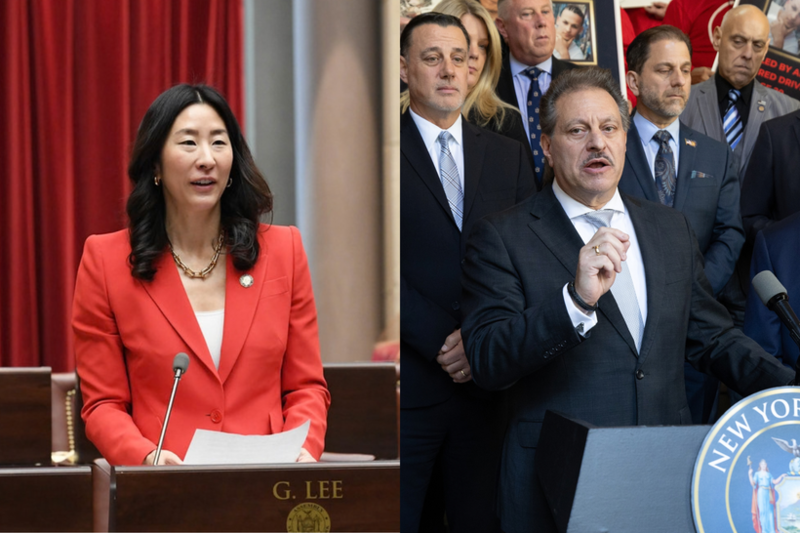
That was the second-largest donation to the super PAC during the primary season, according to disclosure filings, and soon afterwards, New York Forward’s second-largest expenditure, $22,000, went to boost Queens Senator Joseph Addabbo. Addabbo did not face an especially competitive reelection bid, but he is a lawmaker with major influence over Kalshi’s business interests in New York.
Prior to Kalshi’s donation, Addabbo, chair of Senate Racing, Gaming, and Wagering Committee, had successfully pushed for the legalization and regulation of a different type of betting platform: mobile sports betting companies like DraftKings and FanDuel. More recently, he has expressed concern about online prediction markets like Kalshi. “They’re in illegal territory, because we have regulated, for instance, mobile sports betting,” Addabbo told Spectrum News in the spring. “So, let’s regulate prediction markets.”
In March, Addabbo sponsored a bill that would give the state attorney general authority to issue rules and regulations for online prediction markets. Records show that in May or June, Kalshi lobbied Addabbo on the bill.
Addabbo did not return requests for comment.
The company’s recent $400,000 donation to the super PAC comes at a time when the company is under threat in New York: In July, Governor Kathy Hochul and Attorney General Letitia James filed a lawsuit accusing Kalshi of running an illegal gambling operation. It’s not yet clear how the money will be spent.
Previously, the biggest donor to the super PAC had been the Chinese American Independent Practice Association, which represents over 1,800 private practice medical providers who serve the New York City area’s Asian-American community.
In March, after the state senator representing Chinatown announced his retirement, creating an open seat, CAIPA’s political action committee donated $147,500 to the Brown & Weinraub super PAC. A significant portion of the super PAC’s spending — $107,000 — went toward promoting Manhattan Democratic Assemblymember Grace Lee for the open seat in her primary against former Assemblymember Yuh-Line Niou. Lee won handily.
CAIPA already had warm feelings toward Lee. In June 2024, Lee introduced a bill that could enable its members to buy cheaper health insurance for their employees. In the years since, Brown & Weinraub lobbied Lee’s staff several times on the bill, which passed both houses of the legislature this year and awaits Governor Kathy Hochul’s signature or veto. It is opposed by some health insurance companies, such as Blue Cross and Blue Shield, which has argued it could result in “reduced health insurance protections for New York residents.”
Lee’s campaign noted that her support for the bill began long before Brown & Weinraub lobbied her or her Senate candidacy materialized. A spokesperson said she was encouraged by the Senate sponsor to introduce a companion bill in the Assembly.
Lee introduced the bill to “protect quality healthcare access for the most vulnerable low-income immigrant patients in New York,” said her chief of staff, Alex Fraser, noting that federal Medicaid cuts have threatened physicians’ ability to operate in the state. “Grace has been an early and vocal leader in the fight to protect immigrant communities, and she’ll carry that work into the Senate next year.”
While Rantzaklis did not respond to questions, he wrote an op-ed last December framing the super PAC’s efforts as a response to a political culture prone to punishing “attempts at collaboration.”
“We will support effective state legislators who take their responsibilities seriously and have a demonstrated record of delivering for their districts, no matter where they land politically,” he wrote. “Our purpose is to ensure that the people doing the real work of governing are not drowned out by the most strident voices or by challengers focused only on making a splash.”

Albany