Studies link New Mexico drilling to radiation, air pollution, health risks
Sep 08, 2026 | 8:00 am ET
Description
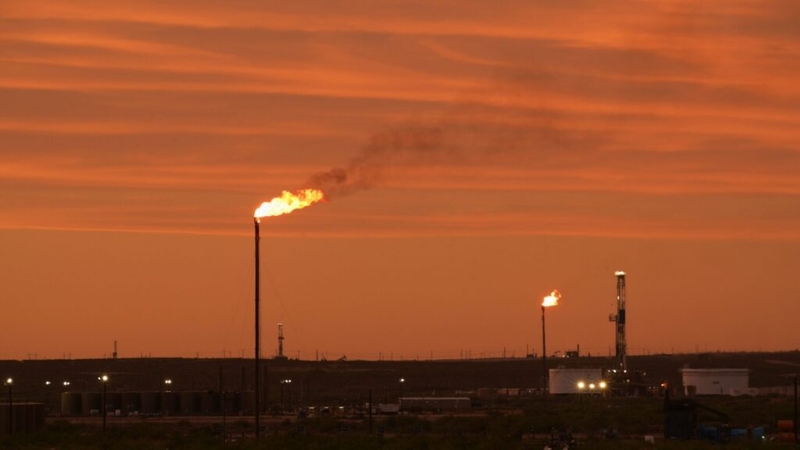
A pair of natural gas flares near Loving, New Mexico. (Jerry Redfern/Capital & Main)
A recently published scientific paper ties oil and gas operations in the Permian Basin to radioactive airborne plumes near the small New Mexico town of Loving. An associated study outlines how high levels of ozone pollution in the same area are also the byproduct of oil and gas production in the nation’s most productive oilfields.
Both scientific studies are based on data collected at an air monitoring station that operated in Loving between May 2023 and May 2024. That work was funded by a grant from HEI Energy. The peer-reviewed radiation study was published this month in Elementa, an imprint of the University of California Press.
Among various forms of air pollution, the monitoring station measured radon and the particles that form from its decay. Data in the study showed airborne radiation levels in Loving rising up to five times normal background levels, depending on wind direction.
Since all readings were taken in one spot, the report’s authors said they could not tie the radiation to a single source. But they pointed to the area’s intense oil and gas development, which they said highlights the need for follow-up studies.
You don’t have to be a scientist to wake up and see it’s brown and it’s not dirt.
Detlev Helmig, an atmospheric scientist with air quality program Boulder AIR, said, “The analyses of our monitoring data provide evidence that oil and gas operations in the Loving area are a likely source of atmospheric releases of radioactivity.” Helmig was an author on the study and helped set up and manage the original monitoring station in Loving.
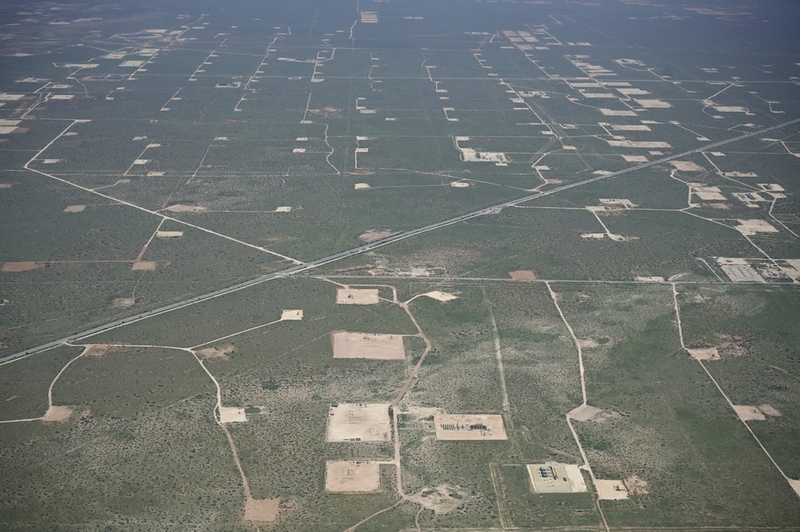
This small town in the Permian Basin is a petri dish for the perils of living amid the oil and gas industry’s most productive oil fields. Hundreds of active oil wells lie within two miles of Loving and another dozen large processing facilities sit within the same sweep. The smell of raw hydrocarbons regularly fills the hazy air.
“It’s pollution,” said Jackie Onsurez, a Loving resident who ran in the Democratic primary for lieutenant governor. “You don’t have to be a scientist to wake up and see it’s brown and it’s not dirt.”
The study says radiation sources include oil and gas industry emissions “such as gas flares at active well pads, gas-fired compressors at midstream sites, and produced water ponds.”
It concludes that this airborne radiation could lead to a small but measurable increase in lung cancer risk.
“There is no safe level of radioactivity. Similar to smoking,” Helmig said. “Even a low number of smoked cigarettes and even passive smoking has been found to be harmful. That’s about the same with the exposure to radioactivity in the air that people breathe.”
In the study’s conclusion, its authors write, “Given the well-established health risks associated with radioactivity exposure, continued investigation is critical.”
The affiliated ozone pollution study results were presented in late June at the Air & Waste Management Association’s annual conference in Austin and reflect work in progress. Its authors hope the full study will be peer reviewed and published early next year.
Preliminary data from the 2023-2024 work in Loving showed elevated levels of nitrogen dioxide — a dominant precursor of ozone. The new work tracks wind patterns and densities to tie that ozone almost entirely to oil and gas production in the Permian Basin and not to metro area pollution — such as smoke and car exhaust — coming from El Paso or other nearby cities. It shows weighted ozone measurements in Loving exceeded those found in Houston or Dallas.
Ozone values in urban areas of China and India are still worse.
The sources of the ozone precursors overlap with those found in the radiation report and include emissions from diesel compressors (used to pump natural gas through pipelines), gas flares and trucks used by the oil and gas industry. All are “critical in driving ozone formation” around Loving, writes Gunnar Schade, associate professor of atmospheric sciences at Texas A&M University. He, too, helped manage the Loving air monitoring station that provided the study data.
He said that while “some ozone will be Texas-made, most is likely New Mexico-made.”
Schade noted dryly that while the pollution numbers are bad in Loving, “Ozone values in urban areas of China and India are still worse.” India in particular records some of the worst air pollution on the planet.
Ozone damages the lungs and aggravates existing lung diseases like emphysema and asthma. Oil and gas operations leak chemicals known as ozone precursors that bake together on warm, sunny days to create ozone, which is the principal component in the formation of smog.
Dani Caputi, the lead investigator of the radiation study, also worked on the initial phase collecting air data in Loving. She said, “We are really hoping that this line of inquiry doesn’t end with this study.”
That has happened before. When the monitoring project in Loving ended in 2024, the group offered to sell the monitoring station to the New Mexico Environment Department — which declined to buy it. This despite the fact that the Loving facility monitored a wider range of chemical sources than the state’s Environment Department did at the time.
Meanwhile, the Environment Department took delivery of a mobile radiation monitoring van in April. But a long-awaited mobile air-pollution monitoring truck may not be in service until the end of the year.
The radiation van cost $480,000 and will house a mobile laboratory that includes a machine capable of measuring radon levels like those assessed near Loving as well as “all radioisotopes including tritium.” Tritium occurs very rarely in nature but is a common product in nuclear reactors and nuclear weapons production.
The Environment Department enforces state laws around air, ground and water pollution at uranium mines, the nation’s only commercial uranium enrichment plant and at Los Alamos National Laboratories, one of the nation’s main nuclear research and weapons manufacturing factories, where tritium is used to make nuclear warheads. Last year, in a controversial decision, the Environment Department approved plans for the Los Alamos National Laboratory to release gases into the atmosphere from overpressurized tritium containers at the nuclear weapons-making facility.
Drew Goretzka, director of communications at the Environment Department, said, “The tritium capability is not intended solely for Los Alamos National Laboratory.” He said the van strengthens the state’s radiation monitoring capabilities across the board, including radiation from oil and gas operations.
Back in the Permian Basin, the New Mexico Environment Department has improved its stationary monitoring stations in the Permian Basin-area cities of Carlsbad and Hobbs to monitor sulfur dioxide, a common, toxic byproduct of flaring in oilfield operations. Studies in both China and the U.S. have shown that exposure to sulfur dioxide during pregnancy can lead to lower birth weights for babies. The Centers for Disease Control and Prevention say that breathing the gas can irritate the eyes and respiratory tract and aggravate asthma and emphysema symptoms.
“These are the first sulfur dioxide monitors in the Permian in New Mexico. I’m not even sure Texas has any sulfur dioxide monitors in the Permian on its side,” said Michelle Miano, director of the Environmental Protection Division at the Environment Department.
She said that natural gas in the basin is naturally high in sulfur dioxide, and while some can leak from facilities, much of it comes from flaring natural gas. Though flaring is theoretically banned in New Mexico, companies flare — or burn off — natural gas for many reasons, including overpressurized gas lines and contaminated gas. Despite the ban, companies reported flaring 33,651 times between Sept. 1, 2025, and Sept. 1, 2026.
Pollution from that flaring could be tracked by a long-awaited air-pollution monitoring truck, which Miano said is on the way.
Our air quality was worse than El Paso, Las Cruces, Albuquerque and Los Angeles over the same time period.
In 2022, a $6.5 million settlement between WildEarth Guardians and Oxy USA Inc. over Clean Air Act violations included $500,000 for air quality projects in southeast New Mexico. In 2024, WildEarth Guardians transferred those funds to the Environment Department to purchase a mobile air lab.
“That one has been a long time coming for all kinds of procurement issues,” Miano said. One stumbling block was the need for trained people to operate it, and her department only recently got enough money to hire them. Plus, she said the truck ended up costing more than the initial settlement money — $589,000.
Miano said the extra money came from recently increased air pollution permit fees. That troubles Haley Jones, an organizer with Citizens Caring for the Future, an environmental group in Carlsbad. “This means that in order to pay for air monitoring & enforcement, [the Environment Department] must continue to issue air permits, which makes our already poor air quality worse,” she said in an email. Those permits set out how many tons of toxic pollutants facilities like natural gas processing plants can legally release.
Jones said that over the last month, Carlsbad had just one “good” air quality day, according to the EPA’s AirNow air quality map. The city is surrounded by oil and gas wells and infrastructure. That corner of New Mexico has the state’s highest concentration of permitted, polluting facilities.
“Our air quality was worse than El Paso, Las Cruces, Albuquerque and Los Angeles over the same time period,” she said.
Miano said the new truck will be similar to the air monitoring facility used by the HEI Energy-funded studies, but “It will have the capabilities for measuring more pollutants.”
Even so, people involved with the initial settlement aren’t thrilled with the process or the outcome.
“We certainly didn’t expect it would take four years to get that monitoring on the ground,” said Rebecca Sobel, climate and health program director at WildEarth Guardians.
“Buying the truck isn’t the finish line, what matters is what [the Environment Department] does with it,” she said. “Who decides where it goes? And how quickly will people see the data? If polluter-paid enforcement dollars buy sophisticated equipment but the equipment isn’t available when something happens, or the public can’t see the results, we’ve missed the point.”
“It’s an utter disappointment,” said Jeremy Nichols of the Center for Biological Diversity. He worked at WildEarth Guardians on the initial Oxy settlement.
The Environment Department “wants to do more monitoring of air pollution in the Permian Basin? That’s like a police department saying they need to do more murder monitoring before they decide to enforce murder laws,” he said. “Data already shows there are serious problems in the Permian Basin and that [Gov. Michelle Lujan Grisham’s] administration should request the EPA designate the region as an ozone nonattainment area. They have not.”
A nonattainment designation would have forced New Mexico and Texas to reduce ozone emissions, which likely would have required much more stringent oil and gas pollution enforcement. Nichols and Sobel said that was the goal all along.
“The intent of the settlement,” Nichols said, “was to direct funds toward pollution reduction efforts, not more data gathering and paperwork.”
Santa Fe, NM