State of the Race: Democratic U.S. Senate race pits old guard, vanguard in battle for party’s soul
Jul 28, 2026 | 2:00 pm ET
Description
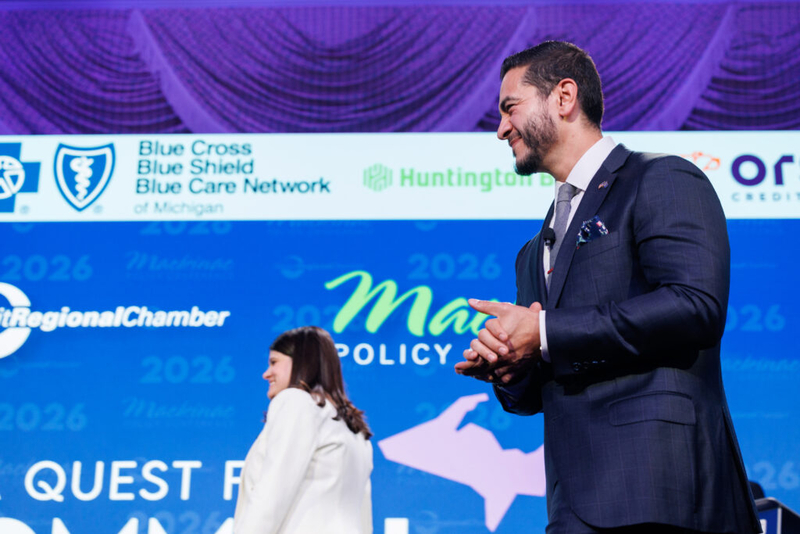
U.S. Rep. Haley Stevens, left, and former Wayne County Health Director Abdul El-Sayed, right, participate in a U.S. Senate candidate debate during the Mackinac Policy Conference on Mackinac Island, Mich., on May 28, 2026. (Photo by Andrew Roth/Michigan Advance)
In August, Michigan Democrats will once again be asked to vote in a bellwether statewide election that could also determine the future electoral prospects of the national party.
Whether voters choose the progressive Abdul El-Sayed or center-left U.S. Rep. Haley Stevens of Birmingham on the Aug. 4 ballot could be a key determinant for whether Democrats or Republicans control the upper chamber of Congress for the next two years.
It could also reveal how purple of a state Michigan really is. Voters in the Great Lakes State last elected a Republican U.S. senator in 1994. However, the lone Republican in the race, former U.S. Rep. Mike Rogers of White Lake, is endorsed by President Donald Trump and seen as the GOP’s best bet for beating the Democrats’ 25-year lock on Michigan’s U.S. Senate seat.
Democratic voters’ decision on whether they’ll send El-Sayed — who they rejected in his 2018 gubernatorial run in favor of Gretchen Whitmer — or Stevens into the ring with Rogers in November will ultimately be a decision on which kind of candidate they want in that fight.
Gretchen Whitmer quickly becomes Haley Stevens’s most prominent ally after a late game endorsement
El-Sayed has run as one of the race’s most progressive candidates, endorsed by progressives including U.S. Sen. Bernie Sanders of Vermont and U.S. Rep. Alexandria Ocasio-Cortez of New York. Stevens, meanwhile, has drawn support from nearly every corner of the Democratic Party establishment, from Whitmer to the retiring U.S. Sen. Gary Peters, who Stevens is seeking to replace.
The choice between the two may also have implications in the national debate over which faction rules the Democratic Party.
“It is certainly going to be seen that way nationally,” Matt Grossmann, a political scientist, author and director of Michigan State University’s Institute for Public Policy and Social Research, told Michigan Advance. “This would be the first test of, ‘well, this succeeded in a swing state.’ Or it will be taken as a sign that swing state victories are harder. People do have some concerns about the electability of further left candidates.”
That was especially true in Michigan, as the candidates are most clearly reflective of the factions they represent.
“A victory will not happen without a massive African American advantage for Stevens, so it would play into the traditional problems that the left has as being identified as the white part of the party, or at least one that has trouble, especially, with African American voters,” Grossmann added. “But El-Sayed has overperformed expectations in terms of not just demonstrating excitement and support, but in being able to appeal to a broader range of voters than when he ran for governor.”
Both candidates are raising big dollars in the final stretch
The August primary will also test the role of big money in politics in a heated intraparty contest.
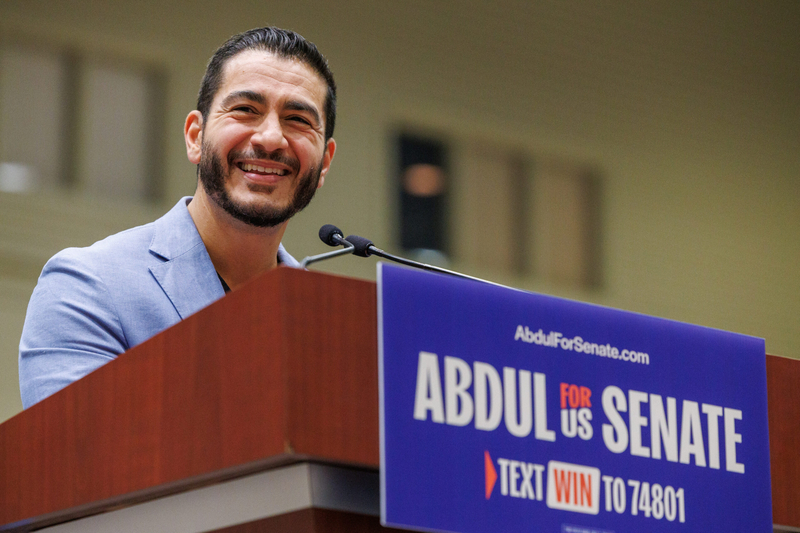
Federal Election Commission filings show both campaigns are well-funded heading into the Aug. 4 primary. Between April 1 and June 30, El-Sayed raised $4.57 million and spent $4.37 million, leaving him with $2.7 million cash on hand. Stevens raised $2.09 million, spent $2.06 million and reported $3.41 million in the bank. Pre-primary filings covering July 1-15 show Stevens had $2.79 million cash on hand after raising $920,859 and spending $1.54 million, while El-Sayed reported $2.55 million after raising $2.3 million and spending $2.48 million.
Outside groups have spent at least $47 million on the race, with the vast majority benefiting Stevens. Nearly $24 million has been spent to support the congresswoman, including more than $9.7 million from the AIPAC-affiliated United Democracy Project and $12.9 million from A Stronger Michigan PAC.
It does matter if the electorate is buying the message that’s been sent with all the money.
Outside groups have spent about $2.5 million supporting El-Sayed, while nearly $10 million has been spent opposing him—almost all of it from the United Democracy Project — which is directly connected to the American Israel Public Affairs Committee.
Even in the face of steep spending disadvantage, Grossmann said that El-Sayed has shown strong fundraising support to fight against Stevens-backed outside spending. It also shows that Stevens’ campaign has not manufactured an effective negative narrative against him.
“I think all those things make it harder for the money to matter,” Grossmann added. “That said, it still is the case that outspending is associated with success in primaries. It does matter if the electorate is buying the message that’s been sent with all the money.”
AIPAC’s spending in the race, however, has been a clear advantage for Stevens in terms of media access. As of last week, AIPAC through United Democracy Project told the FEC that it had purchased $4.87 million in advertising for the final week of the race. The group has also spent a quarter of a million dollars on direct mail against El-Sayed as of July 21.
Both of those purchases pushed United Democracy Project’s spending in the primary past $24 million, funding additional resources to boost Haley and target El-Sayed.
AIPAC becomes a major faultline in Michigan
The debate over whether AIPAC should have such sway on American elections has been particularly fierce in Michigan.
Grossmann said that Michigan was a major battleground for that debate mostly due to the state’s large Arab and Muslim population.
A wide swath of Arab and Muslim Michiganders voted uncommitted in the 2024 primary in protest of former President Joe Biden for supporting Israel in its war with Gaza following the Oct. 7, 2023 terrorist attacks that left more than a thousand Israeli citizens and other civilians dead and more than 250 people kidnapped by Hamas fighters. While it had no real effect on Biden in the primary, many of those voters swung to support President Donald Trump over Vice President Kamala Harris, who became the nominee after Biden dropped out.
Stevens’ connection to AIPAC could swing those voters toward El-Sayed in the 2026 primary, giving him a powerful hedge to the strong Black vote that Stevens is likely to net in Southeast Michigan.
Progressives have been more forceful in making the case to move support away from Israel, causing another liability for Stevens, who is very much aligned with Israel in its foreign policy. AIPAC’s spending on Stevens has only bolstered those associations.
“There’s all kinds of places where you know AIPAC has come in, and they want to attack El Sayed, but that’s not really the main story,” Grossmann said. “The story is that this is the most AIPAC identified candidate that is available, and long standing and not trying to run away from it.”
A cautionary tale of Democrats supporting Israel
AIPAC most notably began supporting Stevens during the 2022 primary race she ran against former U.S. Rep. Andy Levin after the pair were placed into the same district when new congressional maps were drawn. Levin, who is Jewish, favors a two-state solution between Palestine and Israel, saying that while he firmly supports Jewish statehood, Israeli military occupation of Palestinians has been toxic to both sides.
Levin, who has endorsed El-Sayed, told the Advance that despite holding views shared by Republican and Democratic presidential administrations alike, AIPAC went on the attack.
“That was obviously unacceptable to AIPAC,” he said. “The irony is that this particular position isn’t that radical. This is important — this is a Jewish thing to me. Thirty-six times in the Torah it says, in one version or the other, to treat the other as you want to be treated. If you’re serious as a Jew and the obligations of theology, if you’re honest, the ‘other’ to the Jewish people, especially for the Jewish state, is the Palestinian people.”
As AIPAC has continued to heavily back Stevens this year, Levin has campaigned with El-Sayed, who has called for ending U.S. military aid to Israel, supporting Palestinian statehood and curbing AIPAC’s influence in American politics.
Levin also said AIPAC would likely be comfortable with either Stevens or Rogers winning in November.
Pro-Israel groups, donors and many Democratic supporters have often equated opposition to military aid for Israel or criticism of its war in Gaza with antisemitism. Levin rejected that view.
“This whole thing about antisemitism and criticism of Israel gets so mixed up in ways that are really harmful to both,” Levin said. “I’m pro-Palestinian and pro-Israel. To most people, Zionism means support for Israeli Prime Minister Benjamin Netanyahu and his policies, and it’s horrifying, right? I agree with all that. But if you want to go back to the very basics of Zionism as the idea that the Jewish people have a right to self-determination in the Holy Land, I’ll go all the way there, too.”
All guns blazing as the race winds down
Aside from the AIPAC controversy, the race overall was mostly cordial during the year-long buildup to the Aug. 4 contest. Attacks between El-Sayed and Stevens have only intensified, however, since fellow Democrat, state Sen. Mallory McMorrow (D-Royal Oak), suspended her campaign earlier this month. Her name will still appear on the ballot.
Stevens has focused her attack lines on the fact that El-Sayed’s net worth is more than $1 million, painting him as a hypocrite for attacking the wealthy on the campaign trail. That was confirmed Monday when El-Sayed finally released his financial disclosures, showing his net worth could total as much as $2.1 million, which Stevens used as an attack line in the pair’s final debate.
“You talk about getting money out of politics and putting money in people’s pockets, but still no one knows who’s putting the money in your pocket,” Stevens said, referencing close to $300,000 El-Sayed listed as “other income.”
El-Sayed’s campaign has focused on Stevens’ connections to corporate funding and her AIPAC backing and argues she has misled voters by emphasizing her ties to former President Barack Obama.
Stevens’ team has invoked Obama throughout the primary and her association with his auto industry rescue efforts during the late 2000s recession. Mailers from outside supporters of Stevens’ campaign have drawn connections to past support from Obama, even though he has not officially endorsed her in 2026. There has been much debate over whether those mailers were a deceptive tactic to convince Black voters that Obama was backing Stevens.
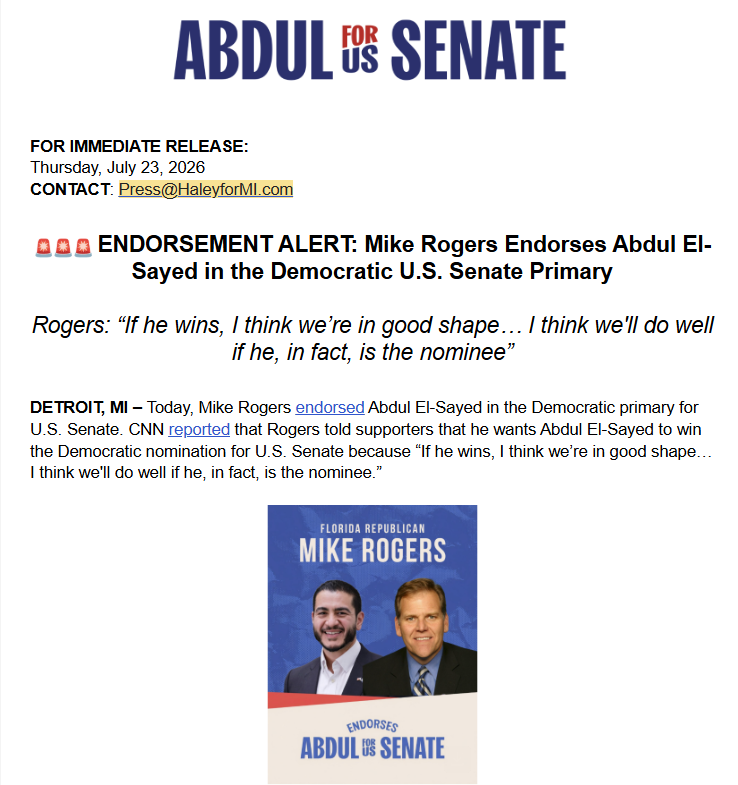
El-Sayed’s campaign noted another recent example of Stevens’ campaign potentially misleading voters when it sent out a notice designed to appear as though it came from El-Sayed’s campaign, touting an endorsement from Rogers, even though it came directly from Stevens’ communications office.
El-Sayed wants the FEC to investigate the email as potentially violating federal election law. Stevens spokesperson Joetta Appiah told the Advance that it was simply a parody.
All things considered, Grossmann said he doesn’t believe the race is as dirty as it could have been. As Stevens calls El-Sayed a major liability against Rogers in the fall, Grossmann said the attacks show how much of a threat he is to Stevens’ shot at winning the nomination.
“It’s harder to make that argument when it seems like a last ditch effort,” Grossmann said of Stevens throwing everything her campaign had at El-Sayed to blunt him before Aug. 4.
Mike Rogers patiently waits in the wings
Meanwhile, Rogers’ campaign is watching this all unfold with good feelings about the divisions within the Democratic Party with a little more than three months until the general election.
Rogers — who lost his 2024 race against current U.S. Sen. Elissa Slotkin (D-Holly) — has faced no real primary challenge and is waiting in the wings for his opponent, raising steady cash for the race ahead. Rogers’ pre-primary FEC filing shows that he has $4.41 million cash on hand.
“Mike Rogers is happy,” Grossmann said. “It wasn’t initially a top-tier Senate race for Republicans because people assumed that if it was a Democrat year, Michigan would be trending toward the Democrats. Now, I think it will be a top-tier Senate race because if El-Sayed wins, he’ll be viewed as more vulnerable, and if Stevens wins, she’ll be viewed as having trouble coalescing support from her own party, even in the general election.”
Both of those scenarios are likely being viewed as net positives for Rogers’ campaign.
“Right now, Republicans are already gearing up to spend a lot more in this race than they otherwise would have,” Grossmann said. “They’ve moved it up in the potential for contests they can win. Stevens is making a big deal out of the fact that Rogers said he was happy to run against El-Sayed, and I think that is sincerely the case.”
Although Stevens has yet to win a statewide race, she did flip the former 11th Congressional District seat away from Republicans in the 2018 bid that sent her to Congress. She has consistently won in subsequent races, and won perhaps her toughest contest in 2020 against Republican Eric Esshaki — Stevens won by a little more than 2 percentage points.
El-Sayed has also never won a statewide race, let alone any electoral victory, putting him at a disadvantage against Rogers, who served two terms in the Michigan Senate and seven terms in Congress representing his mid-Michigan district.
“This has been a race where people will have a harder time buying that disadvantage,” Grossmann noted. “Even if they did buy that, there’s a general trend that shows they wouldn’t necessarily believe it. Mike Rogers’ campaign does believe that it’s true.”
‘Don’t let history repeat itself’
Either way, the Democratic Party will have to reckon with the possibility that too much bad blood has been spilled during the primary race, and that both Stevens and El-Sayed will move into the general election as wounded warriors. Not only will the party need to bridge divides between progressives and establishment forces who have been at each other’s throats online, it will need to focus on the task at hand; beating Rogers in November.
State Rep. Tyrone Carter (D-Detroit), who is firmly behind Stevens, has been a surrogate for the congresswoman appearing at some of her more recent Detroit events. Following a meet-and-greet event organized in Detroit just hours after Whitmer endorsed Stevens, Carter told the Advance that the divisions among Michigan Democrats is a real concern if they want to hold their 30-year streak of electing only Democrats to the U.S. Senate.
“We’ve watched it before,” Carter said. “I hate to say it, but labels do matter when you have different factions of the Democratic Party, the socialists, the progressives working in Lansing with them. It cannot be all or nothing.”
Carter said control of Congress was ultimately at stake.
“Compromise within your own party is not a bad word because getting the gavel is what matters,” Carter said, reflecting on the Democratic trifecta that party commanded in the state Legislature during the 2023-24 session. “I know what it’s like not to have a gavel for four years, and to get the gavel and be able to move the agenda on some things. Watching little kids eat breakfast at school, that’s huge. That wouldn’t have happened. We put all of our differences aside.
“Even the uncommitted understand what uncommitted did to communities. If they did get a lesson from what ‘uncommitted’ meant, it is: Don’t let history repeat itself.”
Lansing, MI