State pension fund criticized for failing to prioritize fossil fuel divestment despite 2021 law
Mar 14, 2024 | 5:30 pm ET
Description
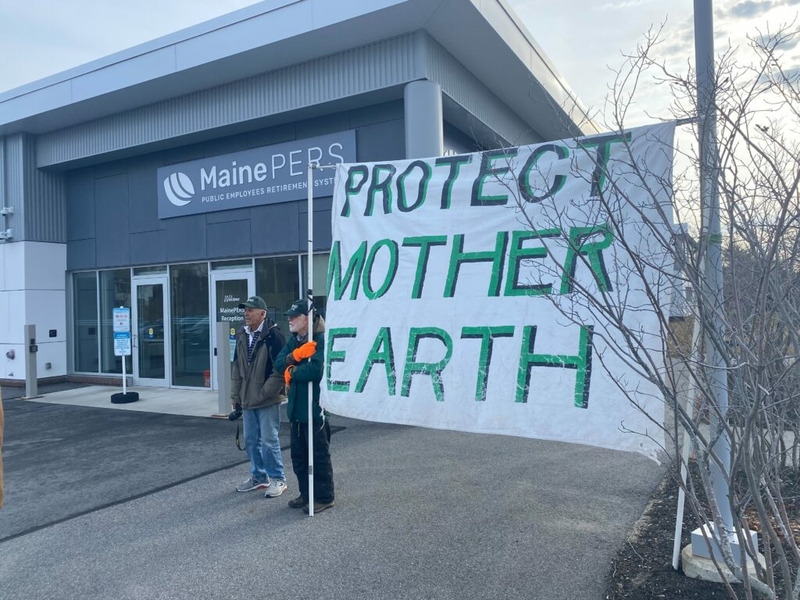
Members of Divest Maine, a coalition of climate advocates, picketed outside the Maine Public Employee Retirement System office on March 14, 2024. (Evan Popp/ Maine Morning Star)
Activists held a rally Thursday outside the state pension fund’s headquarters in Augusta, urging the organization to take steps to fully divest from fossil fuels under the stipulations of a law passed in 2021.
Divest Maine, a coalition of climate advocates, argued that the Maine Public Employee Retirement System (MainePERS) has not complied with that law and is not on track to divest under the edicts of the 2021 statute.
That measure requires the $19 billion system to divest from fossil fuels by the beginning of 2026 and not invest in additional fossil fuel holdings — although it also stipulates that MainePERS must stay within its duty to act in the best financial interests of beneficiaries. The bill was put forward because of concerns about continued financial support of fossil fuels — given the well-demonstrated link between such energy sources and climate change — and worries that putting money in fossil fuels is a risky bet given increasing efforts to transition to renewables.
Organizers of Thursday’s rally called for MainePERS to by the end of June: exclude fossil fuels from public and fixed income portfolios, commit to making no new private market fossil fuel investments, agree to let its existing private investments in such sources expire, and keep in mind climate-related issues when conducting risk assessments for new investments.
“Show good faith and start doing the right thing,” said Linda Woods of Waterville, a participant at the rally and a pension fund beneficiary.
MainerPERS’ presentation to lawmakers
During a Tuesday presentation to the Legislature’s Labor and Housing Committee about divestment, MainePERS officials said the system’s fossil fuel investment exposure fell from 7.8% of the fund’s assets in 2022 to 6.5% in 2023, decreasing by $193 million. They further estimated MainePERS’ exposure to fossil fuels will likely decline by a third by 2026 as investments expire.
However, the fund’s CEO Rebecca Wyke told the committee that fully divesting from fossil fuels by 2026 would violate the system’s fiduciary duty to pension holders — its constitutionally-mandated obligation to act in the best financial interests of members.
“The trustees absolutely have to act in the best interests of those pension recipients as beneficiaries, not as people who live on this earth, but as beneficiaries,” Wyke said. “And it is a very high standard, and that is what is driving this, not any desire not to be cooperative with those who brought forward the legislation.”
Despite the system’s concerns about full divestment, Wyke argued that MainePERS is in compliance with the 2021 law because it has taken steps to increase transparency around fossil fuel investments while fulfilling its fiduciary duty to pension holders.
‘They have not heeded the spirit’ of the law
Proponents of the 2021 measure, however, argue that not fully divesting by 2026 would violate the intent of that law.
“They have not heeded the spirit [of the law] and they seem actually quite defiant, which is upsetting to me,” Molly Schen, a rally participant and member of Third Act Maine — a group of older climate activists — said of MainePERS.
Others argued that divestment fits within MainePERS’ fiduciary duty because the renewable energy transition means fossil fuel investments are becoming increasingly likely to lose value.
“We should be investing in renewables, we should be investing in what is going to be the future,” said Iver Lofving, a MainePERS beneficiary and member of Third Act.
That argument is one that has also been made by some energy industry financial experts. And some other large pensions have started taking such steps, including three of New York City’s funds, although a lawsuit has been filed against the systems for that decision. In addition, the New York State Common Retirement Fund has restricted investments in a number of oil and gas companies.
Those at Thursday’s protest also cited the urgency of addressing the climate crisis as another reason for divestment. Schen pointed to the series of powerful storms the state has experienced in the last few months and said it’s clear Maine is already seeing the detrimental impacts of climate change.
“We don’t have a lot of time to turn off the spigot from oil and gas and turn to our solar and wind renewables,” she said. “We have to do it faster than anyone thought, so here I am saying let’s do it, let’s turn off the spigot, at least at MainePERS.”
2021 bill sponsor knocks MainePERS
Rep. Maggie O’Neil (D-Saco), the sponsor of the 2021 law, also criticized the pension fund. In a letter to members of the Labor and Housing Committee, O’Neil said MainePERS has interpreted its fiduciary duty obligations in an overly broad way.
O’Neil added that the system has lost significant amounts of money from its fossil fuel investments and could fully implement the 2021 law through several prudent, financial options. Such options include moving stock holdings to an index with little or no fossil fuels, not buying fossil fuel company bonds and committing to making no new private market fossil fuel investments, among other strategies, she said.
“We will be living in a dramatically different Maine and a different world in 2050,” O’Neil wrote. “Temperatures will be hotter, sea level will be higher and storms will be worse. MainePERS can and should do more to implement the law, protect our retirement savings and protect our future.”
Lawmakers on Tuesday also questioned MainePERS’ investment strategy and whether its fossil fuel holdings are costing the pension fund money. System leaders said the fund invests in all sorts of different assets and that some of those assets will inevitably lose value. However, investing in a diverse array of sectors helps mitigate that risk, officials argued, and the system’s leadership urged lawmakers to keep in mind the growth in the fund’s value as a whole.

Augusta, ME