State employee union decries pay, staffing in new report
Aug 11, 2026 | 1:19 am ET

Description
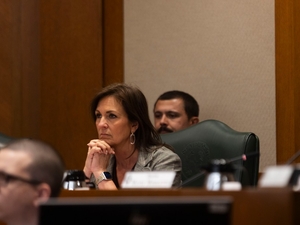
Patrick Moran, president of AFSCME Local 3, released a survey of state workers that found them unhappy with their jobs and struggling to pay the bills. The report calls on Gov. Wes Moore to make good on promises of better pay, staffing and worker safety. (File photo Bryan P. Sears/Maryland Matters)
Nearly eight in 10 state employees have considered leaving their jobs, while nearly 60% said they are working more than one job just to make ends meet.
The data comes from a survey of state workers released Monday by the American Federation State, County and Municipal Employees Council 3. Union leaders called on Gov. Wes Moore (D) and other state leaders to do more to improve pay, working conditions and increase staffing levels.
The report – the first of its kind by the union — surveyed workers represented AFSCME, one of the largest unions in the state with about 50,000 public employee members, including 26,000 state workers. It said more than 2,500 state workers responded to the survey.
“Four years in, we still have a lot of work to do. There are huge gaps in the number of agencies, and they’ve got to be met,” said Patrick Moran, president of the state council. “And if we are going to spend the next four years trying to remedy this, then they need to get working on it now. They needed to get working on it from day one, as they committed to. But we find ourselves still here, and in some cases, I would argue, in greater peril.”
Moran and others said the problems began under former Gov. Larry Hogan, a two-term Republican with whom the union had a contentious relationship. But Moran said things remain tough for state employees, even with the change to Democratic control under Moore.
“I think they have a very long way to go,” Moran said when asked about Moore’s failure to hit early goals. “Governing is hard. It’s very hard, and people come in with big ideas, and they’ve got to live up to those ideas. We’ve seen all around us, whether that’s in county government or the federal government, in certain agencies in certain areas, they are taking those things seriously.”
State workers union sues Moore, university system for withheld raises
But a Moore spokesperson said that workers “have a partner in Gov. Moore, and together, we’ve made meaningful progress to protect workers and create pathways for every Marylander to earn a good living.”
“Workers and organized labor are the backbone of Maryland’s economy, and while there is more work to do, the Moore-Miller Administration will continue working with the men and women who serve our state to build an economy where every worker can thrive,” said Rhyan Lake, the spokesperson.
The union called for across-the-board pay increases to the standard salary schedule as well as for correctional officers, including for entry-level employees. It also calls for guaranteed cost-of-living increases and adjusted salaries to make up for missed scheduled increases.
Union officials said many members have to work more than one job to make ends meet.
“I’m working a second job and working seven days a week to take care of my family and pay for necessities like my BG&E bill,” said Stanton Owens, a board member for the local that represents social services workers across the state.
There were also more than a half-dozen recommendations to improve safety conditions including heat and air-quality standards, a call for improved training and plans to improve failing infrastructure.
The union called on Moore to address caseloads and staffing shortages and eliminate costly contracts. Union officials also want rules governing mandated use of artificial intelligence tools. Owens said employees are “being asked to use AI in our jobs without our input on how it will affect our work and our clients.”
To pay for the raises and other improvements, Moran said the state could cut costly consultant contracts and tighten up “billions in tax credits,” as well as looking “at incomes in the upper stratosphere.”
“They have to look at other sources of revenue that are not going to hurt working people, that are going to benefit working people,” Moran said, adding later: “Maryland is one of the wealthiest states in the nation.”
The report is the latest rough patch for the relationship between Moore and the union.
Moore entered office promising to increase hiring. He failed to meet that goal, but has had some success during his term, which ends in January.

Last year, Moore instituted a voluntary separation program that some union members compared the move to Elon Musk’s Department of Government Efficiency efforts.
More recently, Moran and other union members have complained about wage compression as some new employees are hired at or above pay scales for veteran employees. At the same time, cost-of-living increases have failed to keep pace with inflation.
And some who were hired were brought on at salaries that compressed wages of longtime union members, who have also received little in the way of cost-of-living increases.
Moore took office vowing to fill half of the thousands of vacant positions in state government at the time. He has made some headway.
In 2023, he entered office with more than 6,500 open jobs excluding vacancies in the judiciary and higher education — a vacancy rate of 13.4%. A year later, 5,045 of the state’s 49,900 positions were vacant, a rate of about 10%. In May, according to the most recent data from the Department of Management and Budget, there were about 4,800 vacancies in more than 52,200 state positions, a vacancy rate of 9.3%.
Some of the biggest changes have come in tough-to-hire departments.
The Department of Public Safety and Correctional Services’ vacancy rate in May was just under 9%, down from almost 16%. Tony Sines, president of a Western Maryland local that represents correctional officers, said his members are leaving to take higher-paying jobs with federal or local governments.
“Since July of last year, we’ve lost over 100 officers, approximately 20% of the workforce, from my region to other places,” Sines said. The union has repeatedly highlighted safety concerns associated with vacancy rates and increased overtime.
Department of Juvenile Services vacancies fell from more than 16% to 9.3% in May, while the Department of Human Services vacancy rate in May was just under 7%, down from nearly 15.4%.
Some agencies, such as the Department of Health and the Maryland State Police, have vacancy rates only marginally lower than their earlier rates. Others, including the Office of the Public Defender, report a higher percentage of vacancies now.
The administration still struggles to hire quickly. In 2024, it took 188 days to hire a new employee. In May, that number decreased to 109 days.
The governor, who vowed to beef up staffing by converting contract jobs to state positions, has fallen behind. In 2024, the budget office reported 1,125 contractual positions over two years. In May, that number had increased to 1,161.
Annapolis, MD