In southwest Idaho FBI raid, officials zip-tied teens and used aggressive force, lawsuit alleges
Feb 10, 2026 | 4:22 pm ET
Description
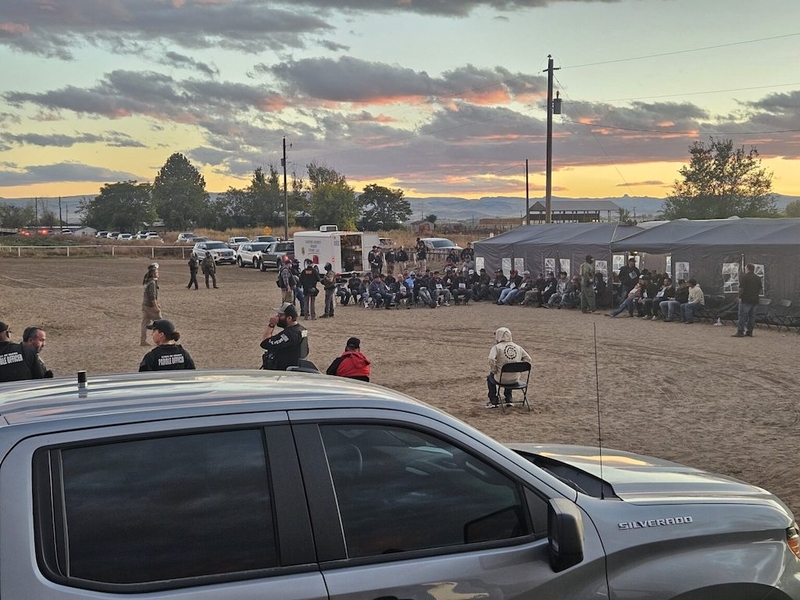
There were 105 immigration arrests in October at a horse racetrack in Wilder, Idaho. Idaho saw one of the country’s largest increases in immigration arrests this year through mid-October compared with the same period in the Biden administration. (Photo courtesy of ACLU of Idaho)
Editor’s note: This story was updated Monday, Feb. 16, to include a statement from the U.S. Department of Homeland Security, and was previously updated with additional details from the lawsuit and a news conference with ACLU officials.
Months after U.S. Immigration and Customs Enforcement, or ICE, arrested more than hundred people in a raid in Wilder, a lawsuit by three families who legally reside in the U.S. alleges law enforcement used aggressive tactics and unjustly detained hundreds of people, including children.
A federal class-action civil rights lawsuit filed Tuesday by the American Civil Liberties Union and its Idaho branch argues that state and federal law enforcement officials plotted to turn what could’ve been a targeted execution of criminal warrants in an illegal gambling investigation into a massive immigration raid; only five people were arrested on gambling charges.
“What happened in Wilder struck at something many Idahoans instinctively fear: a powerful government descending on a community with overwhelming force and a disregard for families, children and the Constitution,” ACLU of Idaho Executive Director Leo Morales told reporters in a news conference Tuesday afternoon.
FBI backtracks on denying children were zip tied in Idaho raid, saying instead no ‘young’ kids were
The lawsuit provides first-hand accounts detailing the mass-detention tactics allegedly used at the raid of an alleged illegal horserace gambling operation at La Catedral Arena in Wilder on Oct. 19.
Two hundred law enforcement officers arrived at the scene “with armored trucks, flashbang grenades, and guns drawn,” the lawsuit alleges.
“Wearing militarized gear and face coverings, they pointed guns and screamed orders at frightened families. They broke the windows of cars parked on the property, sending glass pouring onto those insides, including children who had taken refuge in cars because of rain,” the ACLU wrote. “They threw compliant people to the ground and shot rubber bullets over the heads of teenagers.”
Then, the lawsuit alleges, “law enforcement rounded up the entire crowd, zip-tied most of the adults and many teenagers, and ordered everyone onto the track.”
For four hours, hundreds of people were detained — without food, or consistent access to water, bathrooms or medical treatment, including a man who was bleeding from his head after an officer allegedly struck him with a rifle, the lawsuit claims. Parents were not allowed to feed hungry children, and without bathroom access, some people detained urinated in sight of other detainees and law enforcement officers, the lawsuit claims.
Three Latino families — including parents and children as young as age 3 — that the ACLU of Idaho is representing in the lawsuit are all lawfully present in the U.S. or U.S. citizens.
“Our plaintiffs were treated as less than human because ICE and their willing partners think they can disregard fundamental rights if it gets them immigration arrests,” ACLU’s Deputy Director of Policing Jenn Rolnick Borchetta said in a statement. “From Wilder, to Minneapolis, to Chicago, the Trump administration is trampling our rights using racially biased tactics that make us all less safe. The administration can suggest that this abuse is immune from legal consequences, but it is not, and we intend to prove that in court.”
Lawsuit is against the FBI, ICE, and local law enforcement including Canyon County Sheriff, Caldwell and Nampa Police, and Idaho State Police
The lawsuit is against several local and federal law enforcement officials — including agents of the Federal Bureau of Investigation, ICE, Canyon County Sheriff Kieran Donahue, Caldwell Police Chief Rex Ingram, Nampa Police Chief Joe Huff, Idaho State Police Director Bill Gardiner, the cities of Caldwell and Nampa, Canyon County, and unidentified law enforcement officers.
Initially, the FBI denied that children were zip-tied at the raid. But the agency backtracked the claim to say that no “young children” were, the Idaho Capital Sun reported.
The FBI said it arrested five people linked to the alleged illegal horserace gambling operation. The U.S. Department of Homeland Security said ICE arrested 105 people on immigration violations. About 400 people attended the event, the lawsuit says. Seventy-five people arrested at the raid have been deported, the New York Times reported Monday.
The FBI doesn’t comment on litigation, spokesperson Sandra Yi Barker said in a statement. The Canyon County Sheriff’s Office doesn’t comment on pending litigation, spokesperson Joe Decker said.
U.S. Department of Homeland Security Assistant Secretary for Public Affairs Tricia McLaughlin said in a statement that ICE “didn’t zip tie, restrain, or arrest any children,” and she called the lawsuit “just another attempt to obstruct President Trump from delivering on the American people’s mandate for mass deportations of illegal aliens.”
“The Trump administration is committed to restoring the rule of law and common sense to our immigration system, and will continue to fight for the arrest, detention, and removal of aliens who have no right to be in this country,” McLaughlin wrote. “The ACLU should just change its name. It’s clear they only care about illegal aliens — not Americans.”
Local law enforcement officials said the FBI led the raid.
In a statement, Nampa Mayor Rick Hogaboam said: “We take this matter seriously and are committed to following the legal process with integrity and professionalism.”
Other law enforcement agencies sued were not immediately available for comment.
A day after the raid, advocates and witnesses denounced what they described as law enforcement’s aggressive tactics during the raid. Law enforcement officials released little information about raid tactics.
The lawsuit says law enforcement didn’t release people until they verified they were lawfully in the U.S. At least 70% of people detained were lawfully present in the U.S. or citizens, the lawsuit says.
“The search warrant provided Defendants with a convenient cover as they went fishing for immigration arrests of Latino individuals at a public event that drew attendees celebrating Mexican culture, in service of their shared mass deportation goals,” the lawsuit alleges.
After lining up and detaining the event crowd, the lawsuit claims officers sorted people into groups, partly on assumptions of people’s immigration status based on their skin tones.
“Law enforcement used racial epithets for Latinos and, in denying some Latino detainees water, they said ‘that’s what you get for being here,’” the lawsuit alleges.
People who appeared to be white “generally did not have guns pointed directly at them and were not treated as roughly as Latino-appearing people,” the lawsuit claims.
None of the suing families were asked about gambling, the lawsuit alleges. Undercover agents who visited the venue before the raid also likely knew that security guards screened visitors and confiscated weapons, the lawsuit states.
“There is no undoing the trauma inflicted on the families affected that day. But accountability is how we make clear that what happened in Wilder was unlawful, and that it cannot become a blueprint for policing in communities across the country,” Borchetta with the ACLU told reporters.
Lawsuit includes accounts of teenagers zip-tied
The lawsuit includes first-hand accounts from people who were detained at the raid.
One 10-year-old child represented in the lawsuit, only identified as A.S.P., went up to her father, Ivan Popoca, crying and tried to hug him when armed officers pushed her father and grabbed her by the neck. They were taken to the track, and her father was ziptied, the lawsuit says.
Later, Popocoa looked for his 16-year-old son, identified as E.I.P., who he feared could be hurt or killed, the lawsuit says. Nearly an hour later, the father found him zip-tied, the lawsuit says.
When the 16-year-old was detained at gunpoint, the lawsuit says officers were yelling at them in English. The teenager translated the orders in Spanish because he knew some people nearby didn’t speak English, the lawsuit says. An officer yelled to “get the (f**k) down on the floor” or he would shoot, the lawsuit says.
The lawsuit says officers forced the teenager and his friends to their knees and zip-tied them. Officers later shot at a nearby SUV, and shots went over the head of E.I.P. and others who were on their knees, the lawsuit says.
Officers also refused to release ziptied parents to care for their small children, and refused to loosen zip-ties despite complaints of pain, the lawsuit alleges.
At several points, the lawsuit says 16-year-old E.I.P. told officers that his zip-ties were too tight. His wrists bruised and hurt for more than a week, the lawsuit says.
Another teenanger, a 15-year-old identified only as Y.Z., was denied loosened zip-ties for a couple hours despite asking, the lawsuit says. When he asked again, as his wrists turned red, the lawsuit alleges an officer laughed, said his ties were too loose and tightened them. About half an hour later, the 15-year-old “started to feel the sting of sweat entering an open wound on his now-bleeding wrists,” the lawsuit said.
He still has visible scars from the zip-ties, the lawsuit says. An officer later cut them at his request, the lawsuit says.
The lead plaintiff in the lawsuit, Juana Rodrgieuz, is now scared to attend Latino cultural and other public events. She worries her 3-year-old son is “scared of police,” the lawsuit states. He “now notices law enforcement officers wherever he goes,” the lawsuit says.
The lawsuit seeks an order declaring violations of Fourth and 14th Amendment rights, and awarding damages.
Rodriguez v Porter filing ACLU raid Wilder lawsuit
Boise, ID