Southern faculty voice fears over political interference, academic freedom erosion in annual survey
Sep 24, 2026 | 5:27 am ET
Description
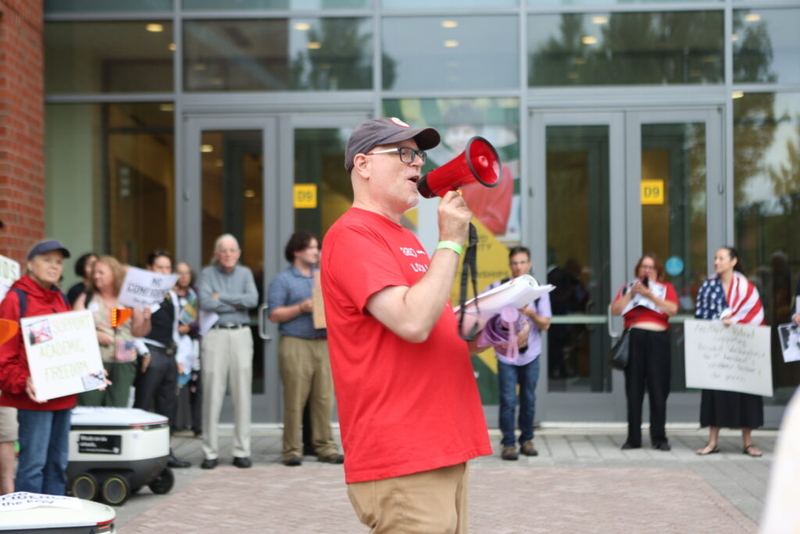
Tim Gibson, vice president of the George Mason University chapter of the American Association of University Professors, said Southern university faculty want "affordable public universities where the money goes to the classroom, not the administrative suite" after the recent release of AAUP's annual Faculty in the South survey. Gibson is seen here addressing a crowd outside the GMU Board of Visitors meeting on Aug. 1, 2025. (Photo by Nathaniel Cline/Virginia Mercury)
Most faculty members from Virginia and Southern states say they would not recommend their state as a desirable place to work, citing concerns about political interference and academic freedom, according to a recent survey by state conferences of the American Association of University Professors.
The responses come from AAUP’s annual Faculty in the South survey, which asks professors in selected states about their jobs. In the survey, 59.4% of faculty members said they would not recommend their state as a desirable place to work for graduate students or other colleagues, up 5% from last year’s results.
Here are key takeaways from the survey’s results.
Advocates say university workers deserve to unionize
Virginia faculty leaders, including Bethany Letiecq, president of the Virginia Conference of the AAUP, say one way to improve faculty recruitment and retention is for Virginia lawmakers to allow collective bargaining for public workers, which lets employees negotiate with their employer over issues such as wages, benefits and working conditions.
“The only thing that professors and other university workers want is the right to choose to collectively bargain,” said Letiecq. “This is a freedom enjoyed by every single private sector worker in Virginia. We just want the same rights as everybody else.”
Efforts to repeal the 1946 Jim Crow-era law that denies state workers the right to unionize were vetoed by Gov. Abigail Spanberger in May.
‘This is about equity’: In Richmond, Va. workers, lawmakers push for inclusive labor rights for all
In Virginia, faculty organizations are also concerned about rising costs, which they say stem from leadership hiring “high-paid” administrators. That concern leads them to argue for unionization as a way to address wasteful spending.
“If professors and other campus workers were allowed to organize into unions, you can bet your life that we will try to put an end to this wasteful bloat and overspending,” said Tim Gibson, president of the George Mason University AAUP chapter. “We want what Virginia families want: affordable public universities where the money goes to the classroom, not the administrative suite.”
Jim Finkelstein, a retired professor of political science, said advisory groups like faculty senates lack legal weight. He said collective bargaining is essential to give workers a formal, legally protected voice in their institutions.
“If Virginia wants to recruit and retain outstanding faculty and staff, it cannot focus only on what it pays them,” Finkelstein said. “It also has to pay attention to whether they have a meaningful voice in the institutions where they work. Collective bargaining provides that voice.”
Faculty name concerns about government intrusion, with many uncertain if they will remain in the field
New to the survey this year was a question about artificial intelligence, which has raised questions about privacy and security.
A total of 85% of respondents said yes, they believed their academic discipline would survive in an AI era. AAUP did not ask faculty to identify their academic discipline.
Faculty also fear government intrusion into the curriculum and the future of college faculty in the South. The AAUP survey found a 6% increase in administrators questioning faculty’s curriculum and a 10.6% increase in faculty saying the Trump administration ended their federal contract.
Those concerns come alongside broader signs of uncertainty in the field. A total of 19.1% of faculty surveyed said they did not plan to remain in academia long-term, and 30% plan to apply to other higher-education jobs in the coming year, a 25% increase from last year.
Virginia was not among the states receiving the most faculty applications, according to the survey. States that received the most applications included California, Colorado, Illinois, Massachusetts, Michigan, New York, and Pennsylvania.
Feedback on proposed accreditation shift
The survey also asked about accreditation, which holds institutions accountable to standards for academic resources, student support, and financial and administrative practices.
Faculty surveyed were asked about a new accreditor that closely resembles the Commission for Public Higher Education, and nearly three-quarters opposed their institution using it.
CPHE is a new accrediting organization established in 2025 by six public university systems to create an accreditation model for public universities, emphasizing student outcomes, academic quality, and more efficient accreditation.
The proposal is uncommon because accreditation in the United States is typically conducted by independent organizations that serve institutions in particular regions or nationally. CPHE is proposing an accreditor whose founding institutions are public university systems.
The survey did not name CPHE when it described the new, unnamed accreditation group seeking federal approval, noting that both were created by public university systems in several Southern states and that the board included top employees from those systems.
Some faculty organizations say they are concerned about the CPHE proposal because it originated with state university systems and emerged amid political conflicts over higher education.
Critics also say the new accreditor could give government-controlled university systems greater influence over the accreditation process.
Richmond, VA