Some voters with felony convictions face new rules for the midterms
Oct 28, 2026 | 2:51 pm ET
Description
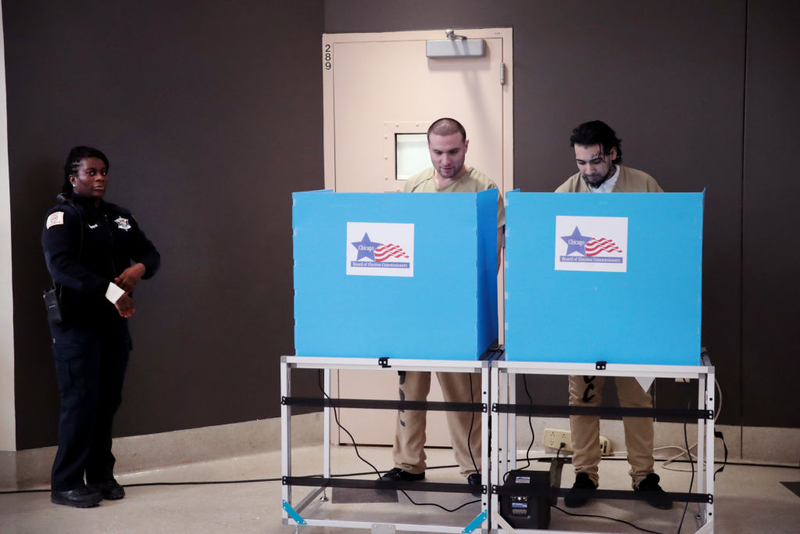
Incarcerated people at the Cook County Jail in Chicago cast their votes in the 2020 Illinois primary election. This year, more than a handful of states across the country have enacted laws changing voting rules for people with felony convictions. (Photo by Scott Olson/Getty Images)
A half-dozen states enacted laws this year changing voting rules for people with felony convictions, including when their rights can be restored and how they can register to vote — affecting voters in next week’s elections.
A couple other states advanced measures that will affect such voters in future elections. And Virginia voters will decide on Tuesday whether to approve a measure advanced by the legislature to automatically restore such rights.
Altogether, at least eight states — Alabama, Delaware, Idaho, Maryland, Missouri, Oklahoma, Tennessee and Virginia — advanced or enacted legislation addressing voting rights for people with felony convictions or people who are incarcerated, according to legislation tracked by Ballotpedia and the National Conference of State Legislatures.
States put criminal justice, marijuana policies before voters in 2026
Currently, 23 states automatically restore voting rights upon release from incarceration for a felony conviction, while 15 require people to complete additional conditions, typically probation or parole, according to the National Conference of State Legislatures. In 10 states, certain felony convictions can result in indefinite disenfranchisement or require additional steps to restore voting rights, while Maine, Vermont and the District of Columbia allow people with felony convictions to vote even while incarcerated.
In Virginia, voters will decide whether to amend the state constitution to automatically restore voting rights to people with felony convictions upon release from incarceration. Currently, the state constitution requires the governor or another appropriate authority to restore the rights.
Lawmakers approved the proposed amendment earlier this year, along with legislation that would align state law with the change. But the statutory changes are contingent on voter approval of the amendment and would not take effect until January 2027.
Missouri enacted a law in July allowing people convicted of certain felonies to regain voting rights before completing probation or parole, while maintaining the requirement for people convicted of specified offenses to complete those terms. The measure went into effect in late August.
In Oklahoma, lawmakers revised voting eligibility requirements for people with felony convictions, allowing those who receive a pardon or commutation to regain voting rights, provided they are not incarcerated or serving probation, parole or supervision for another felony conviction. The law, which takes effect Nov. 1, also clarifies eligibility requirements for people who have completed their sentences.
Tennessee this spring revised its voting rights restoration requirements, replacing provisions requiring payment of court costs and current child support obligations with a requirement that applicants have complied with child support orders for the preceding 12 months.
New laws restore voting rights to residents with felony convictions
A new law in Alabama, which went into effect on Oct. 1, requires the state Board of Pardons and Paroles to publish voting rights restoration procedures and an application on its website. The law also requires the board to post identifying information for people on probation or parole whose voting rights have been restored.
Meanwhile, a new law in Idaho, which went into effect in July, prohibits people convicted of treason in another state or jurisdiction from registering or voting in Idaho, even after completing their sentences. The change brings voting restrictions for out-of-state treason convictions in line with those for people convicted of treason in Idaho.
Some measures would affect voters in future elections.
In Delaware, lawmakers advanced a proposed constitutional amendment that would automatically restore voting rights to people with felony convictions upon release from prison, rather than requiring them to complete their sentences, including probation and payment of fines. The measure would have to pass the legislature again in the next session before taking effect.
In Maryland, Democratic Gov. Wes Moore signed into law a measure requiring state corrections officials by Jan. 1, 2028, to provide monthly information about people released from state correctional facilities to election officials, who must use the information to automatically restore their voter registrations.
Stateline reporter Amanda Watford can be reached at [email protected].