SC Election Commission violated open meetings law, ACLU alleges
Sep 21, 2026 | 5:50 pm ET

Description
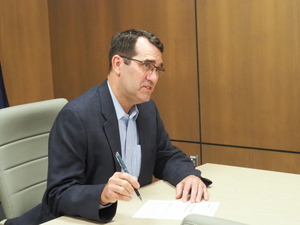
State Election Commission Chairman Dennis Shedd, along with commissioners Scott Moseley, Clifford Edler and JoAnne Day, meet on Wednesday, Oct. 15, at the elections office in Columbia, S.C. (Photo by Skylar Laird/SC Daily Gazette)
COLUMBIA — A civil liberties watchdog is alleging the South Carolina elections office violated public meetings law when it fired its previous director.
The state chapter of the American Civil Liberties Union is suing the state Election Commission in a Richland County court, accusing its members of illegally conducting public business behind closed doors.
In court filings, the organization accused the former chairman of the five-member board, appointed by the governor, of calling other members to lobby for the removal of former state elections chief Howard Knapp. The group also alleges the board polled its members on Knapp’s removal in a closed-door meeting before taking the official vote in public.
State Election Commission spokeswoman Sydni Bain said the agency is aware of the complaint, but as a matter of policy, it does not comment on ongoing litigation.
“Last year, the State Election Commission removed South Carolina’s top election official after a secret trial, secret deliberations and a secret vote. We’re going to court because the Freedom of Information Act guarantees more transparency than that,” the ACLU’s legal director Allen Chaney said in a statement.
State public records law states “no chance meeting, social meeting or electronic communication” may be used to circumvent a public meeting. And “a public body may not commit the public body to a course of action by a polling of members in executive session.”
The State Election Commission fired Knapp on Sept. 17 in a 3-2 vote. At the time, former Chairman Dennis Shedd said in a statement the commission fired Knapp out of a desire for new leadership.
Chairman of SC Election Commission resigns, saying recent chaos is over
Shedd also said the decision was “unrelated to the conduct of any election in South Carolina.”
“The Commission’s leadership and staff remain dedicated to ensuring South Carolina’s elections are accurate, secure, and accessible,” Shedd said.
The commission declined to make any further comment.
Knapp’s firing came amid a lawsuit trying to stop the Election Commission from providing the information of about 3.3 million registered voters to the U.S. Department of Justice over privacy concerns.
Earlier that month, the state Supreme Court overruled a circuit court’s pause on providing that information, clearing the way for the commission to begin handing over names, birthdays, addresses, driver’s license numbers and final digits of Social Security numbers.
Knapp resisted the federal government’s demands for access to South Carolina voter data, the ACLU wrote in court documents.
“That resistance provoked the ire of President Trump’s allies in South Carolina, including the Governor and some members of the SEC,” the organization’s lawyers wrote.
Judge refuses to block voter data transfer, noting election agency’s promise to sign agreement first
In phone discussions with other board members, Shedd accused Knapp of colluding with opposing lawyers in the lawsuit seeking to block the information’s release, the ACLU said.
In its court filing, the ACLU did not state how it came to learn about these phone discussions. Nor did its lawyers say how they learned of the poll taken behind closed doors.
The organization did not respond to the SC Daily Gazette’s questions about the phone discussions or poll.
The organization’s court filings alleged Shedd also had used similar methods to try to oust Knapp in early 2024. In March of that year, the SC State Law Enforcement Division, at the request of the state attorney general’s office, had launched an investigation into Knapp over unspecified allegations of misconduct.
About a month after Knapp’s firing, police arrested him on embezzlement and misconduct-in-office charges related to his use of state-provided vehicles over eight months starting in 2023.
He faces 11 charges total, brought by the Attorney General’s office. They include eight counts of using his official position or office for financial gain — one for each month he’s accused of using state vehicles for personal travel and a public credit card to fuel up. He’s also charged with embezzlement of public funds valued at less than $10,000 (for the fuel), misconduct in office and accessory to a felony after the fact, according to Richland County court records.
Fired SC elections chief charged with embezzlement, misconduct
That case is ongoing.
Knapp’s lawyer, Joe McCulloch, did not immediately respond to a message from the SC Daily Gazette.
At Knapp’s bond hearing last October, McCulloch told reporters: “This is all about politics. We look forward to a very public trial.”
In a third allegation of open meetings law violation, the ACLU argued the Election Commission denied Knapp his right to a public hearing and barred him from the closed-door session in which his employment was discussed.
Public records law says a state employee “has the right to demand that the hearing be conducted publicly” instead of in an executive session.
If asked, Knapp would have demanded a public hearing, the ACLU’s lawyers claimed. The court filing did not state how the group knew Knapp would have made this request.
Columbia