Rogers, Dobson lay out contrasting plans for Alabama secretary of state’s office
Sep 28, 2026 | 6:01 am ET
Description
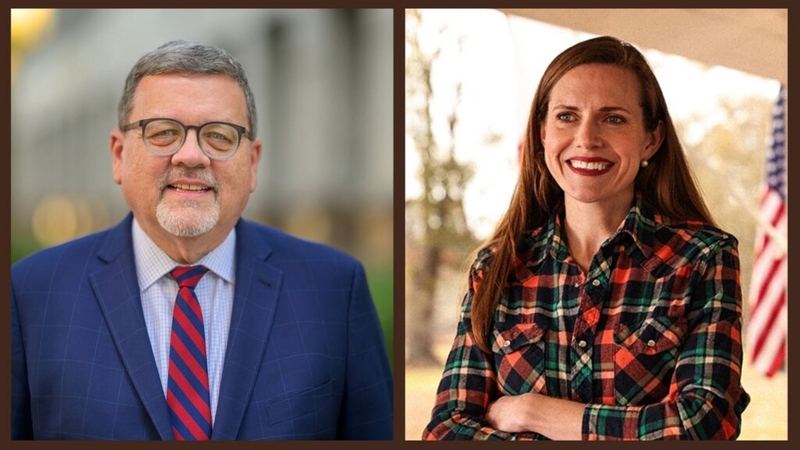
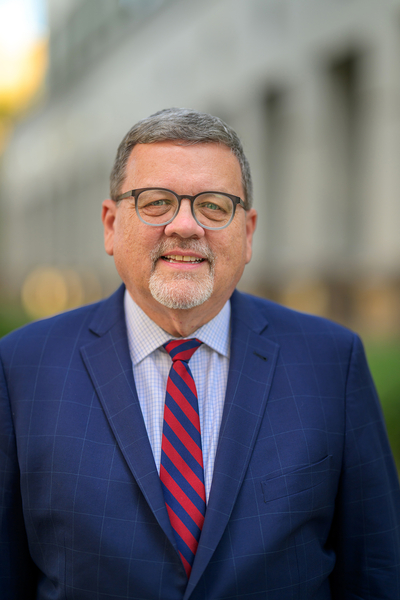
Voters in Alabama will choose between Democrat Wayne Rogers (left) and Republican Caroleene Dobson (right) for Secretary of State. The candidates laid out differing plans for the office, should they be elected. (photos courtesy of candidates; graphic by Anna Barrett/Alabama Reflector)
The contest for Alabama secretary of state features two candidates with contrasting visions for running the office.
The office is responsible for administering the state’s elections, registering voters, registering businesses in Alabama and is the primary record-keeper for the state. The constitutional office has been held by Republicans since 2007. Current Secretary of State Wes Allen was elected in 2022 and did not seek a second term in order to run for lieutenant governor.
Both candidates had relatively smooth primaries. Caroleene Dobson, the Republican nominee for secretary of state and the 2024 GOP nominee for the 2nd Congressional District. won the nomination over two other candidates, and after Republican State Auditor Andrew Sorrell withdrew.
Democratic nominee Wayne Rogers, a first-time political candidate, was unopposed in his party’s primary.
The candidates
Dobson, 39, said in an interview on WFSA in May that her top priorities are secure elections and a strong economy in Alabama, citing her experience in the 2024 race
“It was a tough general election where Republicans were pitted against Democrats, and I witnessed firsthand that while we have some good procedures, some good laws in place when it comes to election integrity,” she said in May. “There’s still a ways to go in ensuring that our elections are 100% secure, that our voter rolls are 100% accurate, that we are shielded from the outside influence of far left activist groups from out of state.”
She also said she hopes to streamline services, reduce fees and increase accessibility to start a business in the state.
Dobson also said she wants to create an “election integrity and securities” division within the secretary of state’s Office, if elected, inspired by Florida’s Election Crimes and Security.
“Currently, we don’t have a dedicated branch of the office to administer these election laws, to serve as a sounding board when folks have questions about election procedure or to investigate election fraud claims of election fraud,” Dobson said.
Election fraud is extremely rare in Alabama. According to the Heritage Foundation, a conservative think tank, there have been 41 convictions or findings of voting fraud in the state since 2000. Over 2.2 million votes were cast in the 2024 presidential election in Alabama.
While Dobson did not explicitly express support for early in-person voting, she did say a working absentee ballot system is necessary for Alabamians who are unable to vote in person on Election Day.
“We have so many vital workers – our truckers, our healthcare workers throughout the state – that can’t physically be there on Election Day,” Dobson said in May. “I’m committed to making sure that we have an absentee ballot system that works, and that the ballot is the chain of custody between the probate judge and the person voting via absentee ballot, and no one else is involved in that.”
Voting via absentee ballot in Alabama is exclusive to certain groups of voters, including the elderly, those registering in Alabama but living outside the county (like a college student or deployed service member) and those with scheduled shifts longer than 10 hours on Election Day. During the COVID-19 pandemic, the state effectively opened the illness excuse to all eligible voters, leading to a surge in absentee voting that year.
Rogers, 64, said in a recent phone interview that his priorities are compiled in what he likes to call the “Alabama Voting Rights Act.”
“The decisions in Milligan, the decisions in the Louisiana case that were decided back in the spring have ripped the heart out of the national Voting Rights Act,” Rogers said. “Let’s make it a state law that makes it easier for people to vote … I am not talking about letting non-citizens vote.”
The U.S. Supreme Court this Spring weakened Section 2 of the Voting Rights Act (VRA) of 1965 in a case known as Louisiana v. Callais, requiring plaintiffs in any case to show intent to discriminate by lawmakers. Under prior case law, plaintiffs had to show the effect of maps was discriminatory.
The justices’ decision led to a special session of the Alabama Legislature to create the infrastructure for August’s special primary election under the state’s 2024 congressional maps. Those maps were previously struck down as racially discriminatory multiple times by federal judges and the U.S. Supreme Court before Callais in a case known as Allen v. Milligan.
In Rogers’ proposed local VRA, the state would re-establish no-excuse absentee voting; open polls the Saturday before an election, and allow 16-year-olds to pre-register to vote when they get their driver’s license. Their registration would not go into effect until they turned 18, but Rogers hopes allowing pre-registration would help with Alabama’s registration numbers.
“We would get a lot more young people registering to vote if we would do that,” he said.
According to the nonprofit Civics Center, 29% of Alabama’s 18-year-olds were registered to vote as of July. Nationally, the group estimates that 45% of 18-year-olds are registered to vote across 39 states that have data available.
Alabama Democrats have long pushed for early voting, but Republican lawmakers have pushed back claiming it will be too costly. The Secretary of State does not have power to introduce legislation.
Rogers hopes that just opening the polls for one day before general elections will be a satisfactory compromise.
“You’ve got two days when you can go into the polls. I think that would make it much more convenient, and we would drive our turnout up by 15 to 20% if we did something like that,” he said.
Rogers also wants to limit campaign contributions to half of the average Alabamian’s annual salary at $27,000 per campaign cycle.
“Why should anyone, or any corporation, or any union, or any (political action committee) be able to give to a campaign more than six months’ wages than the average Alabamian? I don’t think they should,” he said.
His proposal also includes eliminating Alabama’s straight-ticket voting, a system that allows voters to choose a party’s entire slate of candidates with a single ballot mark, which Rogers said “perpetuates the party that’s in power.” Alabama is one of six states that uses the voting system, according to the National Conference of State Legislatures.
Eliminating the system is broadly unpopular within both parties, however some prominent Democrats, including gubernatorial nominee Doug Jones, have called for ending straight-voting, which tends to work against Democrats.
According to data from the Alabama Secretary of State’s Office, more than 1.5 million (67.7%) of the 2.2 million ballots cast in the 2024 general election were straight ticket. Of those, more than 1 million (65.1%) were Republican ballots and about 540,000 (34.9%) went to Democrats. About 58.9% of registered voters voted in the 2024 general election.
In the 2022 general election, about 947,000 (66.6%) of 1.4 million ballots cast were straight ticket votes. Of those, almost 299,000 (20.9%) were Democrat ballots and almost 649,0000 (65.1%) were Republican ballots. About 38.6% of registered voters voted in the 2022 general election.
Campaign fundraising
According to the most recent campaign finance filings, Dobson has raised almost $700,000, and loaned her campaign $500,000 at its start. She spent about $724,000 through the end of August.
Not including Dobson’s personal loan, most of her cash contributions have come from individuals (40.3%), followed by political action committees (PACs) at 36.7% and businesses at 14.4%, according to the reports.
Rogers has raised about $39,000 and spent about $22,000 through August 31. According to the reports, most of Rogers’ cash donations have come from individuals at 71.5%, followed by businesses at 20.8% and PACs at 7.2%.
Meet the candidates
Caroleene Dobson
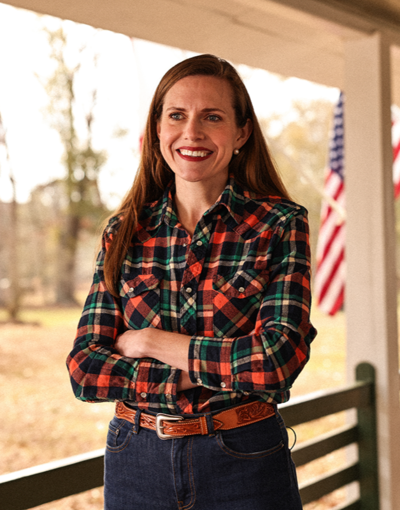
- Age: 39
- Party: Republican
- Occupation: Real Estate attorney
- Residence: Montgomery
- Education: B.A., History and Literature, Harvard College, 2009; J.D., Baylor University School of Law, 2012
- Offices sought/held: Republican nominee for Alabama’s 2nd Congressional District, 2024
- Fundraising: Raised $694,076.11, spent $723,643.09 and has $470,433.02 on hand as of Sept. 2.
Wayne Rogers
- Age: 64
- Party: Democratic
- Occupation: Executive Assistant to Jefferson County Sheriff; Lawyer
- Residence: Birmingham
- Education: B.A., Music, Samford University, 1984; J.D., Samford University Cumberland School of Law, 1988
- Offices sought/held: Former chair, Jefferson County Democratic Party; first-time candidate
- Fundraising: Raised $38,700.63, spent $21,876.62 and has $18,156.40 on hand as of Sept. 2.
Montgomery