A river runs under it
Nov 18, 2026 | 9:44 am ET

Description
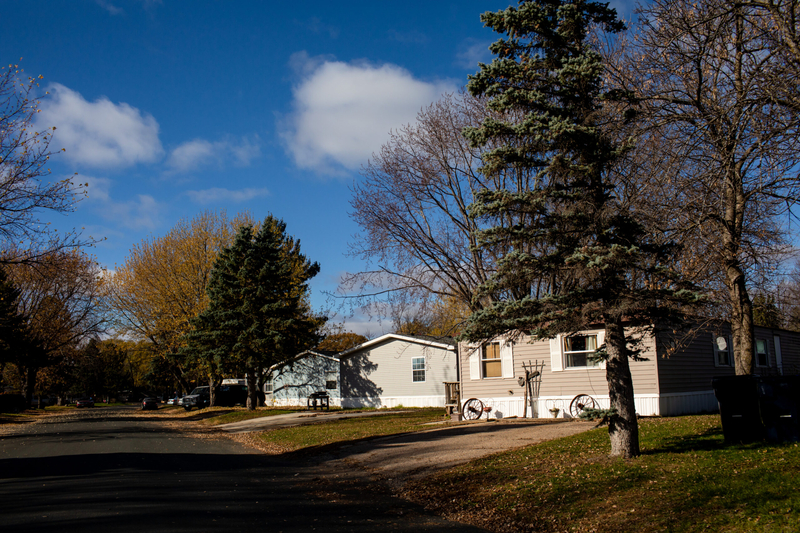
Stephanie Pula poses for a portrait outside of her house in The Meadows manufactured home community in Monticello, Minnesota the Thursday, Nov. 12, 2026. (Photo by Nicole Neri/Minnesota Reformer)
One day in November 2024, Stephanie Pula returned home to the smell of sewage.
She had left three days before to visit her grandmother. Upon her return, she saw the skirting around her manufactured home had been removed without notice. Underneath, she found towels soaked in cold sewage wrapped around the broken drain pipe that connected her trailer to the park’s sewer system. No one — not park management, not her neighbors nor the plumbers who had visited her lot twice — could provide any information about the towels or who was responsible.
Raw sewage had been leaking into the ground beneath her home in Monticello for two weeks and would continue to leak for another four days. Pula was not alone. At least five additional sewage releases were recorded at her park from March to August 2025 along with a park-wide main line failure near the connection to the city of Monticello, according to Minnesota Pollution Control Agency incident reports obtained by the Reformer. In December 2025, the MPCA fined the park $13,957 following an investigation into the recurring pattern.
Roughly 180,000 Minnesotans live in manufactured home parks, renting the land and utilities beneath while owning the home above. All the while, these parks are rapidly changing hands from small family businesses to national corporations, while the laws that protect the residents are still being debated in the Legislature.
Pula’s account, which is consistent with a series of Reformer stories on mobile home parks this year, is becoming all too common and underscores the problems that residents confront when they go up against powerful, multi-state landlords. Stories like this have prompted legislators to action, with Gov.-elect Amy Klobuchar supporting measures to cap lot rent alongside other protections.
Eighteen days, or it’s coming from inside the house
Pula has lived in her manufactured home since 2016, and her family has called the park home since her parents moved in several years before that. Kjellberg’s, now known as the Meadows, was built in 1959 by the late Kent Kjellberg. The park operated on Highway 25 in Monticello for just over 60 years under the Kjellberg name until its sale in January 2021 to Lakeshore Management, an Illinois-based operator of manufactured home communities in 11 states, for roughly $23 million.
The troubles began when Pula’s toilet stopped flushing on Oct. 21, 2024. Roto-Rooter sent two technicians that day. The first technician couldn’t fix it, so the park chose to try again; the second billed The Meadows $2,745 for a three-hour hydro-jet job. Sewer lines beyond the trailer are the park’s responsibility, not the resident’s, according to the community’s lot rules and Minnesota state statute.
Soon after, Pula said that the assistant manager, Rachael Sullivan, left her a voicemail stating that the line was clear and no damage was found. Pula believed her and let it go.
On Nov. 1, with her plumbing issues seemingly resolved, she left for an early Thanksgiving with her grandmother four hours north. Unbeknownst to her, since that initial visit and throughout her absence, sewage had been draining into the ground beneath her home, with another plumbing company, D&D Service and Repair, having written up a job while she was gone for her lot on request of the park “so it doesn’t overflow there.”
When she returned on Nov. 4, she was surprised to find the smell had worsened, with odors permeating her children’s clothes and linens.
Not enough sewage to clean up
Pula reported the backup and smell when she got home. Community manager Rebecca Miller, however, didn’t make the legally required call to the MPCA until Nov. 6. Miller told the duty officer that a “small amount” of sewage had backed up under the home, and that a vacuum truck was brought out but “not needed as there was not enough material,” according to the agency’s incident logs obtained by the Reformer. Miller listed the leak as starting Nov. 4, the day Pula had came home — meanwhile the park’s own plumbing invoices stretched back to the first call placed by Pula on Oct. 21.
The MPCA said, in an April 2025 violation notice that the park let wastewater sit on the soil for 18 days before it was cleaned up — only reporting the discharge after agency staff told them to do so.
On Nov. 7, D&D Service and Repair installed a new joint on the broken pipe. As explained in a recording shared with the Reformer, technician Daryl Cardinal told Pula the fix wouldn’t hold for long. “This has been an ongoing problem for a long time,” he said. When asked if it was a temporary fix, no one argued. D&D declined to comment for this story.
The following day a truck from Roto-Rooter arrived, pumping roughly 100 gallons of sewage from the same location. Their technician told Pula the company had quoted Lakeshore roughly $1.6 million to replace sewer lines park-wide, work that the park never pursued, according to the technician. He continued, noting that the blockage would have to have been in the main line the whole time — the park’s responsibility. A few days before, park staff spread white powder, which the Minnesota Department of Health later said was “likely lime,” underneath and around Pula’s unit.
The powder that was spread over the spill wasn’t the hydrated lime he would have expected, according to the Roto-Rooter technician in conversation with Pula at the time. She asked him what it was, and he said it was “plant food,” based on the fertilizer bags Pula found following another application by park maintenance workers. Roto-Rooter declined to comment for this story.
On Nov. 15, Lakeshore attorney Clarice Scarnecchia told Pula there were no invoices because there weren’t records from vendors working on her lot back on Nov. 6. After Pula sent a video she had personally taken that afternoon, Scarnecchia wrote back stating she had found some records after all.
Nearly three weeks after the leak was resolved, on Nov. 26, Teresa Compton, the regional manager at Lakeshore, sent an email to Pula detailing that the “lime” covering the contaminated soil beneath and around her trailer would remain in place. She noted it would “absorb into the ground.” The wooden block used by D&D’s technician to prop up the cut pipe beneath Pula’s home, however? Pula should replace it herself. The pipe repair, cap replacement and replaced skirting were all described as acts of courtesy from park management.
Pula argued in a Dec. 4 email that the plumbing under her home had never required repair until after the spill, and that she should not be responsible for fixing it now. She requested partial rent relief, reimbursement for proper decontamination, and a land survey to assess if her trailer shifted while standing over sewage. Lakeshore did not concede to any of her requests — they declined to survey, remediate, or do more than spray water on whatever they had laid down under her home, according to Pula.
These issues would bubble to the surface later as Pula and her family sought legal recourse.

Not just her lot
The pipes under Pula’s lot were failing long before the Lakeshore purchase. The park’s plumbing was never constructed to a uniform standard, according to interviews with former staff and residents. When asked for comment, the company declined to respond to any specific questions about the park or Pula’s lot.
Sean Sullivan, who served in maintenance at The Meadows for three years following Lakeshore’s 2021 acquisition, said sewer lines there often sit above the frost line and vary in diameter, with sections of 2-, 3- and 4-in.-wide pipe fitted together. “It’s over 70 years [old],” he said about the system. “Nothing’s been really properly maintained. It’s just been stitch it, repair it, and patch it.”
Since the sale in 2021, the biggest change has been staffing. Previously, the park had five maintenance staff, Sullivan said. During his three years with Lakeshore, this number dwindled to just one, often Sullivan himself. Throughout this period, rent has nearly doubled in the 5 years since Lakeshore took over, Sullivan noted, reaching $760 per month by October of last year, all while he remained the sole maintenance worker for the entire park and its over-300 sites.
“You [went] from personal ownership to corporate ownership,” Sullivan stated. “This is a corporation… the corporation is money, money, money.”
Jean Weisbrich, a resident of the park for over three decades, recalled staff hauling away branches and bagged leaves and generally handling issues like plumbing problems before they escalated. All this ended under Lakeshore, she said. Last year, when branches overhanging her roof required trimming, she had to hire someone.
“They just need to pay their techs more,” Sullivan said. “If they can keep the good techs, that place would look cleaner.”
Four days of odors, plus two years of hearings
In the four days following her return from her grandmother’s home, the Pula family stopped using their bathroom, instead driving to a nearby gas station or Walmart. They took showers at her father’s house, and did laundry at a laundromat across town. Mornings started earlier to allow her children to make bathroom trips before school.
Pula filed for emergency relief on Nov. 8, 2024 once disputes with the park began in earnest.
A judge in Wright County determined that raw sewage had indeed flooded the ground beneath Pula’s home and ordered Lakeshore to provide comparable lodging, which ended up being a rental home in another section of the park. By Nov. 20, the court considered the emergency over: Repairs to the sewer pipe had been completed, and the Minnesota Department of Health had inspected the ground, although they did not test inside Pula’s home, according to Pula. She was told that despite her reservations regarding the safety of her home, to return to Lot 6 within 48 hours.
On Dec. 6, a review hearing concluded the case. Patrick Flynn, an attorney for the Landlord Resource Network who was hired by Lakeshore for the case, informed Judge Richard Ilkka that the emergency had passed. While Pula noted that the leak had affected the condition of her home, Flynn carefully corrected the record on one point: the leak, he stated, “was not in the home at all. It was underneath the home.” Asked whether Lakeshore had turned over all of its records, Flynn remained noncommittal, stating he couldn’t say he’d provided everything “without knowing what it is that the court actually defines as that,” with Miller stating under oath that there was nothing else in her file.
Ilkka said of the hearing, “I’m making this record for this reason… at some future date, Ms. Pula has a lawsuit and says [Lakeshore] didn’t provide me with documentation, there’s going to be this record here today.” Ilkka closed the case, specifically noting no findings on habitability, or whether repairs or soil clean up were adequate. “All of these things could be true,” he said.
Pula filed again in the spring of 2025, asking to hold her lot rent in escrow for rent refunds, a fine and attorney’s fees. This time, her case was dismissed only a month later on grounds she had given inadequate notice, a claim Pula disputes.
New foundations built on soggy ground
Despite its outdated infrastructure, ongoing resident concerns, and history of regulatory investigation, Lakeshore is looking to grow the park’s footprint. Earlier this year, an associated developer pitched 226 new manufactured home units on 44 acres situated south of the park, plus two commercial lots facing the highway. City planning staff suggested a significantly smaller expansion of the park, about eight to ten acres, with single-family homes and townhouses on the remainder. The Lakeshore proposal is still under review.
In June 2026, a state health inspector revisited Pula’s lot and discovered a grayish-white substance still present beneath the home, likely a residue from the substance applied 19 months prior. No active sewage was found. The inspector instructed park management to remove the substance.
Pula filed for emergency relief once again, on Aug. 20, 2026, but was denied in days. She says she can still smell the odors coming from below and inside her home, the smell penetrating both her clothes and her children’s belongings.
“The only document since all of this that states whether my home is habitable is the first emergency order,” Pula said. “Nothing has been tested to show any treatments have been effective.” Looking back, Pula sighed. “[The Meadows] could have prevented this whole thing.” She continues to pay rent for her lot while figuring out what comes next.

Saint Paul, MN