Regulators signal move toward stricter conservation standards for transmission corridor
Nov 20, 2026 | 4:20 am ET
Description
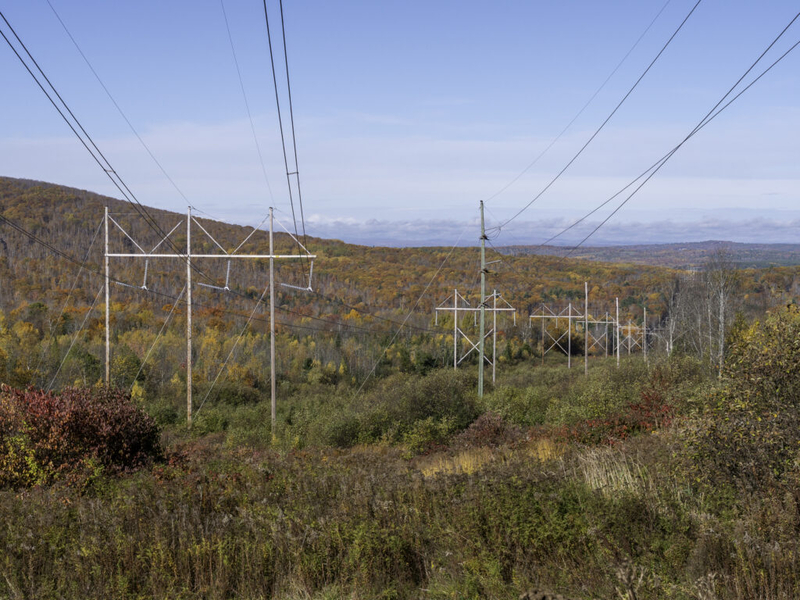
The $1.65 million iNew England Clean Energy Connect project owned by Central Maine Power parent company Iberdrola carries hydroelectric power from Quebec to several New England states.
(Photo of an unnamed transmission line in Maine by BWFolsom/ Getty Images)
Stricter environmental requirements seem to be on the horizon for the long-embattled New England Clean Energy Connect project.
Despite a second marathon meeting on the project’s conservation plan, the Maine Board of Environmental Protection held off on making a final decision Thursday, but are poised to agree on a stronger definition of “mature forest” after staff make final revisions.
Last year, the Maine Department of Environmental Protection approved the project’s conservation plan as part of the construction of 53 miles of new transmission line through western Maine. The $1.65 million interconnection project owned by Central Maine Power parent company Iberdrola carries hydroelectric power from Quebec to several New England states.
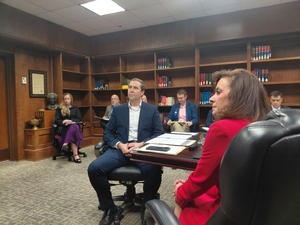
The citizen-led Board of Environmental Protection, an independent body that oversees the enforcement of environmental laws, met to consider an appeal of the department’s decision, filed by the Appalachian Mountain Club, Maine Audubon, Natural Resources Council of Maine and Trout Unlimited.
The groups have argued that the conservation area set aside by NECEC doesn’t meet the board’s earlier standards, and instead should be less fragmented, with more old-growth forest.
Board members on Thursday were largely in agreement in their support of stricter requirements for what counted as “mature forest” in the area.
Chair Robert Duchesne said the original agreement didn’t take into account standard commercial forestry practices in the area, like pre-commercial thinning, and how that would impact the forest even if it technically met the original definition of mature forest.
“So I don’t fully accept the testimony as evidence for the licensee, that that mature standard that was advocated originally is actually being met because it didn’t take those impacts into effect,” he said. “That bothers me, and if you don’t have that, then you really don’t have mitigation.”
Duchesne said he was sympathetic to the challenge NECEC may have working with the landowner on any new requirement, but was not convinced it overruled other interests.
“I am very sensitive about whether the landowner, of which there are very few in the area, would go along with any revisions to this, but that ultimately is not my problem,” he said. “We’re just setting the standards.”
The draft order before the board included other restrictions that the board members voted to remove, including additional no-harvest restrictions and prohibiting shifting of conservation areas over time.
The strongest voice opposing the draft order was board member Brooke Barnes.
“The condition is that the primary goal is promoting habitat connectivity and promoting conservation of mature forest areas,” Barnes said. “I think there’s been some conflation between promoting and protecting, and so we’ve shifted into a mode where I’m seeing these conditions on the proposed board order, and they’re very much in protecting mode.”
But Barnes ultimately said he agreed with the new definition of mature forest, and supported a version of the order that eliminated the other restrictions — a change that the majority of the board supported.
David Kallin, an attorney representing the conservation groups, said they supported the draft order, and would like to see the board also order NECEC to purchase an additional 10,000 acres of mature forest to be managed by a conservation organization or state agency.
Kallin said the original restrictions were a “mirage” and “they didn’t actually create mature forests.”
Lisa Gilbreath, attorney for NECEC LLC, opposed the draft order, and said it “very blatantly exceeds the scope of the conditions.” She argued that the board should not be weighing whether the standards are adequate but whether the project has met their requirements, which she said it had.
“Rewriting the requirements now, as I said, it flips the proceeding on its head,” she said. “It throws out multiple years of work by multiple agencies who have followed their ordinary course in developing a conservation easement.”
But the board was not persuaded, and directed staff to further revise the draft order and bring it back to a future meeting, most likely in January.
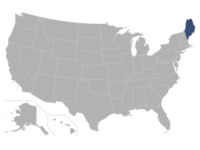
Augusta, ME