As public splits over CHOOSE Act, so do Alabama political candidates
Sep 22, 2026 | 6:01 am ET

Description
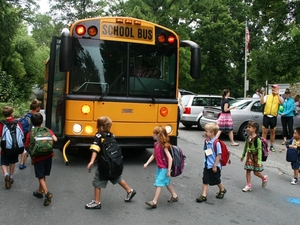
Students walk to class at Collinsville Elementary School in Collinsville, Alabama on Feb. 10, 2026. Candidates in the state's gubernatorial race have differing opinions on the CHOOSE Act, the state's effective school voucher program, and Alabamians are almost equally split on support of the school vouchers. (Eric Schultz for Alabama Reflector)
Alabama’s school voucher program is set to go universal at the beginning of next year, but public perception of the effectiveness of the program is split and candidates sort down party lines about its future.
Under the CHOOSE Act, parents can claim up to $7,000 in tax credits for education-based expenses including private school tuition, school supplies and tutoring.
Currently, the program eligibility is capped at 300% above the poverty level, or $81,960. The program is set to be universal at the start of 2027, meaning anyone can apply regardless of income, leading some lawmakers to become concerned about the money that will be spent out of the Education Trust Fund budget in what could be an already tight fiscal year 2028.
The program has long split Democrats and Republicans, a split that has carried over into this year’s gubernatorial race. Republicans have touted the program as a way for students in struggling schools to have an option for a better education. Democrats said the program diverts funding from already-underfunded schools, and have cited the soaring costs of similar programs in other states, such as Arizona.
According to a survey conducted earlier this year by the Public Research Affairs Council of Alabama, 48% of Alabamians approve of the program while 50% disapprove. The survey also showed 42% of people think the state spends too much money on school vouchers, 24% think the state spends the right amount and and 17% think the state spends too little.
Ryan Hankins, executive director of PARCA, said in an interview Monday the split was mostly along party lines, but there isn’t a clear answer as to why support fell that way.
“A majority of Republicans supported it, a majority of Democrats opposed it, but that was not universal on either side,” Hankins said. “So I think we have some Democrats that support it, and we have some Republicans that oppose it. But we did not drill further down into you know the why as they what made respondents respond one way or another.”
A political divide
Most CHOOSE Act recipients will stay in the same type of school with voucher-like credit
When asked for comment, Republican gubernatorial nominee Sen. Tommy Tuberville’s campaign referenced an interview he did with the Trussville Tribune on Wednesday. During the interview, the senator, who has supported public funding of non-public school options, said he wanted to expand the CHOOSE Act and criticized Democratic gubernatorial nominee Doug Jones’ opposition to it.
“The CHOOSE Act is pretty simple, and I can’t believe anybody would be against it,” he said during the interview. “And obviously, Doug has got a different idea of education. He loves government schools and so do the democrats, but times change.”
In an interview Friday, Jones called Tuberville’s defense of the CHOOSE Act “absurd.”
“I think what it says is that the marketing for it has done a pretty good job of trying to fashion this as a parent’s choice when it is really not a parent’s choice, it is a private school choice,” he said. “They’re the only ones who really get the chance to choose which students that they take, and so I think it’s been a pretty good political marketing ploy by those who want to see money going out of public schools.”
Tuberville did not say how he would expand the program. Sen. Arthur Orr, R-Decatur, said in an interview Monday any expansion made to the CHOOSE Act would “need to be done slowly and incrementally as the revenues allow it.”
“We need to move as far as the appropriation and the dollar amount only at a level which we can maintain,” Orr said.
Who applies for the CHOOSE Act
CHOOSE Act applications for the 2026-27 school year reached record numbers. Gov. Kay Ivey’s office reported 29,341 applications representing 48,927 students. That’s up nearly 7,200 applicants from the 2025-26 school year.
Of the students who applied, over 70% are outside the state’s public education system. The governor’s office said 21,351 (43.6%) represented private school students; 13,425 (27.4%) represented homeschooled students and 8,961 (18.3%) represented public or charter school students.
The percentage of public school students applying for CHOOSE Act money fell from 10,287 (27.9%) who sought the aid in the 2025-26 school year. That same year, 15,436 (41.9%) were from private schools and 9,070 (24.6%) students came from homeschools.
Hankins said that one issue with the CHOOSE Act is that there is no way to measure how the students who take the tax credit are doing. Orr said adding that into the legislation could happen in the future.
“When the bill was coming through the legislature, that topic was discussed and debated extensively,” Orr said. “We can always revisit it, but my opinion would be, let’s get the program going. We’re only what, (17) months in or so? Let it get going, and then we can always come revisit it.”
Rep. Danny Garrett, R-Trussville, who chairs the House Ways and Means Education Committee, said in an interview Friday he doesn’t mind private school students being the majority of applicants.
“This is giving parents all across the state the ability, if they’re in that income bracket, to make the best choice for their child,” Garrett said. “And maybe the best choice for their child is to go to a private Christian school, maybe to go to another kind of school, (like a) classical school. It may be for them to homeschool.”
Jones wants to stop accepting applications and phase the program out, saying he’s “opposed to using taxpayer dollars that are designated for public schools to be used for private schools.”
“I don’t want to take away the choice of folks who’ve already made a choice under this act,” he said. “I don’t think that would be fair to those kids who have maybe transferred schools, but I think there’s a way to phase it out.”
Looking to the budgets
Multiple attempts to reach Democratic lawmakers were unsuccessful. In March, Rep. Barbara Drummond, D-Mobile, also criticized the CHOOSE Act for taking money away from public schools.
“The CHOOSE Act, as well as other initiatives that take money away from public education, it’s not making that system better. It’s making it worse,” she said.
Alabama’s school voucher program might go universal despite budget concerns
Orr said some of the public school students receiving the vouchers are using it to attend other public schools.
“Many times, … it’s (students attending) another public school, but they have out-of-district fees, so they’re (students) taking CHOOSE Act funds as out-of-district fees for a child that doesn’t live in their district,” Orr said. “So to me, it allows an alternative, particularly for those families that cannot afford a private education, but it gives them that hope of a better education.”
Last year, 23,429 students received CHOOSE Act money. Of that number, 6% of them (1,442) planned to use the funds to go to a public school. The overwhelming majority of those students (91%) were already enrolled in a public school.
Garrett cited ongoing growth in Education Trust Fund revenues as keeping budgets whole.
“We continue every year, even with the CHOOSE Act, to put millions, hundreds of millions of more dollars into public education every year. So we have not taken money away from public education. The budgets have grown, and we have continued to increase the contribution to public education,” Garrett said.
In fiscal year 2026 the Alabama State Department of Education received $733 million in the Education Trust Fund to the CHOOSE Act’s $101 million. In fiscal year 2027, ALSDE received $772 million to the voucher program’s $236 million.
Hankins said given the warnings around the FY28 budget “everyone is expecting the next budget debate to be a pretty hotly contested topic.”
“Recent indications say the tax revenues are up, contrary to expectations. So it’ll be interesting to see how that shakes out by the end of this fiscal year,” he said. “But all indications seem to suggest that while costs are going up for governments, revenues are not, and that will be a complicated debate in the Legislature.”
Montgomery