Providence School Board postpones vote on president’s removal after six-hour meeting
Oct 22, 2026 | 3:53 pm ET

Description
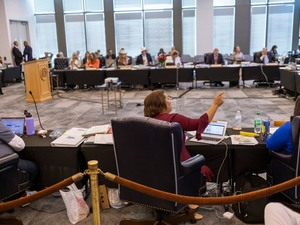
Members of the Providence School Board meet at district headquarters on Westminster Street in Providence on Wednesday, Oct. 21, 2026. (Photo by Alexander Castro/Rhode Island Current)
Providence School Board members were attentive and cooperative as they asked administrators questions about the district’s latest student assessment scores at their Wednesday night meeting. But after the test scores presentation ended, the board went behind closed doors for the next three hours.
A dozen hangers-on waited for the board to reemerge for a vote on whether to oust President Ty’relle Stephens, which six board members sought after a dispute over the setting of meeting agendas and appointing committee leaders.
When the board returned shortly after midnight Thursday — six hours after the meeting started — its members announced they had decided to postpone the vote on Stephens’ removal from his presidency.
Board Secretary Miche’le Fontes said the board agreed to wait until its Nov. 18 meeting so it could review its bylaws and consider revising the responsibilities of its president, vice president and secretary. Fontes added that the members also committed to “a restorative circle with the entire board, led by a certified restorative practitioner to repair the harm that has been caused.”
They’ve already had experts tutor them in how to get along. Rhode Island Commissioner of Elementary and Secondary Education Angélica Infante-Green’s ground rules for returning control of Providence schools back to the city on July 1 — after nearly seven years of state control — included a smoothly functioning school board. In June, the board finished a year-long project with an outside consultant to learn how to work collaboratively in the interest of the district’s nearly 20,000 students at a cost of $50,000, funded by the Rhode Island Foundation funding.
But the board’s power struggles have renewed the not-yet-extinguished tensions between the city of Providence and the state education department. Both sides maintain different interpretations of how the school board can determine its leadership, which has regained its powers over consequential decisions like employment and budgeting since the return to local control.
“A lot of members have a lot of concerns about my leadership,” Stephens told reporters in the hallway after the meeting. “This doesn’t look good for us right now. It doesn’t look good for the entire board.”
Even if the board removed Stephens as president, he would remain on the board until his current elected term ends in Jan. 2029.
On Sept. 6, six board members — Vice President Anjel Newmann, secretary Fontes, Heidi Silverio, Jenny Mercado, Mireya Mendoza and Corey Jones — asked to schedule a vote on Stephens’ removal at the Sept. 23 meeting, with a vote to elect his successor at the subsequent board meeting.
One conflict involved Stephens’ replacement of policy subcommittee chair Heidi Silverio with Night Jean Muhingabo followed by a since-deleted social media post in which Newmann shared an email from Stephens asking for her to resign.
School Board Chief Legal Counsel Sara Rapport said the city rules don’t allow a way to remove Stephens prematurely from his post. That led Newmann to file a complaint with the Rhode Island Department of Education (RIDE) on Sept. 14.
Stephens, who represents Providence’s Region 5 for the school board, is one of the five elected members of the 10-member school board, which consisted entirely of mayoral appointees until January 2025, when the board became half-elected, half-appointed. Stephens became the youngest school board president in the district’s history last year at age 23. He first joined the board as an appointee of then-Mayor Jorge Elorza in 2021 before winning an elected seat in 2024.
Stephens sent a letter Monday to the school community claiming his one-year presidential term was protected by the City Charter’s provisions. He expressed skepticism about his colleagues’ claims about alleged misconduct or failure to fulfill responsibilities.
He ended on a foreboding note: “I would much rather deal with Ty’Relle Stephens, the President, than Ty’Relle Stephens, the Board member.”
Two laws in disharmony (maybe)
On Sunday, Oct. 18, Infante-Green ruled that Stephens violated state law by refusing to schedule the September vote on his own removal. The city of Providence appealed her decision on Tuesday to the Rhode Island Council on Elementary and Secondary Education.
The dispute involves two laws in possible disharmony.
The first is the foundational state statute regarding school committees, which allows for a school board’s chair and clerk to “be removed at the pleasure of the committee.”
The second law derives from Providence’s Home Rule Charter, which sets a one-year term for the school board president, vice president and secretary. It does not, however, define a procedure for premature removal of these officeholders.
State education officials say the two laws are essentially compatible. The city of Providence disagrees.
The city’s lawyers maintain the one-year term afforded by the charter prevents Stephens’ early removal. It presented that argument to RIDE hearing officer Anthony Cottone during a Sept. 15 conference call with school board lawyer Rapport, City Solicitor Jeffrey Dana and Newmann.
The city submitted an expanded set of objections in an Oct. 16 brief, which relied partially on the Rhode Island Supreme Court’s decision in a 2023 ruling that found a municipal charter ratified by the General Assembly could prevail over state law. The state legislature ratified Providence’s charter in 1981.
Cottone wrote in the Oct. 18 decision approved by Infante-Green that the city charter may have the force of a special legislative act. But the charter’s prescription of one-year presidential term can coexist with the state’s provision for removal, he reasoned.
“[T]he two provisions are not irreconcilably repugnant: the officer serves for up to one year, but the Board retains the power to remove the officer at any time during that year at its pleasure,” Cottone wrote.
The decision did not actually require Stephens’ removal. Instead, it concluded that he had violated Newmann’s rights by initially refusing to schedule the vote, and directed Newmann to the Superior Court for further enforcement if necessary.
The case had already migrated to Superior Court on Oct. 13, when the city sued to challenge RIDE’s authority. The next day, Associate Justice Melissa Darigan denied the city’s emergency request to halt RIDE’s administrative proceedings — but she did so without prejudice, leaving the underlying legal matter unresolved.
The city’s appeal now goes to a different administrative body, the Council on Elementary and Secondary Education, which could uphold or overturn Infante-Green’s ruling.
Mayoral spokesperson Carl Austin Miller Grondin reiterated in a statement Wednesday that the city’s law department believes its charter blocks the early removal of the board president, and added that outgoing Mayor Brett Smiley “believes the School Board should remain focused on what matters most: the education and well-being of our students.”
A debate, or several, over how to govern
Stephens only narrowly won his presidency in February 2025 with five affirmative votes, plus four opposed and one abstention. Newmann and Fontes ran alongside him on the winning leadership ticket in the school board’s internal election.
Newmann has argued the board’s November 2025 revision to its bylaws concentrated certain powers in the board president. Per the 2018 bylaws, the vice president and president jointly prepared meeting agendas with the superintendent. But the 2025 version removed the vice president from the equation, and allows the president to deny individual board members’ requests to add agenda items.
“We did pass those bylaws and that’s the truth,” Newmann acknowledged during the board’s Sept. 23 meeting. But she noted there had been pushback among members. “Why are we trying to consolidate power?”
Secretary Fontes, meanwhile, noted that she had been seeking a restorative mediation for months, ever since a June confrontation between the board’s three officers.
“I did not walk out of that room thinking about removing you,” Fontes told Stephens at the Sept. 23 meeting. “I walked out of that room thinking about repair.”
At Wednesday’s meeting, the school board voted to continue working with the Council of the Great City Schools, a Washington, D.C. nonprofit that provides governance training and technical assistance to urban school districts.
Stephens and board member Dr. Steven Williamson abstained from the vote.
“The Council of Great City Schools was used against the school board,” Stephens said. “It was used as a bargaining tool for the commissioner to say the board wasn’t ready [for local control.]”
Will Providence get its schools back sooner or later? Depends which side you ask.
On this too, Newmann diverged from Stephens.
“I do think we’ve sort of suffered in the last couple of months, not having them around,” she said. “A vote yes is a vote for stability, not just the Council of Great City Schools.”
Superintendent Montañez lamented the board’s optics in a statement Thursday.
“It is unfortunate that school board leadership politics continues to be a focus when there is so much work to be done to move the District forward,” Montañez said.
Stephens struck his own conciliatory tone when speaking to reporters after the meeting, saying he would “trust the wisdom of the board” if they decided to remove him.
But he could not resist a chance to criticize Infante-Green, who he has accused of interfering in local governance even after local control has resumed.
But this time around, RIDE spokesperson Victor Morente noted that it was the school board itself who got the state involved.
“This matter originated with a request from the majority of the Providence School Board and RIDE became involved at the explicit request of Board Vice President Newmann,” Morente wrote in a Wednesday email.
Stephens told reporters early Thursday, with his back to a row of file cabinets and camera lights in his face: “She’s the top executive education official in the state, and I really would love for her to want to really work with the board and the school district and not issue legal opinions to to try to just get back at me, to get me removed out of my presidency.”
Providence, RI