Protecting the state constitution, or protecting voters’ right to change it: Amendment L explained
Oct 14, 2026 | 10:00 am ET
Description
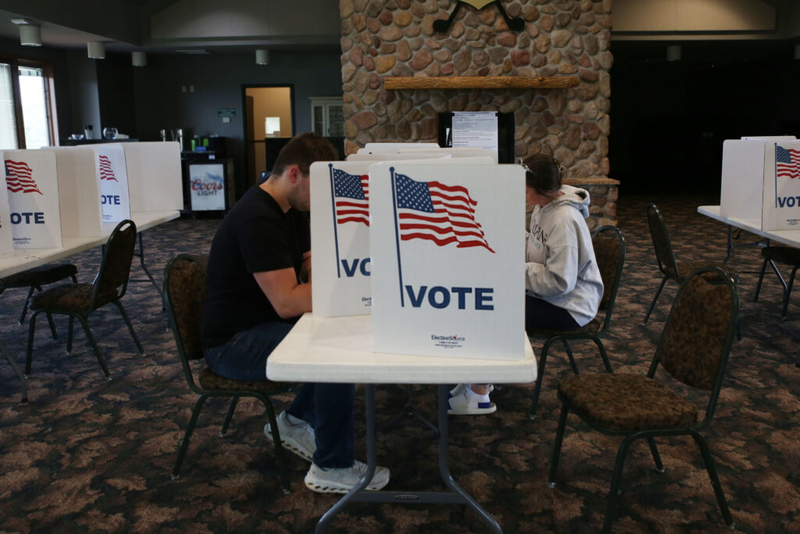
Voters fill out their ballots at a Brandon polling place during the runoff election for the South Dakota Republican nomination for governor on July 28, 2026. (Photo by Makenzie Huber/South Dakota Searchlight)
A question on South Dakotans’ ballots in the Nov. 3 election pits two philosophies against each other: One says it’s too easy to clutter up the state’s constitution with policies that don’t belong there, and the other says voters need the power to amend the constitution with a majority vote when lawmakers fail to adopt policies that voters want.
Amendment L is one of four ballot questions voters are considering in the state’s general election.
The ballot question deals with state constitutional amendments, which only voters can approve. Lawmakers can place amendments on the ballot, and so can citizens if they collect enough signatures from registered South Dakota voters.
Ballot questions need a simple majority from voters to pass, but Amendment L would change the threshold for future amendments to 60%.
In recent years, voters have approved constitutional amendments expanding Medicaid eligibility and legalizing recreational marijuana (although the marijuana amendment was subjected to a lawsuit and invalidated by judges), among others. Policies should not be part of the constitution, said state Rep. John Hughes, R-Sioux Falls, who sponsored the 2025 resolution that lawmakers passed to put Amendment L on this year’s ballot.
He said policies should be proposed and debated as regular laws, and the constitution should only contain foundational provisions like the structure and powers of government.
“Amendment L is a recognition that, through proper voter education, we will see the wisdom of reserving our state constitution as a permanent structure that, by and large, should stay the same and not be changed,” Hughes said.
In the Legislature, Hughes’ resolution to put Amendment L on the ballot received support from entities including the Foundation for Government Accountability, a Florida-based think tank whose website says it supports work requirements for the beneficiaries of social welfare programs, annual recertification for unions and the securing or elimination of ballot drop boxes to protect what it calls election integrity, among other issues. It also opposes what it describes as “far-left” efforts to promote diversity, equity and inclusion.
Similar attempts to raise the threshold for voter approval of ballot questions have been rejected by voters in past elections. In 2018, voters defeated Constitutional Amendment X, which would have raised the approval requirement for constitutional amendments to 55%. Constitutional Amendment C failed in 2022. That measure would have required 60% voter support for ballot questions that increase taxes or fees or require the state to spend $10 million or more in a measure’s first five years of implementation.
Chase Jensen, a senior organizer with the nonprofit Dakota Rural Action, opposes Amendment L. He said Republican lawmakers want to prevent voters from approving amendments — like the one requiring Medicaid expansion, which passed four years ago — that the lawmakers don’t like. Citizens petitioned the Medicaid expansion amendment onto the ballot after Republican lawmakers refused to adopt the expansion.
He added that lawmakers should have heeded voters’ prior rejection of similar attempts to raise the bar for approving ballot questions.
“The fact that if the majority agrees on something, that’s how it should be, that’s a pretty fundamental American idea and South Dakotan idea,” Jensen said. “We’ve been pretty clear already — we don’t like this, and that is not going to change.”
To hear more from the pro and con voices about Amendment L, listen to this episode of Searchlight Report, a podcast from South Dakota Searchlight.
Groups spending money to oppose Amendment L include The Fairness Project, which has spent about $260,000 on advertising so far, according to mandatory reports filed with the South Dakota Secretary of State’s Office. The Fairness Project is a Washington, D.C.-based nonprofit that says it is “dedicated to advancing social and economic justice via ballot measures.”
Complete reports of spending for and against the amendment won’t be available until Monday, which is the deadline for campaign finance reports from ballot question committees.
A “yes” vote on the ballot question will require all future amendments to receive 60% support from voters to be added to the state constitution. A “no” vote would keep the threshold at a simple majority.
Early voting is underway. The voter registration deadline is Monday.

Pierre, SD