‘Process over policy’: Arch reflects on qualities of a good speaker of Nebraska Legislature
Nov 16, 2026 | 6:30 am ET
Description
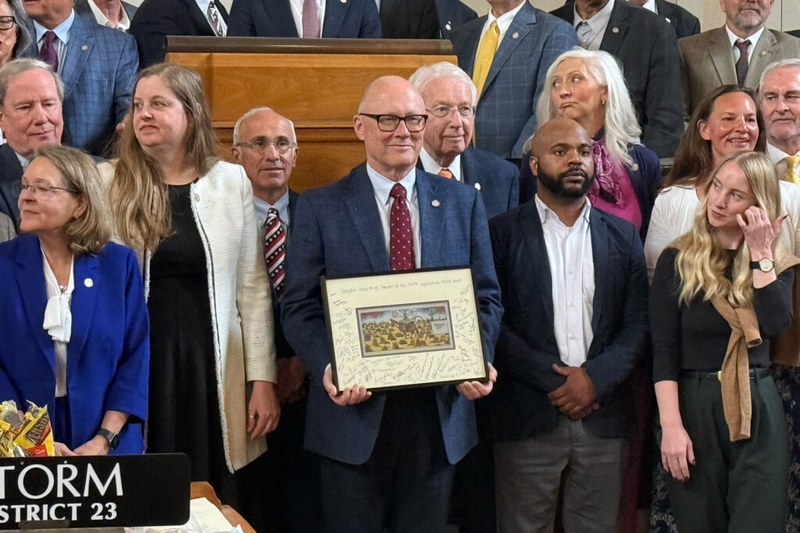
State lawmakers gather around Speaker John Arch of La Vista, center, on the final day of Nebraska's 2026 legislative session. Arch holds a frame gifted to him with signatures from all 48 of his colleagues. The picture shows a man herding cats. April 17, 2026. (Zach Wendling/Nebraska Examine)
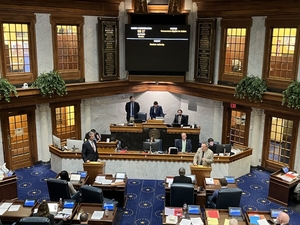
LINCOLN — Speaker of the Nebraska Legislature John Arch has led the Cornhusker State’s one-house legislative branch through some of its most tumultuous moments in the past four years.
Arch, a legislator from La Vista, is term-limited and will be leaving the 49-person Legislature come January. In his tenure, the Legislature faced days-long filibusters where recipes and movie scripts dominated debate sometimes more than policy arguments, in addition to multiple budget deficits following significant income tax cuts approved in 2023.
Having talked to many speakers nationwide, Arch said Nebraska is different, in part because of the one-house, officially nonpartisan Legislature. In other states, by contrast, speakers might appoint committee chairs or decide what bills can come to the floor.
“They have tremendous discretionary power, and that is just not the role of the speaker in Nebraska,” Arch said.
The race to succeed Arch has already begun before the next Legislature begins Jan. 6. State Sens. Teresa Ibach of Sumner and Kathleen Kauth of Omaha have put their names forward. Nebraska has never elected a female speaker of the Legislature.
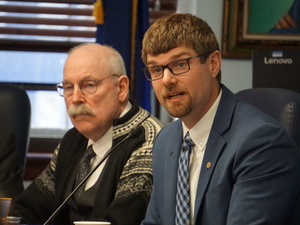
Arch declined to weigh in on Ibach or Kauth. He said a good speaker understands their role is to secure a “predictable, rule-followed process” for the Legislature. There is some discretion, but once the speaker puts out memos outlining the process each year, “you stick to that.”
Arch, for instance, defined “full and fair debate” as eight hours during first consideration followed by four hours in the second round of debate and two hours on final reading. Once those limits were reached, lawmakers could file “cloture” and, with at least 33 votes, end a filibuster. By contrast, most bills for which debate ends before the time limit can pass with a simple majority.
In 2025, after being reelected as speaker, Arch announced a process by which “controversial and emotionally charged legislation” would face half those time limits.
“For the role of the speaker in this Legislature, it is process over policy,” Arch said.
Ibach, Kauth detail runs for 2027-28 speaker of the Nebraska Legislature
Under legislative rules, senators and committees can give a “priority” designation to increase the chances that a bill or resolution is scheduled. Speakers try to schedule as many of those bills as possible as time allows. Lawmakers begin each session working through bills as they advance from committees before priority bills are selected.
Traditionally, speakers don’t speak very often on bills and focus on scheduling, Arch said. He noted a challenge is that the speaker is also a state senator who has opinions and votes to represent their district, which remains important. He said process becomes “your No. 1 function.”
“The institution, the process, all of that takes precedence over personal desire to see a particular policy pass,” Arch said.
Arch said he has had conversations with many lawmakers about leadership roles where they might fit best. Leadership votes are conducted by secret ballot. At least 25 votes are needed.
The next Legislature begins Jan. 6.
Lincoln, NE