Is the primary job of SC’s US senator to support Trump? Here’s how 5 candidates answered.
Aug 04, 2026 | 4:00 am ET
Description
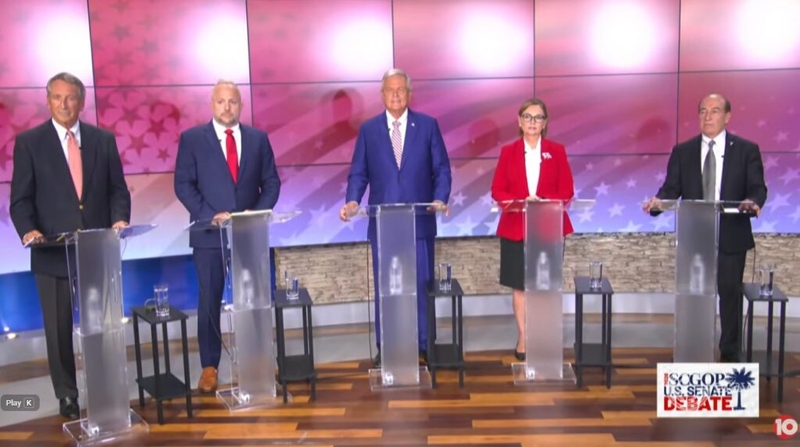
Five Republicans seeking the GOP nomination for U.S. Senate in a special primary participate in the first televised debate Monday, Aug. 3, 2026, at the WIS-TV studio in Columbia. The five (left to right) are former Gov. Mark Sanford, U.S. Rep. Russell Fry, U.S. Rep. Ralph Norman, Sen. Darline Graham, and Upstate businessman Mark Lynch. (Screenshot of Gray Media's livestream)
COLUMBIA — Questions about the war in Iran and candidates’ general willingness to buck President Donald Trump provided some of the biggest distinctions between Republicans on stage Monday asking South Carolinians to support their bid for U.S. Senate.
The winner of the special GOP primary will replace the late Sen. Lindsey Graham as the GOP nominee for November’s general election. The televised debate offered voters statewide a chance to hear from the frontrunners. According to the state GOP, five of its nine certified candidates met the debate’s polling criteria.
The one-hour debate mostly saw the five candidates agreeing with each other. But they differed on whether the senator’s primary job is to support Trump’s agenda.
Two gave a resolute “yes:” Sen. Darline Graham, sister of the late senator; and U.S. Rep. Russell Fry of the 7th District.
Former Gov. Mark Sanford, who in 2019 briefly challenged Trump’s re-election, said his readiness to disagree sets him apart in the crowded field.
U.S. Rep. Ralph Norman and Upstate businessman Mark Lynch were somewhere in between.
It was the first debate for Graham, who was sworn in July 14 to fulfill her brother’s term that ends in January. Not expected to seek the full term, she jumped into the race after Trump simultaneously encouraged and endorsed her campaign.
“This is simple: I completely support the president’s agenda. I’m 100% behind him,” said Graham, of Lexington. “I am honored to have his endorsement.”
Fry, first elected to Congress in 2022 with Trump’s endorsement, also gave an unequivocal “yes.” Many expected Fry to get Trump’s endorsement again.
“The president was elected as commander in chief,” said Fry, a former legislator from the Grand Strand. “He is the coach. It is frustrating for our conservative voters to constantly see people grandstand and jump up and down and oppose him.
“People elected us to do a job,” he continued, adding the president has an “open phone line” to talk through disagreements. “They expect us to get the job done, not grandstand and not get in the way.”
Norman, of Rock Hill, said he supports the president’s agenda and thinks he’s done a great job but said the president likes to hear varying opinions.
“You can disagree with him. He loves competing ideas,” said the 5th District congressman, who flipped his vote for House Speaker Mike Johnson in January 2025 after taking a phone call from Trump on the House floor. “That’s how he makes the final decision. Typically, it’s the right decision.”
Lynch responded “yes,” and noted he voted for Trump every time he was on the ballot, but followed that up with “iron sharpens iron” — that disagreements can bring success.
“I’m not afraid to bring up a question or something I don’t think is right with anybody,” he said. “With that comes the best decisions.”
Sanford, whose last term in Congress was during Trump’s first two years in office, said he thinks the job entails both supporting and disagreeing with the president.
While mostly supporting him, “where I disagree, I have disagreed. And I think that’s the American way,” said Sanford, whose brief presidential run included news conferences across South Carolina with a life-size cardboard cutout of Trump.
“It’s OK to occasionally disagree on things,” Sanford said. That includes getting the authorization of Congress to wage war.
The war in Iran
On whether it was time for the war in Iran to end, Sanford said he applauds Trump’s efforts to wipe out terrorism and prevent Iran from having nuclear weapons. Still, he said, only Congress can declare war.
The last time Congress formally declared war with a country was in 1942, during World War II, according to the U.S. Senate.
Last Thursday, the U.S. Senate narrowly blocked a War Powers Resolution that could require an end to hostilities. In the 49-50 vote, three Republicans joined Democrats in voting “yes.”
Sanford said his position is personal. As governor, he attended funerals of service members who died. “Body bags don’t go back to Washington,” they go back to service members’ home, he said.
Following the U.S. and Israeli bombing attack launched in February, Lynch blamed Trump’s decision on Lindsey Graham’s influence. On the debate stage, he said he supports Trump as the commander in chief, but “it’s time to bring our men and women home to get them out of harm’s way and get back to what’s important here in America.”
Norman and Fry both said they don’t want “boots on the ground” but believe the mission should be completed.
“Iran needs to be defanged,” Fry said.
“I think he’ll eventually, sooner rather than later, use whatever power from the air to take them out,” Norman said.
Darline Graham sounded much like her brother as she backed Trump and Israel.
“We cannot allow terrorists to build nuclear missiles because they’re going to want to kill Americans,” she said. “The more we can fight them over there and prevent it over there, the better for the United States. I’m all for peace through strength.”
US Sen. Lindsey Graham remembered by his ‘beloved’ South Carolina: ‘He was us’
Differing experience
All five candidates pointed to their backgrounds in their pitches for why they should be the GOP nominee.
In both her opening and closing statements, Graham stressed that she’s “not a politician.” Noting she “grew up in the back of a bar and liquor store,” she said she understands the struggles of average American families. She said she’s still in the majority of South Carolinians who lack enough of a rainy-day fund to cover bills for three months.
Fry, the youngest on stage at 41, has drawn a comparison to the Graham siblings’ humble beginnings. In his opening remarks, Fry said he understands “what it’s like when every dollar mattered because my family lived it.” A native of Surfside Beach, Fry said he grew up in a “cinder block house with no heat or air conditioning.”
And he criticized several of his opponents without naming them. In a swipe at Graham, he said, “I didn’t inherit a record. I earned it.”
Lynch, owner of Jeff Lynch Appliance Center in Greenville, pointed to his business experience, saying he’s repeatedly grown the family business over the 40 years he’s been at the helm without going into debt.
“I understand budgets,” said Lynch, who came in a distant second to Graham in the June 9 GOP primary. “I know what being debt-free means. We can’t print money out of thin air in our business.”
Norman, a member of the hardline Freedom Caucus, also stressed his business credentials. A Rock Hill developer before entering politics, he touted being “the most conservative.” First elected to the state House in 2004 and Congress in 2017, he ended his pitch by declaring he’s “tired of moderates.”
Sanford talked about his record as governor and as the 1st District congressman.
Responding to a question about people living in the country illegally, he got a bit mixed up about his record.
He pointed to REAL ID as an example of results during his two terms as governor.
“We enacted it when I was governor,” he said. “A lot of governors weren’t doing it.”
Actually, in 2007, he signed a bill refusing to comply with the post-9/11 federal law to create a national ID standard. The Legislature reversed course in 2017, when it appeared enforcement would be imminent.
He meant to say E-Verify, a spokesman said after the debate. In 2008, Sanford signed legislation requiring businesses to use the E-Verify system to check workers’ legal status or else hire only people who hold a valid driver’s license from South Carolina or other state with similar license requirements. Three years later, then-Gov. Nikki Haley signed a law expanding on the requirements for businesses and law enforcement.
Columbia