Poll: 2 out of 3 North Carolinians get political news from local TV or social media
Sep 25, 2026 | 3:10 pm ET
Description
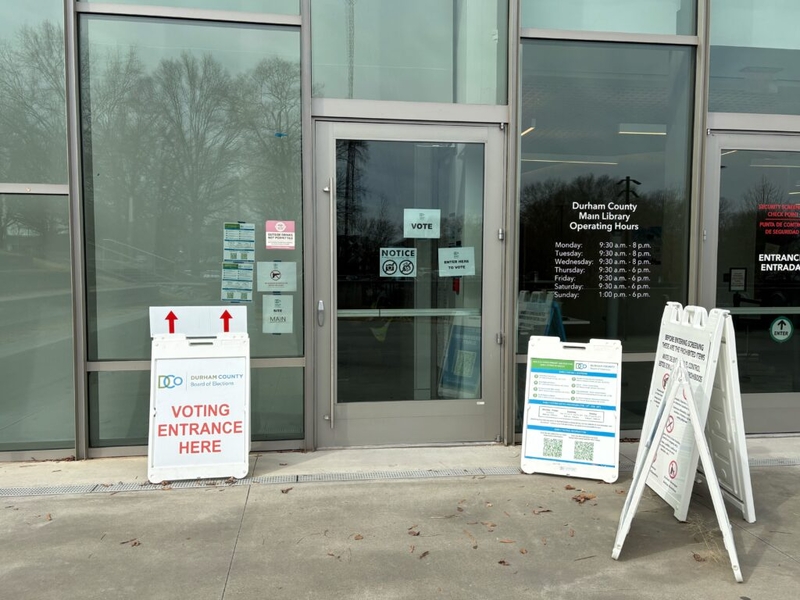
The entrance to the Durham County Main Library, where voters cast their primary ballots on Feb. 12, 2026, the first day of early voting. (Photo: Brandon Kingdollar/NC Newsline)
Local television and social media are where most North Carolina voters get their political and government news, according to a poll released Friday.
Common Cause NC found that the two sources each reach about a third of voters, with 36% of respondents saying they rely on local TV news for their state political news and 35% saying social media.
Voters could name up to two sources — 8% named both — so together local TV news and social media reach 63% of voters.
No other source reached more than 17%, according to the poll. Cable news, radio, a North Carolina newspaper (print or online), and national news networks each reach 17% of voters.
The survey found partisan differences. Democrats are more likely than Republicans to name a North Carolina newspaper, 21% to 12%, while 17% of unaffiliated voters said they get their news from a North Carolina newspaper.
Nearly half of Democrats said they get their state political news from local TV, at 45%, compared to 32% for both Republicans and unaffiliated voters.
Unaffiliated voters rely heavily on social media for state political news, at 42%. Meanwhile, 34% of Democrats and 28% of Republicans say they get their news from social media.
New poll shows NC voters across party lines see childcare as workforce, affordability issue
Cable news leans Republican at 22%, while 15% of both Democrats and unaffiliated voters named that source. Radio tends to be most popular with unaffiliated voters, reaching 21% of independents, 18% of Republicans, and 13% of Democrats. cable n
Six percent of respondents say they don’t follow North Carolina politics. That breaks down to 10% of Republicans, 5% of unaffiliated voters, and 4% of Democrats.
The poll is part of a survey ahead of the 2025 U.S. Senate race. It also shows Democratic former Gov. Roy Cooper maintaining a sizable lead over former Republican National Committee and North Carolina GOP chair Michael Whatley, 51% to 41%.
Common Cause NC conducted a statewide survey of 857 likely 2026 general election North Carolina voters between Sept. 17 and 20. The margin of error was plus or minus 3.3 percentage points.
Raleigh, NC