Pennsylvania community health centers request $5M for ‘crumbling’ safety net backbone
Apr 29, 2026 | 4:47 pm ET
Description
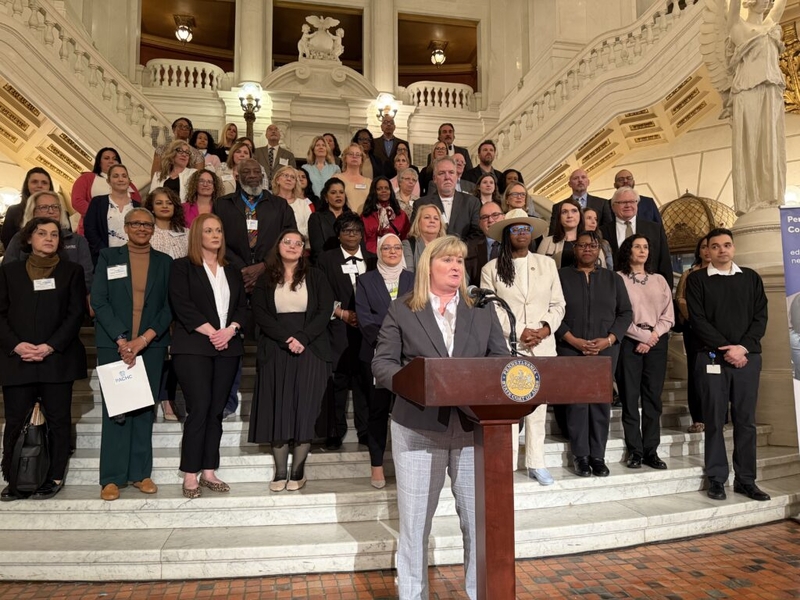
Pennsylvania Community Health Center CEO and President Shelley Riser speaks in the Capitol on April 29, 2026. In addition to primary care, community health centers provide a myriad of services, from dental to pharmacies. (Photo by Whitney Downard/Pennsylvania Capital-Star)
With healthcare access and outcome gaps persistently high, inflated by ever-growing costs, community health centers pitched themselves Wednesday as a way to reduce barriers and provide quality care across the commonwealth.
But they need a little help from the state to keep going.
Listen to Whitney and Emily’s audio recap:
Conscious of the competing budget requests straining the $53.2 billion spending plan proposed by Democratic Gov. Josh Shapiro, health center staffers asked for $5 million — down from last year’s $50 million request.
Pennsylvania is one of four states without any dedicated line item for “this critical safety net,” according to the Pennsylvania Association of Community Health Centers (PACHC), though various state grants do make up the largest revenue stream.
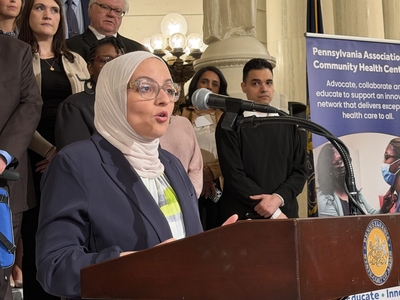
“Because we are community based and community governed, we do whatever it takes to take care of our communities,” said Manal El Harrak, the CEO of Sadler Health Center, which has three locations in Cumberland County. “We are the backbone of the primary care system here in the commonwealth and nationally. However, the backbone is crumbling.”
Organizations under PACHC assist more than 1 million patients — many of whom are low-income — across 450-plus centers each year, according to its annual report. About 16% of patients are uninsured and 44% are on Medicaid or CHIP, the public option for children.
El Harrak and others pointed to low Medicaid reimbursement and diminishing returns from federal drug programs as challenges for centers. Previous analysis from Matrix Global Advisors, on behalf of PACHC’s national arm, found that community health centers reduce overall demand for healthcare services and add billions to the commonwealth’s economy.
“This $5 million will go a long way for the patients that they care for in community health centers all across Pennsylvania,” said Rep. La’Tasha Mayes (D-Allegheny). “It is a small amount compared to the great work that all these centers do.”
State House lawmakers advanced the budget earlier this month on a bipartisan vote, without the $5 million request. Leaders in the Republican-controlled Senate, however, criticized the proposal’s “unsustainable” spending.
Health disparities persist, with some positive news
The request comes on the heels of new data documenting the gap between health access and outcomes across racial and ethnicity, with Black and Hispanic Pennsylvanians lagging behind their white and Asian American or Pacific Islander counterparts.
The New York-based Commonwealth Fund’s 2026 health disparities report concluded that the state’s inequity was less severe than other Mid-Atlantic states, putting Pennsylvania in the middle of the pack across several measured categories.
But organization President Joseph Betancourt emphasized that such disparities “are not inevitable,” but rather “shaped by policy choices and health system decisions that can be changed.”
“States that perform well have taken the pains and the efforts to collect data and to identify and address gaps,” said Betancourt. “When they do, particularly with the focus on those that are the most vulnerable, what we see is an improvement in (overall) health system performance.”
Researchers also pointed to community health workers and incentivizing care in underserved communities as ways to shrink the difference.
Black Pennsylvanians are more likely to die before the age of 75 from a preventable cause that can be targeted at a public health level, such as kidney disease, diabetes and certain cancers.
But gaps for children are much smaller. Roughly two-thirds of Black, Hispanic and white children got age-appropriate preventative care and dental visits in the last year. For vaccines, Black children were more likely than white children to be up to date — but Hispanic children fell far behind both populations.
Researchers worried that recent gains in health coverage will be erased by federal action, specifically the expiration of enhanced tax credits for Affordable Care Act coverage and Medicaid work requirements. Higher uninsured rates would also increase the pressure on community health centers.
“These recent changes are likely to make it even harder for people to afford and access care, and risk widening the very disparities this report documents,” said Betancourt.
Following the federal government’s opposition to many recommended vaccinations — and its endorsement of the false claim connecting vaccines with autism — Pennsylvania has formed its own oversight body with a coalition of northeastern states.
But Betancourt and others pointed to possible opportunities to close gaps in care with new technologies like artificial intelligence and telehealth. He pointed to virtual therapy as an option for patients who sought providers who spoke their language but couldn’t find someone in their community. Or for someone without reliable transportation.
“There are likely countless examples like that where the deployment of technologies — digital, AI — could really help address very specific challenges that all patients face, certainly, but vulnerable patients and communities of color might face disproportionately,” said Betancourt.
Lawmakers have met several times to learn about the use of AI in healthcare, and states are all grappling with how to govern the resource-hungry tool.
Harrisburg, PA