One year since abortion law took effect, advocates say Iowans seeking care face new barriers
Jul 29, 2025 | 4:14 pm ET
Description
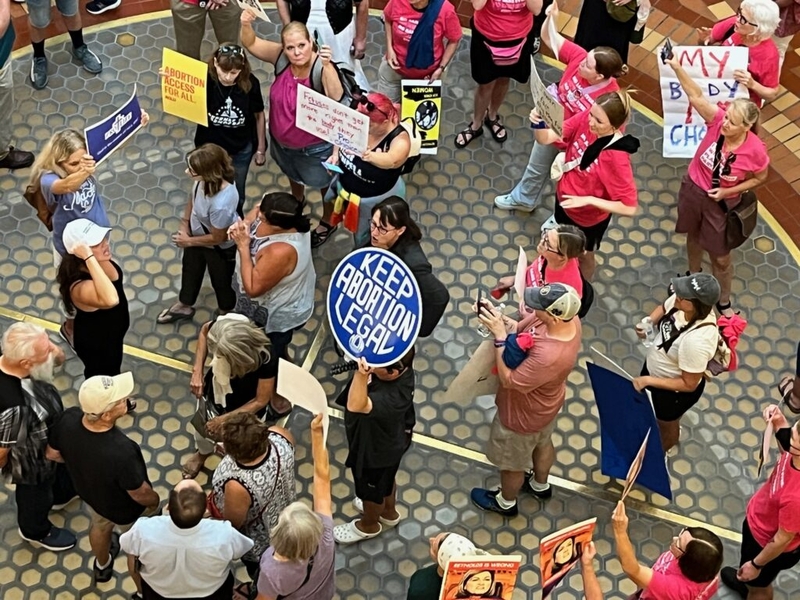
Hundreds of Iowans rallied for and against abortion restrictions on July 11, 2023 in the Capitol rotunda. (Photo by Kathie Obradovich/Iowa Capital Dispatch)
Abortion access advocates say the number of Iowans who seek abortions has not decreased in the year since the state’s six-week abortion ban began enforcement — but the barriers to receiving that care have risen.
The so-called “fetal heartbeat” law went into effect on July 29, 2024. The law, signed by Gov. Kim Reynolds in 2023, bans abortions after cardiac activity can be detected in an embryo, which can occur as early as six weeks of gestation. Some exceptions exist in the law, including for reported cases of rape and incest, and when an abortion is necessary to save the mother.
According to data from the Iowa Department of Health and Human Services, the number of abortions performed in Iowa decreased sharply in 2024 after the law was enacted. In 2023, there were 2,771 induced terminations of pregnancies in the state, a number that fell to 1,792 in 2024. Last year, two-thirds, 1,196, of those abortions occurred in the first six months, before the abortion law went into effect, according to preliminary HHS data.
As abortions performed in Iowa fell following the law’s enactment, Planned Parenthood North Central States said the number of Iowans traveling to other states for abortion care increased by 182% in that time period.
Groups like the Chicago Abortion Fund (CAF), a group that partners with the Iowa Abortion Access Fund (IAAF), have been working in the past year to help Iowans travel out of state for abortion services. These two groups have helped 870 Iowans in accessing abortion services, according to a news release, with 75% of those people traveling to other states to receive care.
Megan Jeyifo, executive director of CAF, said their organizations have provided more than over $382,000 in direct support to Iowans seeking abortion care in the past year. These funds are needed because demand for these medical services has not diminished under the ban — they have only become more difficult for Iowans to access, she said.
“As awful as this has been for Iowans, the numbers of Iowans having abortions has not gone down post this ban and that could be for a lot of reasons,” Jeyifo said. “… We know abortion bans don’t … stop abortions. People are going to have abortions, it’s just going to make it really, really, really hard and traumatic and stressful and exhausting and awful for them. And … that’s where we come in to try to mitigate.”
Many Iowans seeking this care are going to states including Illinois, Minnesota, Nebraska and Wisconsin to get access abortion services, she said. The abortion funds also still provide resources to help people find medical care within the state.
But for people seeking abortions within the state, accessing care that remains legal under the 2023 law can be a struggle, Dr. Emily Boevers, who provides OB-GYN services in Waverly said. In a news conference on the one-year anniversary of the abortion ban Tuesday, Boevers said doctors across the state are having trouble helping patients who need abortions when their pregnancies are nonviable or if their lives are endangered.
She shared the story of a fellow physician who performed an abortion when a patient faced with ongoing bleeding and increased instability during early pregnancy in order to preserve their life and wellbeing. Though the doctor studied the law to ensure it met the guidelines on a legal abortion with the support from the patient and their family, they were met with a “weekslong inquiry from her hospital system and their risk management team and legal team about if she had violated the law, including an ethics inquiry,” Boevers said.
“And again, this is one of the few OB-GYNs providing care in Iowa, who saved a maternal life, and should be thanked for saving this life and keeping this woman healthy for her family, and meeting this woman’s needs … but instead, she faced a weekslong legal inquiry,” Boevers said. “That is one example — and an extreme one for sure, because we all fear what will happen If we have an unstable patient in our care and how we will respond ,and how we will be able to meet the needs of that patient while also preserving our ability to care for all of the other patients in preserving our licensure.”
While Democrats and reproductive health care advocates said the law has had negative impacts for women and mothers, Republicans have celebrated the law, and said there are other avenues where the state is supporting maternal and infant health care.
Reynolds said in a Tuesday news release the decrease in abortions since the law began enforcement shows “a powerful victory for life.” She also pointed to other measures that show the state’s commitment to supporting mothers and children, like the More Options for Maternal Support, or MOMS program, providing state funding for maternal care nonprofits that encourage alternatives to abortion — referred to by some as “crisis pregnancy centers” — as well as the state’s extension for postpartum Medicaid coverage at a lower income eligibility level.
“This is what it means to be comprehensively pro-life — surrounding everyone involved in a pregnancy with love and support, promoting strong families, and intentionally building a culture of life,” Reynolds said.
Iowa Democrats have said these decisions have not meaningfully made maternal health care more accessible for Iowans in need. Jeyifo, with CAF, also said GOP efforts to highlight investments in maternal health care while talking about abortion bans is “asking people to believe that two things cannot exist together.” Being able to access abortion care is a meaningful component of maternal health care, she said, including for prospective parents.
“In my view, both as a mother and a person who’s had abortions and a person who does this work, you simply cannot improve maternal health outcomes while stripping people the ability to decide if, when, and how they’re going to parent or give birth,” Jeyifo said.
Iowa Senate Minority Leader Janice Weiner said Tuesday the abortion law also has new implications a year later, when put in the context of cuts to Medicaid made through the budget reconciliation bill advanced by Republicans in Congress and President Donald Trump. Iowa already had a maternal health care shortage, she said, and the compounding impacts of the abortion ban and potential closure of hospitals will make accessing this care even more difficult.
“When our federal representatives and senators in Washington vote to roll back Medicaid coverage — which is going to have an even further impact on rural hospitals, on nursing homes, but also, ultimately on our urban hospitals — that has an impact on everyone in the state and their ability to access care,” Weiner said. “I believe, personally, that that really started with abortion bans. Because when it seems like it’s okay to take away one right, one way to access medical care, suddenly that opens the door. And those are definitely issues that we will be talking to voters about in the run-up to 2026.”
Des Moines, IA