Oklahomans to decide on adding voter ID requirements to state constitution
Aug 11, 2026 | 6:30 am ET
Description
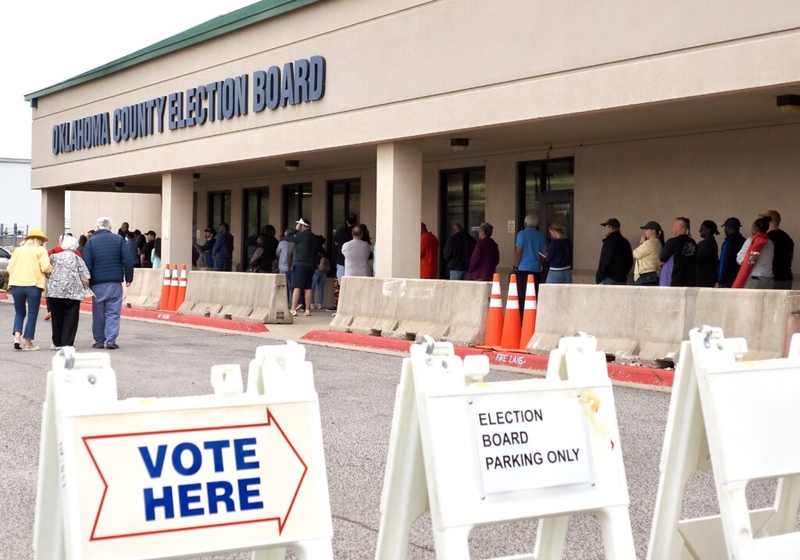
Voters wait in line outside the Oklahoma County Election Board on Oct. 30, 2024 to cast a vote in the Nov. 5 election. (Photo by Emma Murphy/Oklahoma Voice)
OKLAHOMA CITY — Oklahomans are set to vote later this month on whether to amend the state Constitution to include voter identification requirements and to give lawmakers greater authority over election law.
If State Question 846 is approved by a majority of voters, the Oklahoma Constitution would be amended to require proof of identity for any method of voting and to allow the Legislature to enact any laws necessary to specify the ID requirements.
Lawmakers placed the state question on the Aug. 25 ballot by passing Senate Joint Resolution 47 this session. Oklahoma’s current state law, approved by 74% of voters in 2010, already requires identification.
State law currently requires one of three forms of identification at the polls:
- A photo ID with the voter’s name, photo and a valid expiration date, issued by the U.S. government, the state or a federally recognized tribal government;
- Voter identification card provided by their county election board; or
- A sworn affidavit to prove identity in order to vote with a provisional ballot.
Cole Allen, a policy analyst for the Oklahoma Policy Institute, said while the state question wouldn’t make any immediate changes, it would grant the Legislature expanded power over state election law in order to comply with the constitutional changes.
Lawmakers would also need to outline the requirements for voter identification for mail-in voting, which is more complicated since Oklahomans aren’t voting in front of election officials, he said.
The Oklahoma Constitution currently gives lawmakers the power to determine the how and when elections are held and to pass laws to detect and punish election fraud, Allen said.
“By expanding the legislative authority, it gives our Legislature and politicians more power over who can vote and how they vote beyond what the Constitution grants them right now,” he said.
Oklahoma already has very secure elections, and Allen said he’s not sure how the state question would improve election security. Oklahoma’s chief election official recently affirmed the security of the state’s election despite the federal government claiming otherwise.
Long-term, it’s possible for lawmakers to make the voter identification laws stricter until voters are disenfranchised, whether intentionally or unintentionally, Allen said.
“But I do think the more likely scenario is that this restricts access to the ballot for people who are legal voters who simply can’t get their hands on or don’t have the time to go to the DMV to get a driver’s license,” he said. “Or can’t afford to get a passport, or don’t know where their birth certificate is.”
Allen said five other states – Arkansas, Mississippi, Missouri, North Carolina and Wisconsin – have a constitutional requirement for voter identification, but the language and requirements vary from state to state.
Lawmakers in support of the measure have argued the state question will ensure the integrity of Oklahoma elections.
House Speaker Kyle Hilbert, R-Bristow, and Senate President Pro Tem Lonnie Paxton, R-Tuttle, were the authors of the legislation that added the state question to the August ballot.
Neither responded to requests for comment.
All registered Oklahoma voters are eligible to vote on the state question, regardless of party affiliation.
Oklahoma City, OK