Ohio senators consider eliminating data center sales tax exemption
Nov 19, 2026 | 3:50 am ET
Description
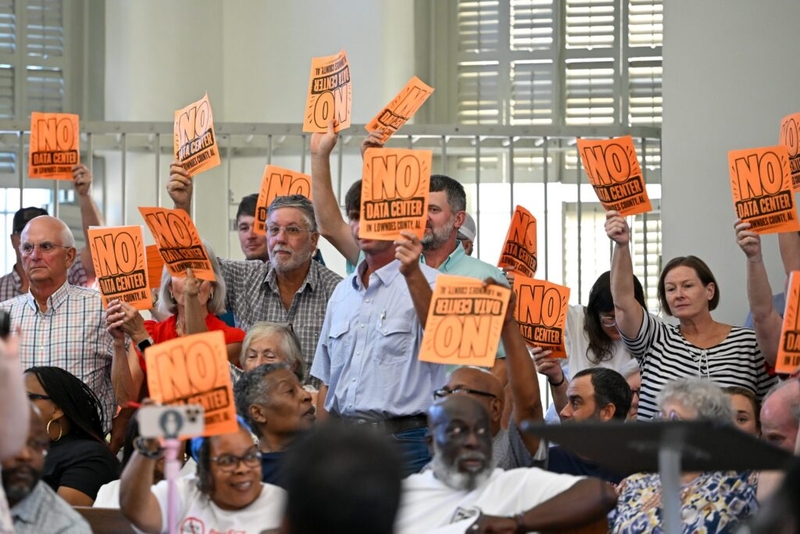
Alabamans hold up signs that read “No Data Center” at a County Commission meeting on Aug. 24, 2026, in Hayneville, Alabama, in the Lowndes County Courthouse. (Anna Barrett/Alabama Reflector)
With just a few weeks left in the current session, a bipartisan measure nixing Ohio’s data center sales tax exemption got its first hearing in the state Senate.
After Ohio voters soundly rejected data centers at the ballot box, there’s little question about the appetite for reining in the industry. Still, the measure faces long odds for passage.
Ohio Senate Bill 374 sponsors Sens. Louis Blessing, R-Colerain Twp., and Kent Smith, D-Euclid, have been trying, one way or another, to roll back the state’s data center sales tax exemption since 2024. Their current bill is very simple: it blocks state officials from awarding new exemptions starting in Oct. 2027.
Smith explained when they initially drafted the bill, official estimates put the tax break’s annual cost at $130 million. In reality, it cost Ohio $1.5 billion in 2025 alone.
“For that reason, there is now bipartisan outcry to end this tax break,” Smith said.
Lawmakers actually eliminated the exemption as part of the state budget last year. Gov. Mike DeWine vetoed the provision arguing it played a role in attracting investment to the state.
“Gov. DeWine himself may have actually had a change of heart,” Smith added, “when he paused the data center tax break while the legislature considers the policy.”
Earlier this year, lawmakers tried a different tack, cutting the tax break in half through Ohio House Bill 646. The measure, which makes several changes to data center policy in Ohio, sputtered out before lawmakers left for the summer recess.
Ohio state Sen. George Lang, R-West Chester, acknowledged the tax incentive is unfair, but downplayed its significance.
“I can only speak to one that I know of in Butler County,” he said. “The fees the data center was going to pay up front far exceeded any sales tax that would have been collected over a decade had the sales tax been in there.”
As for the $1.5 billion in foregone tax revenue, Lang said in his opinion the state “doesn’t need the money” and he expressed doubts about how responsibly the state would spend the cash if it had it.
Blessing said one option lawmakers could consider would be backfilling state education funding.
“If we don’t do that,” he said, “we’re just going to continue to see more and more levies, more and more school cuts.”
Lang also asked if they’d accept an amendment trading elimination of the tax break for an end to data center moratoriums. Blessing said to get there, lawmakers would likely need to follow the model of the Ohio Power Siting Board. The state could probably extract better deals, he said, than a township or village.
But given the results of November’s election, it’s far from clear local governments would welcome state control over siting — even in exchange for more local tax revenue.
Follow Ohio Capital Journal Reporter Nick Evans on X or on Bluesky.
Columbus, OH