Ohio data center tax boondoggles just one example of Kasich corporate giveaways
Sep 21, 2026 | 3:35 am ET
Description
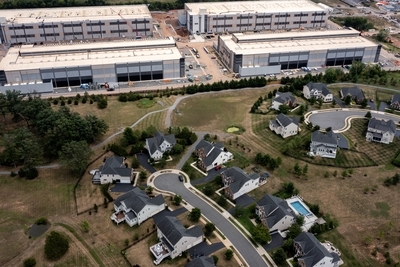
An Amazon Web Services data center is shown situated near single-family homes. (Photo by Nathan Howard/Getty Images)
Former Gov. John Kasich’s massive tax giveaways a decade ago to the tech giants now building data centers in Ohio will continue to plague the state for another 30 years. But that $2.3 billion in state sales tax exemptions to 18 companies is just one of many naïve and shortsighted Kasich deals, from 2011 to 2019, in which state assets were turned over to corporations – weakening the state.
Indeed, his two terms of transferring state wealth to private companies may, in retrospect, define his time in office. In addition to the tech deals that limit the state from reining in the data centers that a growing majority of Ohioans hate, Kasich’s legacy is a litany of pro-corporate/anti-taxpayer blunders:
- Offering $400 million Ohio dollars in 2011 to lure the dying Sears retail giant from a massive suburban campus in the distant Chicago suburbs to a new, sprawling rural campus somewhere in Ohio. This was unlikely to happen, but its shows intellectual bankruptcy of Kasich’s economic strategy. (The $400 million offer, incidentally, equaled the amount of federal funding Kasich rejected for a Cleveland-Columbus-Dayton-Cincinnati passenger rail system.)
- Selling off farms, equipment, facilities, and livestock at 11 Ohio prisons in 2017 – when the Department of Rehabilitation and Correction was in the middle of a $9 million expansion and improvement of those facilities. Among the assets auctioned off at “fire-sale” prices were 12,500 acres of farmland, 2,300 head of beef cattle and 1,000 dairy cows.
- Creating JobsOhio and funding it with the taxpayer dollars that had supported the wildly popular Clean Ohio program.
In fact, the ham-handed and foolish Sears and prison-farm plans pale in comparison to the one-two punch of creating JobsOhio and gutting the Clean Ohio Fund in 2011.
Through creation of JobsOhio and putting state liquor proceeds into the hands of a private company, the Kasich administration did more than an end-run around the state constitution and privatizing public assets. The arguably worst facet of privatizing economic development was, ironically, Kasich’s dismantling of what was perhaps the greatest economic-development program in the state’s history – Clean Ohio.
For about 10 years, Ohio’s liquor proceeds funded the brownfield-cleanup portion of Clean Ohio – a popular urban and rural environmental cleanup program created through a constitutional ballot issue overwhelmingly approved by voters in 2000 and renewed and revised in 2008. The Clean Ohio program was a four-pronged, bipartisan, urban and rural, multifaceted statewide environmental program that sold $400 million in bonds to:
- expand and support parks, open space, wetlands, and natural areas facing threats;
- provide grants to farm owners who place easements on fields to perpetually preserve farmland through an Ohio Department of Agriculture program;
- maintain and expand recreational trails throughout the state;
- and, in the biggest part of the program, clean up urban brownfields and turn them back into profitable, tax-generating properties in Ohio cities.
Originally proposed by former Republican Gov. Robert Taft in 1999, the program was created in 2000 upon passage of Issue 1, with 57.4 percent support by Ohio voters. In 2008, Democratic Gov. Ted Strickland led the campaign to renew Clean Ohio – and it was overwhelmingly passed in all 88 counties by 70 percent of Ohio voters in a big-turnout presidential-election year.
But after Kasich became governor in 2011 and hatched his JobsOhio scheme, Clean Ohio was disemboweled.
The $100 million each year over four years was split evenly between urban brownfields ($50 million) and rural greenfields ($50 million, broken into $25 million for open space and $12.5 million each for farmland and trails). Bonds for the projects on the green side were repaid through general state revenues; the brownfield bonds were backed by state liquor profits.
The key to the brownfield remediation was a laser focus on cleanup of contaminated industrial sites rather than pointing fingers and assessing blame. Typically, developers with new plans for defunct industrial sites would seek a Clean Ohio grant and then work with environmental specialists on the long process of remediation and eventual redevelopment in Ohio’s cities.
This came at a time when industrial sites across the country were tied up in courts for decades. The sites typically had changed hands several times over the decades, and contamination often went back a century or more. In many cases, the dumping of toxic waste began well before laws were enacted to prevent such dumping. Every dollar spent on litigation to assign blame for the pollution was a dollar less to clean up the mess.
The liquor-backed bonds allowed for sites to be cleaned and redeveloped into profitable and tax-generating properties without waiting on the courts. The program was recognized nationally for its scope and innovation.
Clean Ohio thus thrived through three administrations, two governors and two political parties. It led to hundreds of millions of dollars for projects in all 88 Ohio counties and won bipartisan support at the local and state levels. The $400 million for the Brownfields program alone led to cleanup of 7,600 acres of contaminated sites, and, according to the Greater Ohio Policy Center, “placed Ohio as a national leader in brownfields redevelopment.”
Greater Ohio analyzed 21 brownfield projects between 2003 and 2012, and found they “resulted in a net positive value for the state’s investment, producing $1.16 billion in one-time contributions and $1.4 billion in annual contributions to the state GDP.” They also added $55 million state and local taxes. And that doesn’t include the number of jobs for the remediation itself and the new neighborhoods and buildings that were constructed on former brownfield sites.
It wasn’t until 2021 that Clean Ohio got back to some semblance of its original self and re-established the grant program. But that came after almost a decade uncertainty and a significant decline in grants while JobsOhio runs around ready to offer subsidies and take credit for companies making a footprint in Ohio.
Brian Williams is a freelance writer.
Columbus, OH