New recess law has Oklahoma teachers wondering, ‘What is the point?’
Nov 18, 2026 | 6:30 am ET
Description
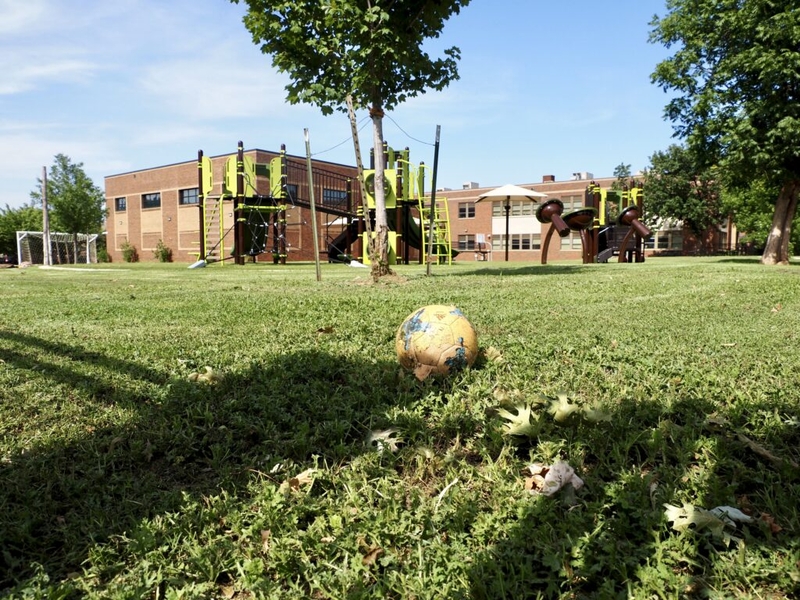
A soccer ball sits in the grass on the Wilson Elementary playground in Oklahoma City on June 29. (Photo by Nuria Martinez-Keel/Oklahoma Voice)
OKLAHOMA CITY — A new Oklahoma law doubling minimum recess time, initially celebrated by cheering children at the state Capitol, has caused frustration among educators.
The law, which requires elementary schools to offer at least 40 minutes daily of recess and prohibits taking it away as punishment, has prompted complaints that the policy comes at the expense of academic time and undermines teachers’ ability to discipline poor behavior.
In its first year of effect, the law already has upended school schedules and raised concerns about the added cost of lengthening district calendars, particularly after the Oklahoma State Department of Education announced it would phase out a policy that allowed recess to count toward the instructional minutes of a school day.
Disciplining misbehavior has been “a struggle” ever since the law changed, especially when no one in a child’s home life will enforce accountability, said Jordann Hardin, a third grade teacher in a large Oklahoma City-area district.
“There’s not very many tools in a teacher’s toolbox for discipline, and they just took away a major one,” said Hardin, who’s been teaching for 15 years.
A child who’s thrown trash all over the school cafeteria can’t be held back from recess to clean up the mess, she said. Issues that Hardin normally would have addressed by taking away five minutes of recess time instead are causing her to make more phone calls home, leaving some parents baffled why they’ve been contacted over a minor incident.
Hardin said her school previously offered a sufficient 30 minutes of daily recess, which she called “quite possibly the most instructional part of our day” because students practice their interpersonal skills.

This year, her school added another 10-minute play period to meet the new legal requirements, and while it seems to have made a minimal difference to students, the cost is more than just 10 minutes, she said.
“It’s the transition time going out to recess,” Hardin said. “It’s the lining up. It’s the coming back in. We’re losing so much instruction time just to be able to put in 10 more minutes of recess.”
Siomara Davis, president of the Edmond Classroom Teachers Association, said her union members have been wondering aloud, “What is the point?”
Edmond Public Schools had to rearrange its elementary schedules, start class five minutes earlier and convert a professional development day into a typical school day, all to add 15 more minutes of daily recess.
Davis said many teachers already build in time for movement into their lesson plans, and the extra play period has been more disruptive than helpful.
A class will “really be getting into the swing of the lesson for the day” and then have to stop for a recess break, she said. The teacher then has to allot time “for bringing kids back in and calming them down, getting that restroom break time, the drink time and getting back into the flow of things only to shortly after then go to lunch and recess again,” Davis said.
“I get a lot of, ‘When are they going to change this?’ I get a lot of, ‘Why do we have to do this?’” she said. “I also get a lot of, ‘Do you know what I could be teaching right now? Do you know how much I could get done in 20 minutes of class time?’”
While this law took effect, other legislation heightened pressure on elementary learning. Oklahoma lawmakers passed a bill this year that will hold back third graders from advancing to fourth grade if they score too poorly on state reading tests, starting in the 2027-28 school year.

Amid the added emphasis on testing, Sen. Ally Seifried, an author of the recess bill, has said extra time for play could help students burn more pent-up energy, allowing them to better focus in the classroom.
Seifried, R-Claremore, previously told Oklahoma Voice she has committed to looking at the law again during the next legislative session, which begins in February. She declined to comment further for this story.
Jenks Public Schools already provided 40 minutes of daily recess before the law. Superintendent Stacey Butterfield called it “an integral part of learning.”
But if the Education Department proceeds with its current plan to consider all 40 minutes as non-instructional time next year, even Jenks will have to add school days to compensate, Butterfield said. She estimated the longer school year will cost her district $2.7 million, despite the Legislature considering the recess law as having no fiscal impact.
“Oklahoma has one of the shortest calendars,” she said. “We need to be looking at adding to our calendar. But if we’re going to do that in Oklahoma, we have to pay for it.”

The Legislature this year added $232 million to the state budget for public education while also adding seven days to the minimum length of a school year for districts with minutes-based calendars, a requirement that will take effect in the 2027-28 academic year.
Much of that $232 million, though, is earmarked for specific expenses, like teacher pay raises and reading programs, and can’t be applied to general operational costs.
State Superintendent-elect Robert Franklin said he expects lawmakers will need to revisit the recess law and that he’ll “have to wrangle with it” once he’s sworn into office in January.
Until he’s taken the oath of office, he said he’s “not going to make any rulings at all” on whether he would change the Education Department policy on recess counting toward instructional time.
Franklin, a longtime educator, said recess is instructive for students, particularly on “how to get along with each other and share.” However, he said the intent of the legislation and its real-life application “are not lining up, and that’s where we’re going to have to figure out what’s next.”
“If we’re doubling the time dedicated to play and activity rather than the work of literacy development and math development, we’re sometimes getting the equation upside down,” Franklin said.
Oklahoma City, OK