New Mexico judges working on statewide guidelines for artificial intelligence use in court
Aug 26, 2026 | 1:00 pm ET
Description
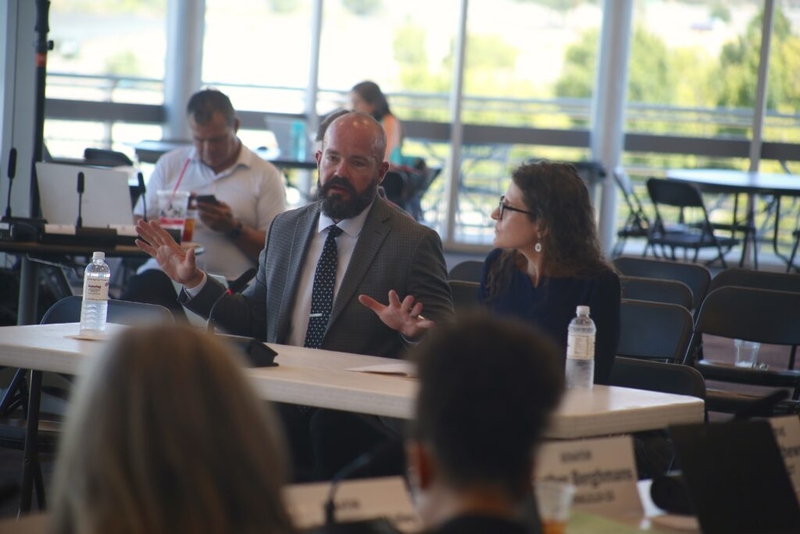
New Mexico Sixth Judicial District Judge Jarod Hofacket, left, and Second Judicial District Family Court Judge Jane Levy, right, speak about artificial intelligence use in court before the interim Courts, Corrections and Justice Committee in Albuquerque on Aug. 25, 2026. (Danielle Prokop for Source NM)
Two New Mexico judges told a panel of state lawmakers this week that the underlying theme of the guidelines they’re crafting for artificial intelligence use in the courtroom is, “Please, don’t be dumb.”
Second Judicial District Family Court Judge Jane Levy and Sixth Judicial District Judge Jarod Hofacket spoke before the interim Courts, Corrections and Justice Committee in Albuquerque on Tuesday and updated them on their AI-focused efforts. They said they are working on three separate sets of guidelines — one each for self-representing litigants, attorneys and judicial staff.
They pointed to two examples of AI-related fiascos in the courtroom as evidence that guardrails are sorely needed.
An Arizona family last year used AI to recreate their deceased relative, who died in a road rage incident, to deliver his own courtroom statements. And the New Mexico Supreme Court recently found a local attorney in contempt of court for using AI to file a brief that contained fabricated witnesses and testimony.
Levy and Hofacket sit on the state Supreme Court’s Committee on Artificial Intelligence and the Courts, which also includes academics and state lawmakers, and is set to produce annual recommendations so that anyone interacting with the legal system understands the expectations regarding AI use.
“It’s a tool to be used, like anything else — like spellcheck. But it is just a tool,” Levy said. “How do we make it so every lawyer appearing in the state understands what the rules are in front of every judge?”
State Sen. Antoinette Sedillo Lopez (D-Albuquerque) told Levy and Hofacket that she has encountered problems with AI’s credibility firsthand.
“I asked it a legal question and what was fascinating is it used a bill that was in the Legislature to say what the law is,” she said. “I was like, ‘Oh my God. That’s my bill.’ It didn’t pass.”
Hofacket responded that he believes the “human element” of the courtroom experience remains essential.
“I think about going to a fast food restaurant. If I order something from a human employee and they make a mistake, I’m not nearly as upset as if I have to use a kiosk to order something and it doesn’t come out that way,” he said. “There’s a human element to judging. Having a human sit and listen to your problems and come up with an answer — even if you don’t like it — is part of the experience.”

Santa Fe, NM