New Mexico Election 2026: New Mexico state treasurer
Sep 14, 2026 | 5:12 pm ET
Description
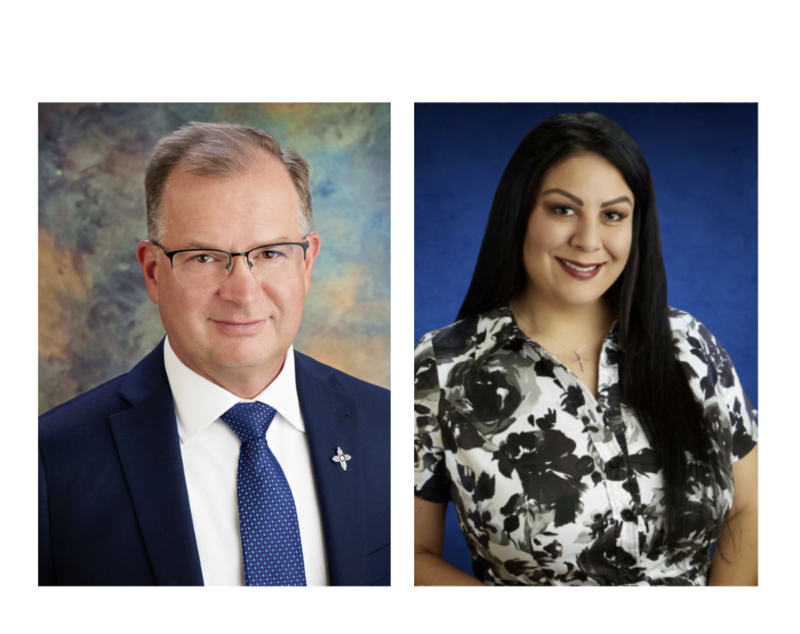
The Nov. 3, 2026, general election features a race between Democrat and incumbent State Auditor Laura Montoya, right, and Republican candidate Jim Ellison. (Courtesy photos)
The New Mexico state treasurer plays an increasingly important role in the state’s financial future, as leaders seek to transition the New Mexico economy from one reliant on record oil and gas revenues into one that sustains itself with investment returns.
In the four years since incumbent Democratic State Treasurer Laura Montoya has been in office, the assets under her management have grown in value from roughly $14 billion to more than $24 billion. The State Investment Council, on whose 11-member board the treasurer sits, oversees a fund that has grown to more than $75 billion, making it the second largest sovereign wealth fund in the country.
The state treasurer acts as the state’s chief financial officer, tasked with managing financial portfolios and paying debts. The treasurer also serves on multiple boards and committees, including the state’s mortgage finance authority, as well as pension fund boards for state employees and teachers.
Montoya seeks to continue growing New Mexico’s investments in a second and final term. To do so, she’ll have to defeat Republican candidate Jim Ellison, a former researcher at Sandia National Laboratories and former member of the state Public Regulation Commission. Ellison ran unopposed as a write-in candidate in the June 2 primary, garnering enough votes to appear on the Nov. 3 general election ballot.
Whoever wins the election will oversee an office with an approximately $6.3 million budget and earn an annual salary of $144,714.
Source NM spoke to both candidates about their visions for the office and what they plan to do if elected. Their answers below have been edited for length and clarity.
Jim Ellison
Republican Jim Ellison moved from Georgia, where he worked at a power utility, to New Mexico roughly 20 years ago to work at Sandia National Laboratories, where he researched the impact of natural disasters on power grid capacity.
He served on the PRC between 2023 and 2024, where he analyzed and approved utility rates, a job that required “rigorous” financial analysis, he told Source NM, and one that gave him “hands-on experience” applying financial expertise to serve the public interest.
Ellison also touted his 2013 designation as a Chartered Financial Analyst, which the CFA Institute touts as the “gold standard” in investment credentials, one that certifies a holder is qualified to serve in executive positions in investment, risk and asset management.
What makes you the most qualified candidate to be state treasurer?
I clearly have the investment background, having the CFA charter, which is a very rigorous program of three exams and takes about four years to finish, and only about one in five people who started actually finish it. Investing is an incredibly important part of what the State Treasurer’s Office does. Arguably, it’s the key role of the state treasury. There aren’t any outside money managers who do that. It’s done in-house, and you know the treasurer doesn’t directly manage it, but hires and evaluates the staff that manage it. I feel my investment background and understanding puts me in a good position to make sure that that fund is being managed properly. I do feel my experience at the PRC and experience at a power company were also important in terms of understanding financial issues and management.
What is the aspect of being state treasurer that is most overlooked, in your opinion?
I think the fact that the treasurer manages the state treasury’s treasurer’s office manages $20 billion and is responsible for keeping that money safe, liquid and earning a return is something that a lot of people don’t fully appreciate.
If elected/re-elected, do you have any new initiatives you intend to implement in the office?
I would institute a new report, an investment performance report, that I would have out within four months of the close of the fiscal year, which would be in plain English and would have appropriate benchmarks.
A problem with the current treasurer’s report is that it contains no benchmarking, and anyone in the investment profession understands that in order to assess performance, you have to compare it with a reasonable benchmark. The current annual report simply asserts that performance has been better than the benchmark and gives a number for how much money was earned over the fiscal year, but asserting that you’ve done better than a benchmark is just not good enough. You need to quantify it and specify the benchmark.
I would advocate for the unclaimed assets function to be transferred to the state treasurer’s office. Right now, that’s handled by Taxation and Revenue. Last November, they sent out a press release saying that they had $390 million worth of unclaimed assets, and that if anybody thinks that they might own some of those assets, they should contact Tax and Revenue. They also said they distributed $18.5 million, which is less than 5% of the total outstanding amount.
To me, it seems pretty clear that Tax and Revenue, their main function is to collect money, not to not to distribute it, and the treasury is a more natural home. I think that we are doing New Mexicans a disservice right now by not making it easier, by not contacting people who own these assets.
The state treasurer sits on the State Investment Council board, which oversees the state’s roughly $75 billion sovereign wealth fund. What are your recommendations for the best use of that funding?
The treasurer is one of 11 board members on that board. The governor is the chair of the State Investment Council. So the treasurer is one of the voting voices. I do think people will maybe pay a little extra attention to what the treasurer says, but the treasurer does not have, by any stretch of the imagination, unilateral control over those investments. The proper action for the board is really to set policy. The statute does define some of the parameters that the State Investment Council works in, the kind of things they can and can’t invest in, and the board works within those and and further makes specifications regarding risk and return and how outside investment managers should be selected, and then monitors to make sure that the executive team at the State Investment Council is adhering to those policies, and I think that’s the right role for a board member.The board should not get into approving each separate asset manager and certainly should does not get into individual investments. That really is up to the operating team.
Are establishing baby bonds a good use of the state’s wealth?
Obviously, this is advocacy. It’s not something that the treasurer can actually do on his or her own. It’s advocacy in front of the Legislature. I feel that the treasurer should be more focused on what’s in their control.
I know that the incumbent has been advocating for financial education, financial literacy, to be a mandatory part of a high school education. And I would say the same thing. I think every New Mexican does need to be financially literate, and I would use the partnerships that exist and the ability of the treasurer to speak out and educate to help further those goals. But when we have an education system where it’s unclear [whether] we’ve got seniors graduating with senior level reading, writing and math abilities, to say, ‘Let’s pile on some more requirements that you know may or may not help in furthering that.’ I’m just not ready to say that.
I want to do an excellent job at being the state treasurer at the core competencies of the state treasurer, and act where I can. But I’m not going to tell the legislators that they have to put this in as a priority when I don’t know how that’s going to impact other educational goals.
The treasurer also sits on the New Mexico mortgage finance authority board. What can that authority do better to reduce the state’s housing shortage?
That’s a really good question. I don’t have any immediate thoughts on that. That’s a very complicated issue. The mortgage authority is just one piece of the puzzle, so I don’t have any comments on that right now.
What impacts have Trump’s tariff policies had on the state’s economy, in your opinion?
I’m running for state treasurer, and you know this is national level politics, and I just will not have any sort of influence in that or decision-making over that. My focus is 100% how can I be the best treasurer I can, and to do a good job investing public funds, do a good job of reporting and being transparent. It seems like the incumbent is getting involved in all sorts of policy initiatives outside of her office and can’t seem to get an annual report done on time.
You’ve called for the treasurer to be more transparent and also unearthed documents showing that she was late in providing annual reports to the Legislature. Can you elaborate on that?
It seems like the incumbent is getting involved in all sorts of policy initiatives outside of her office and can’t seem to get an annual report done on time. They have a statutory obligation to report to the Legislature at the commencement of the regular session. They have not met that statutory obligation for three years straight. If you go back to [previous State Treasurer] Tim Eichenberg, the last three years of his tenure, that annual report was sent to the Legislature either before or during the session. Under Laura Montoya, that report was sent to the Legislature, the legislative librarian after the close of the session, months after the close of the session.
[Source NM has a pending request to the Legislative Council Service regarding Ellison’s allegation and will update this story as needed]
Laura Montoya
Incumbent Democrat Laura Montoya is a lifelong New Mexican who earned bachelor’s and master’s degrees from New Mexico Highlands University. Since then, she’s served in a variety of government roles at the federal, tribal, state and local levels, including two four-year terms at the Sandoval County treasurer, before being elected to the State Treasurer’s Office in 2022 for her first four-year term.
While treasurer, Montoya has pushed the Legislature to implement financial literacy education requirements in high schools and also announced in June that she was proposing giving all New Mexico infants “baby bonds” worth $7,000, at an estimated cost of $700 million. At current rates, those bonds could reach $25,000 in value by the time New Mexico children reach age 18.
Both the financial literacy requirements and “baby bonds” proposals require legislative approval.
What makes you the most qualified candidate to be state treasurer?
I believe what makes me most qualified is that I have built a reputation of having transparency and accountability in every position that I’ve worked in, and I’ve a proven track record of getting things done. Whether it’s legislation, whether it’s managing investments, whether it’s getting improved audits, whether it’s getting the best equipped staff trained up. So the collaboration and the effort we’ve done with bankers and legislators and educators and non-for-profits and profits has all shown a reflection of the work that we’ve done to serve New Mexico in a way that is very meaningful, but also full of a lot of love. I mean, being from here, born and raised, I’m very proud to be a New Mexican, and I want to do my best to make sure that my hometown community and my parents are proud of what we’ve done, and that my state can feel proud of the work that we’ve done on their behalf.
What is the aspect of being state treasurer that is most overlooked, in your opinion?
I say the part that’s most overlooked is how much we serve everyone with how much money we earn. Most people would never know that we grew that fast, and they would never know that we earn $2 million a day on their behalf, or that we have the local government investment pool that helps smaller rural communities that don’t have a lot of money be able to get more money to help offset for their roads and schools and hospitals, whatever their priorities are.
If elected/re-elected, do you have any new initiatives you intend to implement in the office?
I want to finish implementing what we’ve started, strengthening what we’ve already implemented and then introduce “baby bonds” legislation, [as well as] financial literacy as a graduation requirement. When we started the initiative, and the Legislature only put it in as a local option, there was only 5% of New Mexico high schools having financial literacy as a graduation requirement. I’m proud to say that today, with the collaboration of everyone, we’re at 67%, so we want to complete that.
The state treasurer sits on the State Investment Council board, which oversees the state’s roughly $75 billion sovereign wealth fund. What are your recommendations for the best use of that funding?
What we have invested already is a long-term investment, so we want to keep that solvent and continue to grow the fund. We’ve had legislation shift that we’re not going to be reliant on oil and gas anymore [by diverting excess revenue into trust funds], and that was a humongous shift for us. That was a great thing for us to do. We’ve shifted our asset allocation to make sure we’re diversified in all aspects, which strengthens us as well.
Are establishing baby bonds a good use of the state’s wealth?
Absolutely. It’s a very good way to strengthen our families, our community, our children and our economy. The data that we received from [public policy research firm] ECOnorthwest proved that you’ll have a decrease in the social services that we pay into every year, which is [more than] $10 billion, and we’ll have a decrease in the data that shows incarceration high, suicide high, substance abuse high. All of those factors decrease, which then helps people in home ownership and business contribute more into the economy and strengthen it. I’m really excited about baby bonds.
The treasurer also sits on the New Mexico mortgage finance authority board. What can that authority do better to reduce the state’s housing shortage?
We’ve been doing quite a significant amount of changes. We’ve housed a lot more people. We have now 40 programs, so pretty much anyone can qualify for different types of programming. We’re deploying more capital around the state instead of only in the cities. We’ve had a lot more weatherization for tribal, for rural communities, which has been really important. And the amount of funding that we get from the Legislature, this last year was about $50 million. We were able to deploy all of that, as well. So it’s a pretty good-oiled machine to get the housing done, and whenever there’s more money, we’ll be able to already have the systems in place to deploy it.
What impacts have Trump’s tariff policies had on the state’s economy, in your opinion?
I’ve been very public that New Mexico is the No. 1 Medicaid recipient and the No. 1 food stamp recipient. When tariffs came first across the finish line, we tried to educate people that it’s not about other countries paying the cost. The burden is on whoever purchases in the United States, which then goes on to the consumer, and so we are in a position today where most people are feeling that. On the side for the consumer, the taxpayer, they’re really struggling to make ends meet with gas prices higher and cost of living higher. Especially because we are a border state, and a lot of the production stuff that we get is in agriculture and in healthcare, and both of those have been negatively impacted since this tariff war began.
The state Department of Finance and Administration has criticized you for certain transportation-related upcharges you sought taxpayer reimbursement for. What is your response to that?
I can’t do anything in travel without permission from DFA, and they scrutinize mine more than anyone else’s because they know mine’s always under a microscope. So five people look at my travel before I ever even get to step foot outside of New Mexico, or whenever I travel even in state, and the state is paying for it. So I feel very confident that my entire public service career, being the youngest county treasurer and the first female Latina elected in the country, that I pretty much have served my entire career being naked to all New Mexicans. I’ve lived in the fishbowl.
What I think I have been able to do in all of the years of service is build strong relationships through teamwork and collaboration, and have people have a sentiment of respect for me because I’ve had to do it with 10 times the work that anyone else would have to.
If people can’t appreciate or respect that I’m more valued than $3.72 [the amount of an upcharge for a high-priority Lyft fare], then their values need to be reevaluated. And I also think it’s funny that nobody’s looking at how much money I save the state or all the boards, councils, and commissions with the work that I do for them on a regular basis.
Your opponent has also accused you of failing to provide your annual reports on time to the Legislature. What’s your response?
[He’s] so wrong. Nothing in my office can be done, as far as on a budget perspective, without going to interim [legislative] committees. But you go when they tell you to go. They pick a date and the time in which you go before them, and you present your budget and everything that your office has done. It’s a full analysis, and we have given [Ellison] all of the information to explain and teach him what the Legislature is all about.
I’m very proud of the changes we’ve made in our investment strategy and in our transparency and accountability to the people that we serve.
Santa Fe, NM