New controversies bring fresh disagreements to final RI gubernatorial debate
Oct 21, 2026 | 9:28 am ET
Description
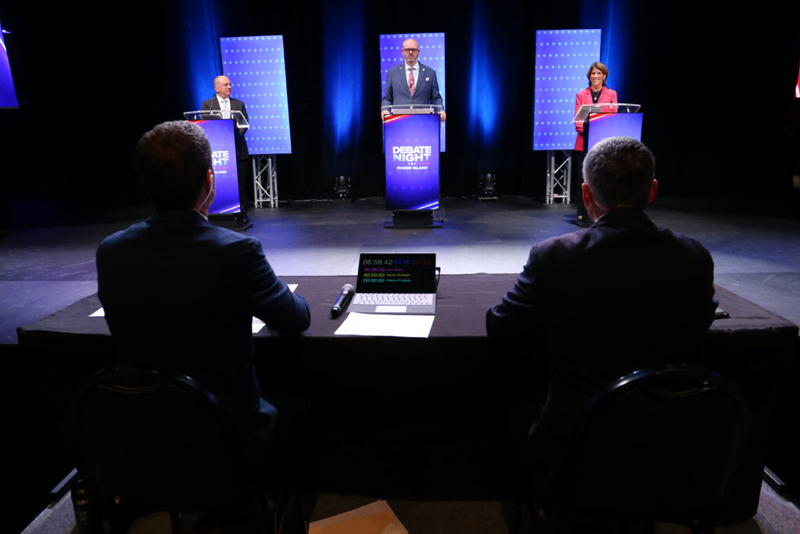
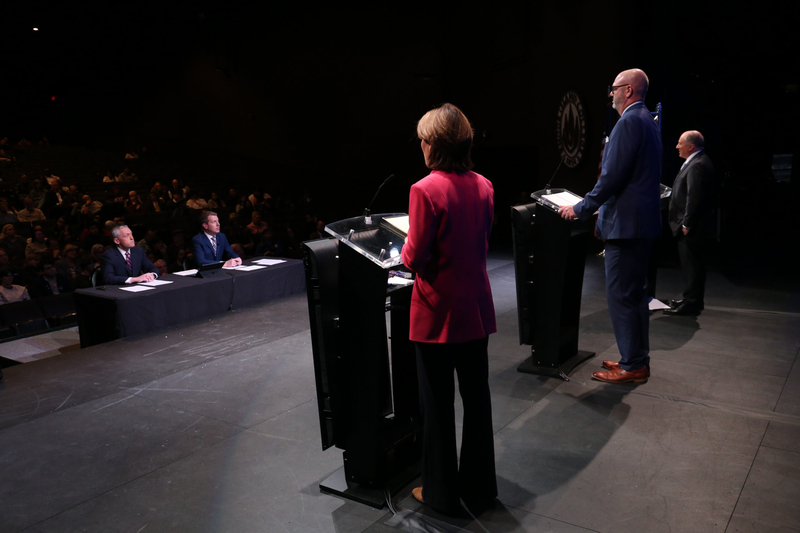
WPRI's Tim White, left, and Ted Nesi, right, seen from behind, moderate the last gubernatorial debate before the Nov. 3 general election on Tuesday night, Oct. 20, 2026, at Rhode Island College. The three gubernatorial candidates on stage from left to right are independent Ken Block, Republican Aaron Guckian and Democrat Helena Buonanno Foulkes. (Photo by Corey Welch/WPRI 12)
The Washington Bridge got only a fleeting mention during Rhode Island’s final gubernatorial debate Tuesday, eclipsed by fresh controversies over tax returns, public polling and federal lawsuits.
But familiar tensions carried through the hourlong event at Rhode Island College, hosted by WPRI-TV 12, as candidates bickered over who was best suited to lead the state.
The latest public poll, released by The Pell Center at Salve Regina University on Tuesday morning, shows Democrat Helena Buonanno Foulkes with an 11-point lead over independent Ken Block, with Republican Aaron Guckian a distant third.
Guckian, who has just $7,000 in his campaign finance account, has faced pressure to drop out, including from his GOP primary opponent, Elaine Pelino, who is urging her supporters to vote for Block.
Guckian vehemently rejected a question from debate moderators that his presence in the race was “helping Helena Foulkes win.”
“That question leads the voters and the public down a road I don’t respect,” Guckian, 50, of East Greenwich, said.
He noted his 17% support among likely voters, per the Pell Center poll, was similar to pre-election support for 2010 Republican candidate John Robataille, who narrowly lost to independent Lincoln Chafee.
Guckian turned the tables on Block, calling him a spoiler multiple times throughout the debate, including when he pointed out that Block brought typed notes to the podium. Candidates were told in advance they could not bring notes.
Block put his papers away after being singled out. But he did not give up other battles so easily, including his insistence that his tax returns were not for public view.
Foulkes repeated her calls for Block to release his 2025 tax information Monday, citing a Rhode Island Current profile piece in which Block refused to share the documents. Foulkes’ campaign shared summary documents from her tax filings with media outlets, including Rhode Island Current, on Monday. Foulkes and her husband reported nearly $3 million in taxable income, before deductions, paying more than $176,000 in state taxes and nearly $713,000 in federal taxes.
“It’s fair for the people of Rhode Island to know what is the financial status of these two men who are running for this office,” Foulkes, 62, of Providence, said of her opponents.
Guckian has also not released his tax returns, but promised to do so, having just submitted his filings by the Oct. 15 extension deadline.
Block maintained his stance to not share his tax returns. As a small business owner with multiple pass-through organizations reflected on his personal income statements, Block said sharing the documents could help his business competitors.
“I’ve been plenty transparent,” Block, 61, of Barrington, said when pressed by moderator Ted Nesi why he could not share even top-line summaries of his tax flings without exposing proprietary business information.
It’s fair for the people of Rhode Island to know what is the financial status of these two men who are running for this office.
Foulkes also faced questions about transparency after a $315 million settlement reached last week between the Department of Justice and her former employer, CVS Health. She served as president of CVS Pharmacy for part of the time covered by a 2024 lawsuit alleging the pharmaceutical giant filled unnecessary prescriptions for opioids. Under the settlement, CVS did not admit any wrongdoing.
Foulkes did not answer directly when asked if she agreed with that statement by CVS. Instead, she reiterated her campaign’s refrain about efforts to cut off pill mill doctors and other drug abatement measures.
“Of course, there’s always more you want to do,” she said. “At the same time that we were cutting off doctors, we were being sued by doctors. We were also being sued by patient advocate groups that we weren’t filling enough of those prescriptions. So it was complicated.”
Gov. Dan McKee hammered Foulkes over her ties to CVS and the opioid crisis during the Democratic primary.
But Block and Guckian have criticized the Democratic nominee more on policy and ideology than her resume.
Guckian called Foulkes’ housing plan “a con job,” blasting her proposal to use the state millionaire’s tax to set up a low-interest loan program to incentivize developers to build affordable units. Foulkes says the proposal will create 20,000 new homes by 2034.
Yet Guckian and Block both evaded questions about how many new housing units their own housing proposals would generate. Guckian said his proposed “veterans village,” a veteran-specific affordable housing community located near Quonset, would grow like a crescendo, from 5,000 to 10,000 then 15,000 units.
Block offered a range of 10,000 to 30,000 while emphasizing the importance of streamlining permitting and regulation for developers, with buy-in from municipalities.
“Difficult problems often require a lot of prep work before you can actually bring forward an answer that’s going to work,” he said. “There’s a lot of ‘ready, aim, fire,’ I’m hearing over there. But what we really need to do is take our time, lay the groundwork, and we’ll have a much more successful outcome.”
Squabbles over housing plan details, as well as energy and education policies, have surfaced in previous debates.
I’ve been plenty transparent.
But the final debate offered new insight on other key issues, including the controversial 2011 pension reforms led by then-General Treasurer Gina Raimondo. Retired state workers and teachers have denounced the pension cuts, routinely pressing lawmakers to restore the cost-of-living increases that were frozen to shore up the state’s pension system.
Granting that wish comes at a major cost for the state, and it risks some of the progress made toward reducing the unfunded pension liability, according to a 2024 analysis by a panel overseen by the general treasurer’s office.
Block said he would restore cost-of-living increases for those who retired before 2012, and have diminished ability to replace lost pension benefits. He proposed using excess earnings from pension fund investments, not state tax revenue, to fund the COLA benefits.
Foulkes also expressed empathy for the retirees on fixed incomes, grappling with rising costs, but said she could not commit to any pension changes without a better understanding of the financial implications.
“I’m not going to do what politicians too often do, which is stand up here and make a promise I can’t commit to,” she said.
Guckian, who has pledged to cut 10% from the state’s $15.2 billion budget, maintained that savings pulled from government efficiency and incentive measures could be used to help retirees.
“If I don’t do it, I won’t run again in four years,” Guckian said of his proposed cost-savings measures.
Yet Block, whose software engineering firm helps state governments and private governments reduce unnecessary spending, dubbed Guckian’s pledge to cut $1.5 billion in state spending a “fantasy.”
The pair relayed contradictory accounts of a phone call between them in January. Block said Guckian called to ask for his support and advice in how to save money in the state budget. Guckian said he called Block only to ask if he was going to run, at which point Block said it was unlikely because of his business.
“He quit on moderates, he quit on Republicans, and he’s going to quit on you,” Guckian said, alluding to Block’s two prior runs for governor under two different parties.
Block’s response: “I’ll let the voters figure out which one of us is more believable here.”
He quit on moderates, he quit on Republicans, and he’s going to quit on you.
What the candidates did agree on
There were brief moments of agreement among the three.
Each answered yes when asked if the state should reexamine its sports betting laws, given the potentially harmful and addictive implications, especially for young people.
They shared openness to demolishing the “Superman” building in downtown Providence if the redevelopment plan to turn the vacant office building into apartments does not come to fruition. All supported holding back third-grade students who aren’t proficient in reading, based on a model started in Mississippi.
Each enthusiastically supported subjecting magistrate judges to the same independent, merit-based review by the Judicial Nominating Commission already used for Superior and Supreme Court judges. And none wanted to give law enforcement agencies free rein to use of Flock cameras, though they differed in how much regulation is necessary for automated license-plate readers.
Block and Foulkes both supported a line-item veto, which would empower the executive branch to influence specific items in the state budget, while Guckian said he did not think the effort would be successful.
Block and Guckian both expressed support — Block’s more reserved – for a natural gas pipeline expansion project that would widen pipelines in Massachusetts and Rhode Island. Foulkes was opposed, emphasizing the importance of renewable energy sources instead.
Asked who they would support in the lieutenant governor’s race, Foulkes backed Democrat Lt. Gov. Sabina Matos while Guckian named Republican challenger John Loughlin.
Block refused to answer.
Early voting runs through Nov. 2, ahead of the Nov. 3 general election.
Providence, RI