Nebraska’s Lancaster County senators address brain drain, higher education in town hall
Dec 19, 2023 | 1:50 am ET
Description
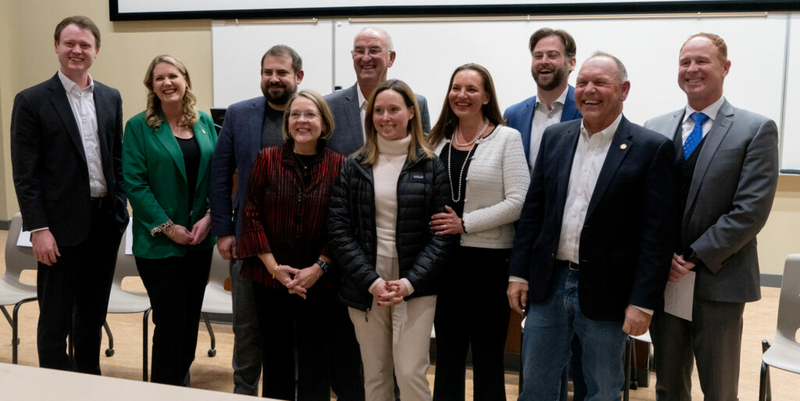
Nine of the 10 Lincoln and Lancaster County state lawmakers joined for a town hall at Union College on Monday, Dec. 18, 2023, in Lincoln. (Zach Wendling/Nebraska Examiner)
LINCOLN — Weeks before Nebraska’s 2024 legislative session begins, many in the state’s second-largest county delegation want to work together and set a different tone in the new year.
Nine of the 10 lawmakers representing Lancaster County joined together Monday night at Union College for a town hall previewing the upcoming session. Nearly every state senator’s district includes part of the capital city.
The delegation comprises State Sens. Beau Ballard, Carolyn Bosn, Eliot Bostar, Tom Brandt, Rob Clements, Danielle Conrad, Myron Dorn, George Dungan, Jane Raybould and Anna Wishart. Seven reside in Lincoln; Brandt is from Plymouth, Dorn is from Adams and Clements is from Elmwood. Clements was the lone absence Monday.
Brain drain and workforce
Many in the delegation said the state must work on workforce development and address persistent and worsening brain drain.
Solutions will be multi-faceted and nuanced, Dungan said, with one solution to move past culture war issues.
“Nebraska, I think, for the better part of the last many decades, has been sort of a bastion of reasonableness amongst a lot of this ire that we’ve seen in a lot of other states,” Dungan told a crowd of a few dozen. “We’ve sort of been divorced from a lot of these other debates that we’ve seen because people have focused on issues that I think matter to most Nebraskans.”
Dorn said solutions will not be a “quick fix,” as the Legislature has been working for years to address the issues “a small step at a time.”
Brandt said workers who are interested in Nebraska need housing. He said there is a divide not just between Nebraska and other states but within the Cornhusker State.
“Everybody focuses on this imaginary line between Nebraska and our other states — it’s internal to the state of Nebraska,” Brandt said.
He said starting salaries for police officers or teachers in his district are lower than in neighboring Lincoln.
Post-secondary education
Bosn said there is also a need for reciprocal licensing. She said that when some families move to Nebraska, someone may be licensed in teaching, law enforcement or hair care in another state but must go back to school before being licensed here.
“I don’t know that they cut hair differently here than they do in Iowa, but I can’t imagine they do it that differently,” Bosn said. “I don’t think that’s a good use of our time or our money.”
There has also been an emphasis on four-year college degrees, Bosn said, and trades have been minimized. This leaves some individuals, she added, feeling like “second-rate citizens.”
Wishart said she is working on legislation for tuition assistance for the trades.
As Wishart heads into her final legislative session, she said she hopes the Legislature will adequately fund post-secondary education.
Conrad, who represents the University of Nebraska’s flagship campus, said the state must invest in higher education, including NU and the state college system, which together are a “generational point of pride” and address many of the senators’ identified challenges.
If the state does not, Conrad said, the burden is passed on as a “hidden tax” to families. She said this happened in 2023 despite a period of “unprecedented economic prosperity.”
“Nebraska needs to right this wrong rather quickly, in my opinion,” Conrad said. “We kicked the can down the road, and we balanced our budget on the backs of the moms and dads who are writing those tuition checks or forced our students to take out higher student loans.”
‘Right the ship’
Ballard said the delegates “punch above” their weight class and are always looking at how to grow Lincoln and surrounding communities in a “fiscally responsible but also progressive way.”
“How we grow Lincoln, grow Lancaster County is something that the delegation takes great pride in,” Ballard said.
Bostar, whose district includes Union College, organized the town hall and said legislative accomplishments must be done as a team because the amount of things that can be done alone is “absolutely zero.”
Bosn said each senator in the Lancaster delegation adds to the team. As an example, she said she could work with Dungan, combining their backgrounds as a former prosecutor and a public defender, respectively.
It’s teamwork, Dungan said, that brings optimism not to repeat some of the frustrations that plagued the 2023 session.
“My staff makes fun of me sometimes for being an optimist, but my optimism comes through, yet again,” Dungan said. “I really do think this next session we have a chance to really right the ship and get back to what is, I think, business as usual.”
2024 priorities
Monday’s town hall was moderated by Jason Ball, president and CEO of the Lincoln Chamber of Commerce. As part of the event, senators previewed what they plan to work on in 2024. Lawmakers will return to the Nebraska State Capitol for a 60-day session beginning Jan. 3.
Here is a breakdown of each senator’s priorities or continued focuses for the 2024 session they identified Monday.
Click on a photo and use the arrow keys on your screen or your keyboard to scroll through the gallery.
- State Sen. Beau Ballard of Lincoln — Ballard said he will work to “keep the ball rolling” when it comes to the East Beltway, such as appropriations to work on environmental and feasibility studies. He said he will also work on water infrastructure for his communities in northwestern Lancaster County and look to further provide property tax relief. (Zach Wendling/Nebraska Examiner)
- State Sen. Carolyn Bosn of Lincoln — Bosn said she will continue work in public safety and toured nearly every correctional facility in the state since the Legislature adjourned in June. One of her focuses will be on educating those in Nebraska corrections for safe reentry and to reduce recidivism. (Zach Wendling/Nebraska Examiner)
- State Sen. Eliot Bostar of Lincoln — Bostar said he will continue to work at the intersection of insurance and health care, such as improving accessibility and affordability of cancer screening, improving child care and investing in primary care. He said he will also continue to work on Lincoln’s water concerns and economic development, including the planned convention center. (Zach Wendling/Nebraska Examiner)
- State Sen. Tom Brandt of Plymouth — Brandt said he will continue work on his 2023 priority bill around dark fiber (Legislative Bill 61), which would release some of the “handcuffs” put on public power districts in the realm of retail broadband. (Zach Wendling/Nebraska Examiner)
- State Sen. Danielle Conrad of Lincoln — Conrad said she will work to address equity in the state’s tax codes, not just for the wealthiest, and will seek to expand government transparency when it comes to taxpayer dollars and oversight. She also pointed to the ongoing legislative-executive branch battle over state inspectors general of corrections and child welfare. (Zach Wendling/Nebraska Examiner)
- State Sen. Myron Dorn of Adams — Dorn said that next year he’ll continue work on the state budget and that part of the Appropriations Committee’s goal is to ensure American Rescue Plan Act dollars are spent before the end of 2026, as required under law. (Zach Wendling/Nebraska Examiner)
- State Sen. George Dungan of Lincoln — Dungan said he is looking at 2024 as a way to return to the “norm” and is seeking to increase prenatal assistance. He said he is also working to permanently increase salaries for the state’s court interpreters. (Zach Wendling/Nebraska Examiner)
- State Sen. Jane Raybould of Lincoln — Raybould said she will look to fill the “awfully big shoes” of her predecessor, State Sen. Patty Pansing Brooks, in supporting the tribes of Nebraska. Raybould said she will also be assisting with water concerns, workforce affordable housing and child care. (Zach Wendling/Nebraska Examiner)
- State Sen. Anna Wishart of Lincoln — Wishart, the only Lincoln lawmaker to be term-limited next year, said she will bring back a bill for a pilot program for intergenerational care facilities. These would bring together seniors and young children under one roof and address child care and long-term care needs. (Zach Wendling/Nebraska Examiner)
Lincoln, NE