Mountain strong: North Carolina marks the 2-year anniversary of Hurricane Helene
Sep 25, 2026 | 6:00 am ET
Description
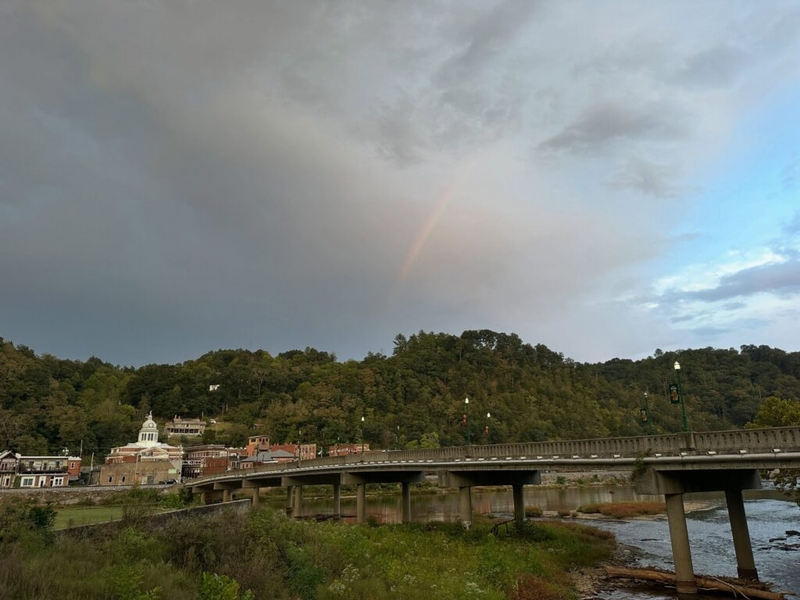
A rainbow shines above downtown Marshall on September 18, 2026, a week before the town marks the two-year anniversary of Hurricane Helene. (Photo: Courtesy of Sky Walsh)
Before there was Helene, there was Katrina.
The destructive Category 5 hurricane that devastated New Orleans in 2005 convinced Alex Webber to move from Louisiana to the mountains of western North Carolina.
Webber thought she’d found a climate-safe area in the picturesque town of Marshall until 2024, when Hurricane Helene brought catastrophic flooding and landslides to her backyard.
This weekend marks the two-year anniversary of Helene, and Webber brushed away tears as she recounted 24 months of trying to rebuild the life she had before the storm arrived.
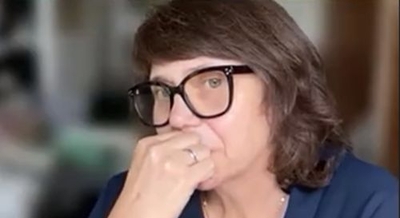
“Our business was completely gone,” said Webber. “At home, our driveway was destroyed and that was $7,000 to rebuild.”
Webber said claims made to FEMA and her insurance company were turned down.
“We came back through Go Fund Me,” Webber said in a call with reporters organized by the nonprofit Extreme Weather Survivors. “It was almost easier in Katrina.”
Fellow Marshall resident Gina Heath says she’s grateful for the parts of town that have made a comeback. But it’s hard not to think about the loss. Twenty-five of the 27 homes on her street were lost to Helene.
“After the hurricane hit in late September, most of us were not able to do income-generating work,” said Heath. “For me, I was juggling, supporting, getting my kids through a very uncertain time, creating normalcy however I could.”
Heath said she thought FEMA would have a bigger presence on the ground in helping her community recover.
“Eventually, secular and religious nonprofits came and helped people to rebuild. We never got anything significant from FEMA,” said Heath.
Two years later, Heath said two-thirds of Marshall is thriving. Even though many municipal buildings, including Marshall’s century-old courthouse, remain untouched, she said she feels fortunate.
“Not every town in Western Carolina has that same story at this point,” said Heath.
Chronicling a slow recovery
Extreme Weather Survivors, a national network of individuals and families impacted by climate-fueled disasters, surveyed 300 North Carolina adults directly affected by Hurricane Helene.
What they found was that 1 in 4 still have not returned home, even though they plan to. Seventy-one percent personally know someone who is still struggling financially, nearly two years later. And 60% said they felt abandoned by the government during and after Hurricane Helene.
Webber said the one exception was Gov. Josh Stein.
“Our state governor has been coming in very quietly. He just comes in with his wife and checks on downtown,” said Webber. “He’s been seen around town multiple times. They’ll come for the weekend, no cameras.”
Stein has made numerous trips to the mountains in the months after Helene, while back in Raleigh the Governor’s Recovery Office for Western North Carolina (GROW NC) is facilitating a collaboration across state agencies to support the recovery, while also managing federal and state reporting requirements.
Matt Calabria, director of GROW NC, is in charge of answering to frustrated state legislators who want to know why the program is not moving faster, while trying to get as much money as possible from the federal government, which has been slow to respond.
Calabria told NC Newsline this week the state has reopened more than 99% of roads closed or affected by Hurricane Helene. More than 1,250 homes have been repaired or rebuilt through Renew NC and with volunteer partners. And recently, the state announced funding for 828 new affordable housing units for the region.
Calabria is aware some survivors are tired of waiting and feel the process is slow and cumbersome. He doesn’t disagree. Instead, he uses the feedback to sharpen his funding requests to the N.C. General Assembly and to Congress.
“Hearing from folks is never unwelcome, and it’s never a distraction from the job. It is the job,” Calabria said.
‘In the thick of it’
On Friday, Stein and the recovery office will be in Mars Hill to unveil the Western North Carolina Economic Recovery Plan, a long-term framework to rebuild and grow the region’s economy. It’s intended to build on work already underway by counties, chambers and small businesses.
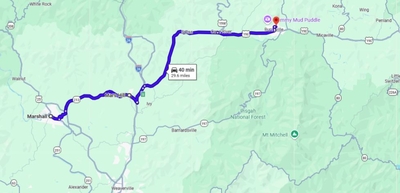
Sixty miles away in Green Mountain, Leo Sharp and Tessa Reed Sharp will spend the day continuing to rebuild their century-old homestead that was heavily damaged by Helene’s floodwaters.
The couple moved to Mitchell County in 2022, hoping to renovate their home and create a small business selling tea, eggs and honey from their beehives. Helene washed away the chicken coops, toppled the hives, and left them with an early estimate of $120,000 in damages.
As construction continues indoors, the couple is dividing their time between the living room and a tent pitched on wooden scaffolding across their property.
“It’s kind of become like our little staycation,” said Tessa Sharp with a smile.
Rebuilding a century-old homestead after a once-in-a-century storm
The couple was working this year to replace some kitchen cabinets and flooring, when they discovered supports underneath the house had been washed out by the floodwaters. They didn’t catch that before, adding to the list of things that would need to be addressed.
“There’s a lot of blessings in disguise with progress,” Leo Sharp said. “A couple steps back, couple steps forward, but all in all everything, every step that we take forward is a good source of hope.”
The rebuild has taken longer than they expected, but Tessa Sharp finds comfort in their tight-knit community.
“Knowing that we’re not in the thick of it solo, that really helps,” she said.
The Sharps, like many others, are not waiting for government funding for their recovery. The two have opened an online store to sell their artwork to bring in additional revenue for rebuilding the homestead.

“Vantage” is a piece Leo Sharp created to remind the couple to remain vigilant. It features a heron soaring above the mountains of western North Carolina.
“From up high, everything else seems so small,” he said.
‘We start working’
The couple credits Stephanie Johnson with helping the region slowly recover.
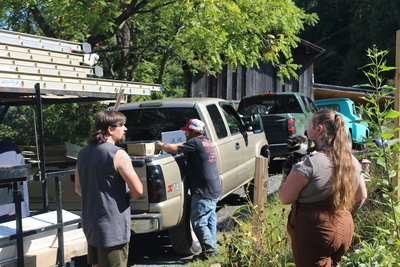
Two years ago, Johnson was just planning to set up a short-term aid distribution site in the local Roses parking lot. But the need in Yancey County was tremendous. The rural county had 7,000 structures damaged or destroyed, including 1,500 homes. People were desperate for building materials to start fixing their houses.
“I was very much like, ‘Oh God, now you want me to get into building materials?'” Johnson recalled.
The next day, unsolicited, a trailer arrived with 100 front doors to donate.
“They were beautiful doors,” said Johnson. “That was very much a clear answer to me that yes, God intended me to end up organizing building supplies.”
She founded the nonprofit Rebuilding Hollers Foundation, and began by asking on social media for tools, shingles, sheetrock and lumber. With each ask, the donations slowly started to arrive.
With a background in commercial contracting, banking and real estate, Johnson and others developed Rebuilding Hollers into a fully operational community-based nonprofit. The group received over 593 requests for help.
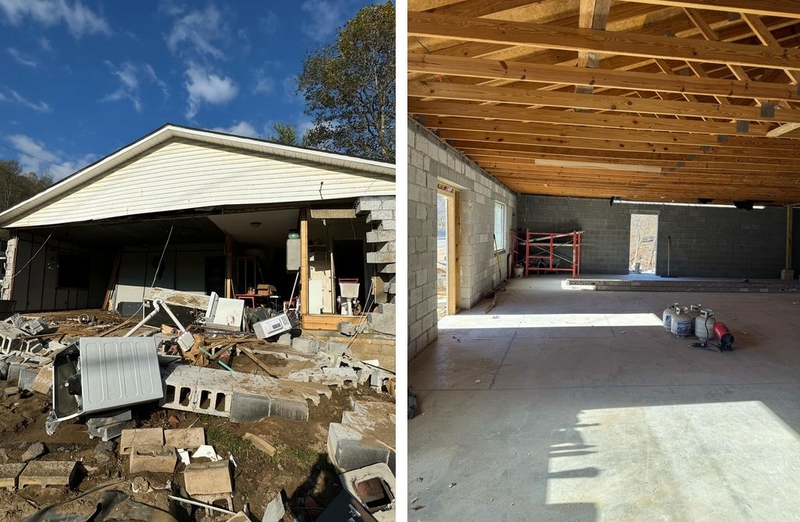
“We have met the needs of 301 of those projects. We still have 292 projects that need help,” said Johnson.
They keep the application process simple.
“Do you live in Yancey or Mitchell counties? Were you affected by the storm? Then we go see the property,” Johnson explained. “We come up with a plan. We start working.”
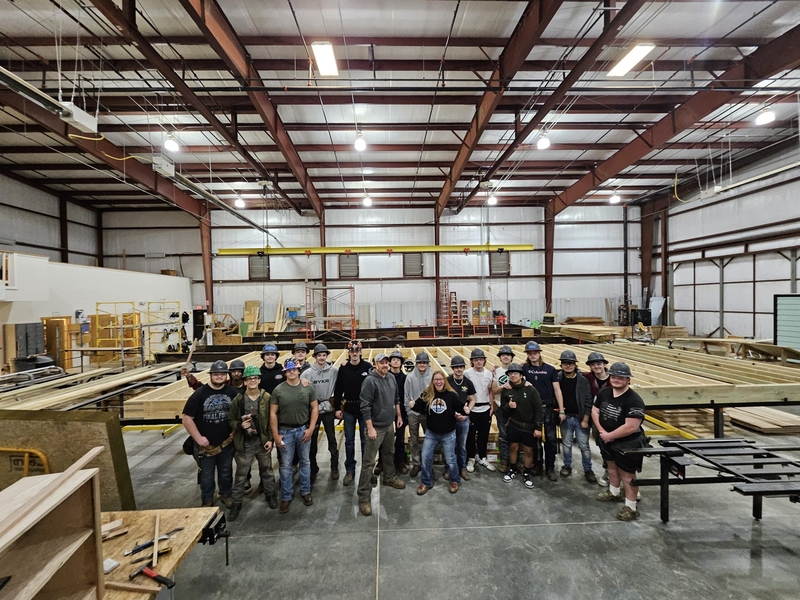
A partnership with the carpentry program at Mountain Heritage High School, also made possible through donations, is helping with the rebuilding process..
“We get the site ready and prepped up. The school builds the subfloor, the framing, and then a home delivery truck moves it to the site,” said Johnson.
Local contractors then finish out the house.
Rebuilding Hollers has recently opened a storefront where storm survivors can shop for free to replace household goods like light fixtures and linens.
An online store and an October fundraiser provide a steady stream of income to keep the nonprofit moving forward. On Friday, Rebuilding Hollers will be accepting donations at a community concert and voter registration drive in Burnsville, NC sponsored by Extreme Weather Survivors. The national group is hoping to engage voters on the issue of climate change.
Heading into year three of the recovery, Johnson said she has 25 neighbors still living in campers, waiting on her group to help.
“We stick together as a rural mountain community,” said Johnson. “It’s really pure faith and absolute determination that this storm will not define our community.”
Raleigh, NC