More people accessing abortion in Montana as economic barriers increase
Dec 26, 2025 | 7:15 pm ET
Description
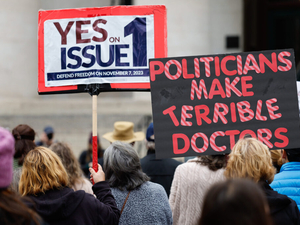
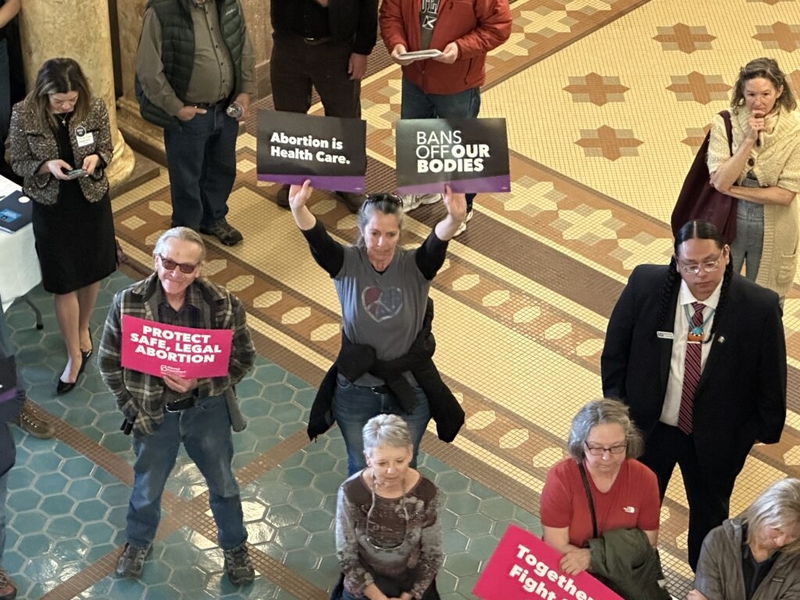
Montanans calling on the government to protect abortion in state law and stop other bills they say are targeted at people's individual health care rights rallied at the state Capitol in Helena on Friday, April 7, 2023. (Photo by Blair Miller, Daily Montanan)
After the landmark Dobbs decision, where the U.S. Supreme Court sent the topic of abortion back to individual states, conservative politicians predicted a renaissance of restrictions that would essentially curtail the practice — at least in Republican-led states.
But the latest annual “#We Count” report, which tracks abortion statistics at the state and national level, reveals the opposite: The number of abortions since Dobbs and after a raft of state-level restrictions seems to indicate the policies have been either ineffective or backfired.
From January to June 2025, when the latest data was available, there were 591,770 abortions provided nationwide, said the report, produced by The Society of Family Planning.
Montana leaders in reproductive rights said they weren’t surprised the numbers didn’t skyrocket as the Treasure State became a sort of oasis, surrounded by other politically conservative states that have continued to restrict the practice.
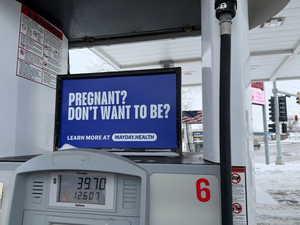
Instead, the biggest change is how the overall economy continues shape healthcare, and by extension, abortion and reproductive care. For example, more women nationwide and in Montana are accessing abortion via telehealth — a growing trend.
At the same time, more women in the state and beyond are having more economic struggles obtaining healthcare, even as the number of providers hasn’t changed as dramatically in Montana as it has in other states.
Telehealth changes impact abortion care
In Montana, like many states, the number of abortions performed rose slightly — jumping from a rolling average of around 200 to slightly higher than 210 per month.
Montana has kept the procedure legal and available for decades, tracing its protection to a 1999 Montana Supreme Court case, Armstrong vs. State of Montana. In 2024, voters enshrined the right to access abortion in the state Constitution up to the point of fetal viability outside the womb, generally pegged at 21 weeks. Providers in Montana say the surgical option — the only one available — after that point isn’t offered in state, and is rarely used anyway.
Montana continues to be a destination for those who need in-person abortion care. And traveling a long distance, either in state or out of state, remains the same. What has changed is access to telehealth, which made significant strides during the COVID-19 pandemic.
In Montana, the number of patients accessing telehealth abortions averaged around 45 before Dobbs; today, that number is above 50 per month. Meanwhile, in-person visits are slowly getting less frequent.
Before Dobbs, nearly 95% of visits for people seeking abortion were in-person. Today, that number has fallen to 73%. Montana’s average mirrors the national trend: Twenty-six percent of abortions in the state utilize telehealth.
In Montana, the total number of abortions hit 250 in January 2025, but then receded slightly to 210 a month.
South Dakota and Idaho have banned the procedure, but residents use shield laws to protect their medical information and mail-access to prescriptions. Those two states report that 100% of any abortion was prescribed via telehealth or obtained by travel.
According to #WeCount, shield laws provide protections to medical providers so they can mail medications to people in states with abortion restrictions.
“It’s not stopping it. It’s just making it more challenging,” said Erin Case, the executive director of Montana Abortion Access Program. Her organization helps support providers and patients for abortion and reproductive health.
That challenge boils down to economics — less money for healthcare, less money for raising children and less money for travel.
Weighing financial considerations
For example, MAAP said that more people are asking for help, often related to travel and lodging expenses. Others need childcare help, which has also grown more expensive.
They’re also noticing a different trend: Many of the women who are seeking reproductive care already have children, and many doubt their ability to financially care for more.
“This isn’t just about a family, it’s about finances,” Case said. “Some people just can’t add a child because of the barriers.”
MAAP said that it has seen a massive increase in demand for financial assistance. For example, in 2025, Case said the organization has pledged more support and spent more than it has in its previous 12 years.
“Luckily, we have a very supportive community in Montana, but we’re also dealing with a very challenging economy,” Case said.
MAAP board chairwoman Aileen Gleizer agrees.
“The need continues to outpace the funding,” Gleizer said. “Yes, our funding has increased, but the number of applicants has, too.”
MAAP has even noticed that financial assistance for abortion often becomes more pressing during the winter months, when reliable transportation, clear roads and added expenses, like the holidays, become factors.
“This highlights that abortion is about healthcare, but it’s also about access — it’s getting harder and more expensive,” Gleizer said.
Case and Gleizerworry that with spiking healthcare costs, including no government support for premiums, that demand and access will only continue to worsen.
Case said that the average amount that MAAP provided in February 2024 per requestor was $354. Today, that number has risen by more than 10% to $384 — and that’s just an average. Gleizer said the organization has helped out some with as much as $2,000. In 2025, MAAP pledged $267,334, which supported 686 clients, a 43% increase more than 2024.
Telehealth, mifepristone are the next battlefronts
Martha Fuller, the chief executive officer for Planned Parenthood Montana, said the overall numbers have increased slightly, but her organization wasn’t really preparing for a huge increase. That’s because abortion in neighboring states has been somewhat restricted, while Montana’s laws were more permissive.
That didn’t change, she said.
“We’ve seen a slight shift of where patients come from, but we have not seen huge increases, and I don’t think we were expecting it,” Fuller said. “Access was still difficult and roads were still long before Dobbs. Because Montana has played this role (for awhile), so we have not seen a huge shift.”
She said she’s aware of a few more people traveling from much greater distances, like Texas, but Montana is often not the closest stop either.
Medication used for abortion and telehealth is only used through 11 weeks of pregnancy.
Instead, she sees the next battlefront on the abortion subject coming in the form of a resurgent effort to ban the medication mifepristone as a way to halt the procedure, especially with the growth of telehealth. Just recently, members of the Trump administration have been under increasing political pressure to re-evaluate the drug’s long track record of safety.
Fuller said that the state’s longtime, historic commitment to individual freedom and privacy has helped continue to ensure access.
“People still have the attitude that it’s none of my business, and you don’t tell me what to do, and I don’t tell you what to do,” Fuller said.
She said the Constitutional Initiative that enshrined the medical practice has also helped politically, even if the demand for the service remains steady.
“Some politicians have said, ‘Maybe we shouldn’t be spending our time doing this,’” Fuller said.
2025 was also the first year that Fuller can remember not having to testify at the Legislature to block legislation.
Fuller said that the #WeCount reporting is as important for what numbers are included as it is for what it cannot calculate.
“What this report cannot tell us fully is the deep economic and racial disparities,” Fuller said. “Look at the map and where there is not access, especially in the (American) South. There are large Black populations and large low-income populations. That’s different if you look at the map and see where there’s better access.
“People who struggled for care continue to struggle for care in places that are rural, poor, and steady employment is difficult.”
Another wrinkle
Since October, Congress and the Trump administration have banned support to the national group Planned Parenthood. Case and Glazier point out that while the measure was meant to target abortions, it ignored the other critical healthcare the organization provides, including cervical cancer screenings as well as testing for sexually transmitted infections.
They’ve already seen an uptick in people requesting help for those other services.
Editor’s note: This story was updated on Dec. 30 to reflect a name misspelling, and to better describe a statistic.
Helena, MT