Missouri AG agrees to let Torch Electronics keep slot machines in veterans, fraternal halls
Nov 16, 2026 | 4:37 pm ET
Description
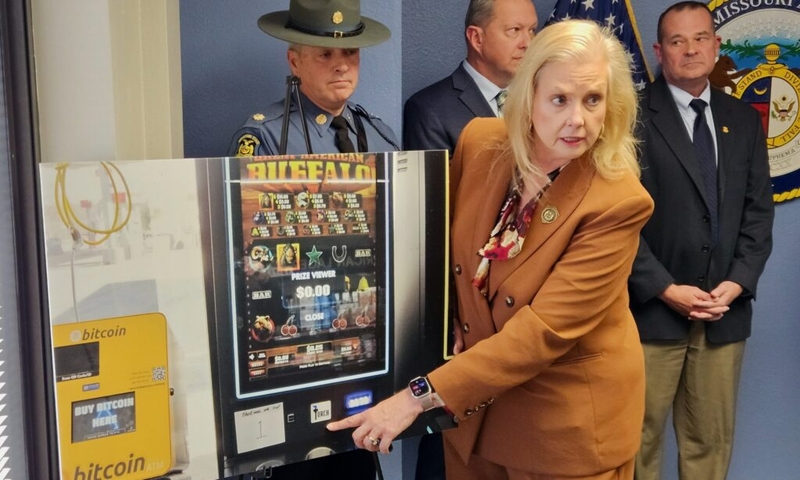
Missouri Attorney General Catherine Hanaway shows the markings on a Torch slot machine Monday, Nov. 16, 2026, during a news conference in Springfield. She was joined by, from left, Major Steven Wilhoit, Lt. Don Jones and Sgt. Jason Trammell of the Missouri State Highway Patrol. (Rudi Keller/MIssouri Independent)
SPRINGFIELD — Torch Electronics will pay the state $13.5 million over two years and keep its illegal slot machines out of for-profit businesses to avoid state prosecution for violating gambling laws, Attorney General Catherine Hanaway said Monday.
But under the agreement, the company can continue operating its machines in veterans halls, fraternal clubs and other qualifying nonprofit locations.
Torch, the largest vendor of the cash-prize games once common in convenience stores and bars, did not admit its games violate state laws against unlicensed games of chance. The company also will be allowed to enroll new nonprofit locations until Jan. 1, 2027, Hanaway said.
“This marks a significant step forward in our efforts to eradicate illegal gaming in Missouri,” Hanaway said. “It’s a big deal. This is a big win for us. It’s a big win for the people of the state.”
Torch declined to comment on the agreement.
Lawsuits challenge Missouri attorney general crackdown on gambling machines
Hanaway announced the agreement in Springfield, where city officials have spent years trying to remove Torch machines and similar games. In October, an appeals court upheld the city’s authority to deny Torch a license to place its games.
The agreement protects Torch and its owner, Steven Miltenberger, as well as employees, vendors, retailers and others from state prosecution for their involvement with Torch as long as they comply with its terms.
Torch agreed to pay $4.5 million this week, plus $4.5 million in each of the following two years. The agreement calls for an additional $6.5 million payment if Torch violates its terms.
The payments are classified as fines for federal tax purposes, meaning Torch cannot deduct them as business expenses. But the company is not admitting to any wrongdoing.
“Based on current and future ongoing litigation risk, Torch is willing to resolve the claims with the state without making an admission of liability,” the non-prosecution agreement states.
Torch began installing its machines in the years before the COVID-19 pandemic. Hanaway has estimated that 25,000 similar machines — not all owned by Torch — were operating in the state before she began an enforcement crackdown late last year.
On Monday, Hanaway said she could not recall how much profit Torch had made during the years its machines operated statewide or how much money the machines handled in March, the last full month before Torch agreed to limited operations.
The $13.5 million settlement was negotiated down from the state’s initial demand of 21% of Torch’s gambling revenue, matching the tax Missouri imposes on casinos’ adjusted gross receipts, Hanaway said. She did not disclose how much the initial demand would have totaled.
“The estimates have been that across all the machines, revenue, gross revenue, might be as much as $1 billion, but the claimed payout and these are some things that we can’t 100% verify,” Hanaway said.
Hanaway pressured Torch to shut down its machines in retail locations in April amid the threat of possible state and federal prosecutions.
The April shutdown did not extend to nonprofit locations such as veterans organizations and fraternal clubs, Hanaway said. The new agreement preserves that exemption, which she described as a matter of prosecutorial discretion.
“We have to use prosecutorial discretion and resources, and we wanted to go after sort of the biggest and the baddest first,” she said. “So Torch was obviously the largest company, but also, it does make a difference that the businesses that had these machines were putting the money in their own pocket, as opposed to the VFW or the Elks Club who are doing something good to support the community.”
The exemption applies only to what Hanaway termed “bona fide” nonprofit organizations. For-profit businesses cannot qualify simply by reorganizing as nonprofits or creating nonprofit affiliates, she said.
The St. Louis Post-Dispatch reported last month that several businesses had restarted their Torch machines after setting up new entities.
Hanaway said Torch insisted on retaining the exemption.
“It’s tough to negotiate an agreement like this,” Hanaway said. “We’ve already had these machines shut down for about six months, and they’re shut down into the future. We want to work towards an agreement, and also the not-for-profits, like they will tell you that they have been relying on these machines.”
Federal judge rules Missouri’s gas station slot machines are illegal gambling devices
Torch machines will remain shut down in retail locations, the agreement states, until the company wins a court decision, upheld on appeal, that its machines do not violate state law or the General Assembly legalizes the games.
The agreement also leaves open another path for Torch’s machines to return to retail locations. If state lawmakers authorize the Missouri Lottery to offer video lottery games, Torch machines could operate during the transition period between passage of the bill and the start of the state-regulated games.
The debate over video lottery drew millions of dollars into this year’s legislative elections. State Rep. Bill Hardwick, one of the most prominent supporters of video lottery legislation, won a state Senate seat, as did one of its vocal opponents, Springfield Democrat Betsy Fogle.
Torch is the largest but not the only vendor of the gambling machines. Hanaway said her office is pressuring other vendors to shut down their games and has begun negotiating with some of them.
“We absolutely are going to be going after those other companies,” Hanaway said. “We’re already in negotiations with some of them.”
Jefferson City, MO