Minnesota Truth Council begins process of documenting impact of federal immigration operations
Aug 26, 2026 | 6:25 pm ET

Description
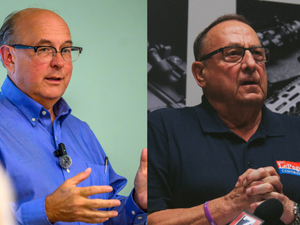
Pedro Dos Santos, a board member of immigrant rights nonprofit Fe y Justicia, describes immigration agents threatening to ram observers with their cars at a meeting of the Minnesota Truth Council on Wednesday, Aug. 26, 2026. (Photo by Madison McVan/Minnesota Reformer)
A truth council assembled by Gov. Tim Walz heard testimony for the first time Wednesday from people who say they were harmed by the thousands of federal immigration agents sent to Minnesota this winter.
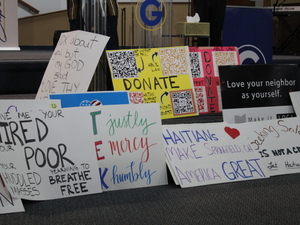
Immigrants and community leaders shared stories, often through tears, about violence and abuse committed against themselves and others during Operation Metro Surge and Operation PARRIS, which targeted recently-arrived refugees in Minnesota for re-verification, leading to arrests and deportations.
Walz established the Minnesota Truth Council via executive order in March. Its mission is to “create a public record of both the harm endured and the generosity and resilience of Minnesotans across the state,” per the executive order.
Truth councils have long been an important step in the reconciliation process in countries that have experienced human rights violations, said Madeline Lohman of the Advocates for Human Rights, which is running the council.
The council is chaired by retired Hennepin County Judge Peter Cahill, who presided over the murder trial of Minneapolis police officer Derek Chauvin, who was convicted in the killing of George Floyd. The council has no law enforcement power and will produce a report on its findings and policy recommendations for the governor, state Legislature and Congressional delegation.
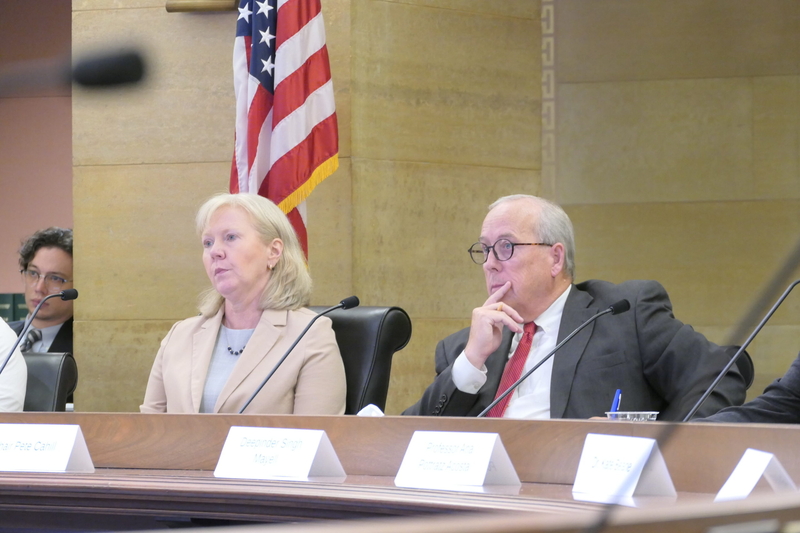
Wednesday’s meeting focused on violations of the U.S. Constitution and the rule of law.
Pedro Dos Santos, a board member of immigrant rights nonprofit Fe y Justicia, described agents posted outside of rural trailer parks, checking the papers of people driving in and out. Christin Crabtree, a Minneapolis parent who is running for a seat on the school board*, recounted the violent arrest in January of a teacher outside of Roosevelt High School and the use of pepper spray on teenagers, hours after an ICE agent killed Renee Good.
Montha Chum, executive director of MN8, a southeast Asian political advocacy group, described an elder who couldn’t chew her food for months because she was scared to go to the dentist for new dentures.
Imam Yusuf Abdulle, executive director of the Islamic Association of North America, described families experiencing extreme hunger as they sheltered at home for fear of ICE. Rachel Dionne-Thunder, CEO of Indigenous Protector Movement, decried the arrests of indigenous people in Minnesota and agents’ treatment of observers, including following her to her own home.
“For the original people of these lands to be targeted by immigration enforcement is a testament and shows the truth that these were only and purely racially profiled stops and detainments,” Dionne-Thunder said.
Attorneys said it was difficult to reach clients in detention. Hanne Sandison, immigration and legal services director for The Advocates for Human Rights, described conditions at the Whipple Federal Building, where many immigrants were temporarily held during Operation Metro Surge. Sandison described broken phones and incorrect phone numbers for legal services.
“No one had any of their paperwork. Everyone I saw was shackled at the ankles, even while in the cell, and even while sleeping,” Sandison said. “The people I saw sleeping were on the floor, shackled and with no bedding.”
The council is still accepting stories from people impacted by the immigration operations. Its next meeting featuring testimony is Sept. 9.
*Correction: This article has been updated to reflect that Crabtree has advanced to the November general school board election.

Saint Paul, MN