Minnesota churches provide critical supports as immigrants hide at home
Feb 12, 2026 | 7:00 am ET
Description
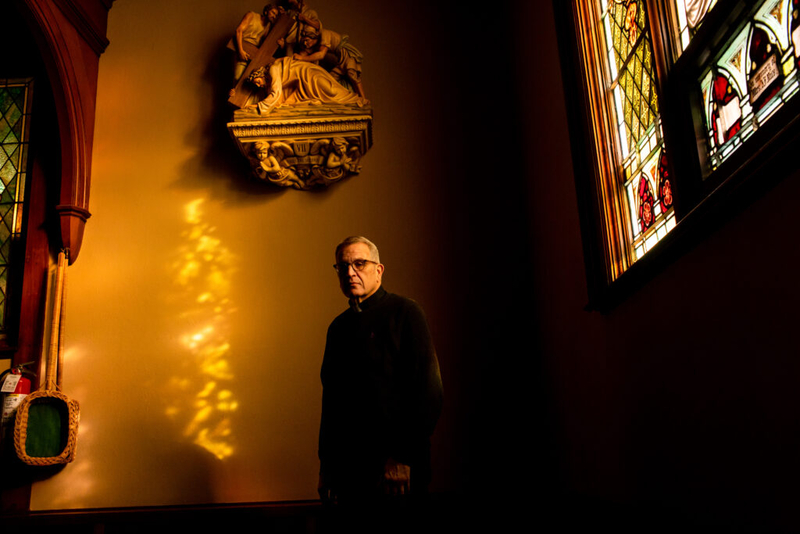
Father Dale Korogi poses for a portrait in Ascension Catholic Church, Wednesday, Feb. 11, 2026. (Photo by Nicole Neri/Minnesota Reformer)
When Father Dale Korogi takes the podium to give the homily to the parishioners of the late morning Mass at Ascension Catholic Church in north Minneapolis, he is used to seeing hundreds of faces watching him — mostly the faces of immigrants from Latin America.
Now, he sees only a few dozen in the pews, as most of the immigrants in his congregation are staying home until the Trump administration withdraws the thousands of immigration agents who have been deployed in Minnesota as part of Operation Metro Surge.
“I’m not an activist by nature,” he told the congregation as he began his homily on Sunday. “I rarely involve myself publicly with rights movements. This time is different. What is happening to our immigrant families, friends, neighbors and children is not another headline or policy debate — an abstract issue. Cruel and dehumanizing trauma is being inflicted upon people I love.”
Then, as he does every week, he repeated himself in Spanish — a language he began learning when he was selected to lead the church in 2015.
Belying Republican claims of “paid protesters,” churches like Korogi’s have become critical nodes in the immigrant defense networks that have sprung up in response to Operation Metro Surge. It’s a natural extension of churches’ spiritual worldview — backed by scripture — that compels believers to help the vulnerable.
Churches also have existing support systems for congregants in need: meal trains for those recovering from surgery, financial assistance for those who lost their jobs or have found themselves in medical debt, spiritual care for the grieving.
Operation Metro Surge has created a new category of people in need: immigrants sheltering at home — many of them with legal status — declining to go to work or send kids to school for fear of ICE.
The families need groceries and rent money and activities for their children, and congregations are stepping up to help.
The work is sensitive; many involved have declined to speak about details publicly out of fear that ICE will follow volunteers to immigrants’ homes.
At a know-your-rights training hosted in January by Monarca, an offshoot of the immigrant rights group Unidos MN, a trainer recommended that people who deliver groceries and donations to at-risk families avoid using their cars to follow or protest ICE.
Iglesia Dios Habla Hoy, a south Minneapolis church, is providing food to thousands of families with the help of a massive stable of volunteers and donors. A form on the Ascension Catholic Church website allows families to request help — rides to and from school, or grocery delivery.
Wayman African Methodist Episcopal Church in north Minneapolis is similarly providing material help to impacted families — and its pastor, Rev. Anthony Galloway, is finding ways to bring comfort and security to immigrants who are overcome with fear.
Last month, Galloway talked to an immigrant woman who is hosting an exchange student and didn’t know what to do to protect the student. Galloway said the woman told him she had a dog that she was too scared to take outside.
He calmed her, and helped her make a plan to find a neighbor who would walk the dog with her. The conversation helped him realize that immigrants’ anxiety was preventing them from being able to make contingency plans.
The church’s music department has hosted some special events meant to calm fears.
“They’re just places to breathe and let music wash away some of the anxiety for a moment,” Galloway said.
As attendees soaked in the music at a recent event, a group of male parishioners stood outside, keeping watch for signs of ICE. They did the same for a yearly mammogram event the church hosts, trying to make sure the church’s women felt safe enough to leave home for a screening.
Like Galloway, Korogi has been receiving many calls and texts from members of his congregation, seeking emotional and spiritual support.
Many of the immigrant members of his congregation have rarely missed Mass and carry extreme guilt about staying home.
“Some just need to keep hearing, ‘You know, these are extraordinary times and extreme times,’” Korogi said. “‘And here it says in church law that if you can’t do it, you can’t do it — you can’t put yourself in danger.’”
There’s one figure in Catholic Church history that Korogi keeps looking to for inspiration: the late Salvadoran Archbishop Óscar Romero, who was canonized in 2018. Romero had been “very churchy and kind of withdrawn” as a leader, Korogi said — until his friend and fellow priest Rutilio Grande was shot and killed by state security forces in the lead-up to the Salvadoran Civil War.
“It just cut him to the heart,” Korogi said. “But he was completely radicalized for the Gospel. People will say that he was fearless, but he was not. He was really afraid, but he did it anyhow. He spoke the truth.”
A right-wing death squad with ties to the Salvadoran military assassinated Romero in 1980.

Saint Paul, MN