Minnesota attorney general is eager to put case against Big Oil in front of a jury
May 11, 2026 | 7:00 am ET
Description
Photo illustration by Getty Images.
The Trump administration’s latest lawsuit against Minnesota aims to short-circuit a six-year effort by Minnesota Attorney General Keith Ellison’s office to hold two fossil-fuel companies and the industry’s top U.S. trade association accountable for what Ellison calls “a campaign of deception” targeting his constituents.
The two-term Democrat told the Reformer he won’t be cowed.
“This case has been pending for six years because the industry has been throwing everything but the kitchen sink at us,” he said. “Ellison won’t quit — never.”
Ellison, who’s standing for a third term in November, filed the initial complaint against ExxonMobil, Koch Industries and the American Petroleum Institute in June 2020. Since then, the parties have repeatedly clashed over the proper venue for the case to be heard, with the defendants arguing for removal to a federal court system that legal experts say would likely be more sympathetic to the fossil fuel industry.
Minnesota has come out ahead in that fight, at least so far. The U.S. Supreme Court declined to take up the defendants’ appeal in early 2024. A subsequent round of wrangling concluded last month when the Minnesota Supreme Court cleared the case to move into pretrial discovery.
The Trump administration filed its suit three weeks later.
The lawsuit defending the fossil fuel industry isn’t a total surprise from an administration with close ties to Big Oil. The Washington Post reported in 2024 that President Trump told a group of oil executives at his private club Mar-a-Lago that if they raised $1 billion for his campaign, he would roll back burdensome environmental regulations.
In a news release announcing the recent suit, the U.S. Department of Justice accused Minnesota of attempting to regulate global greenhouse gas emissions, which it says are “subject to exclusive federal authority,” while undercutting efforts by the federal government and other states “to make energy affordable and reliable.”
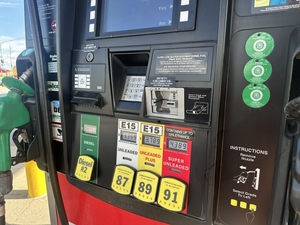
That catchphrase, used regularly in pro-fossil fuel messaging, has taken a hit this year amid a U.S.-Iranian blockade of the oil-rich Persian Gulf that has sent U.S. road fuel prices soaring and caused shortages of diesel, jet fuel and other refined products elsewhere in the world.
The DOJ cited a 2023 concurrence by Eighth Circuit judge David Stras, who President Trump appointed in 2018 and who may hear the administration’s new suit on appeal, that state-led efforts to change fossil-fuel companies’ behavior “on a global scale” are “beyond the limits of state law.”
In that opinion, Stras acknowledged, however, that “as the law stands now,” he had no choice but to deny the companies’ request to remove the case to federal court.
In a brief interview with the Reformer, Ellison called the Trump administration’s intervention “frivolous” and predicted it would fail. The administration was unsuccessful in previous challenges to lawsuits Michigan and Hawaii filed against fossil-fuel companies, he said.
Ellison also pushed back on the notion that Minnesota wants to infringe on the federal government’s ability to “regulate” fossil fuels or refined products. Unlike state and local lawsuits taking fossil-fuel companies to task for causing climate change, he said Minnesota’s suit is about protecting consumers from alleged deception about the pollution caused by burning fossil fuels.
“We’re not saying you can’t sell oil,” Ellison said.
“We’re saying it’s just like tobacco,” he said. “If you say that ‘nine out of 10 doctors smoke Pall Mall’ … you’re lying to people,” he said.
Minnesota’s allegation: oil industry deceived the public
The evidence for deception has arisen from a wide array of sources, including investigative journalism by the Los Angeles Times, for instance, which reported that Exxon researchers were considering the effects of global warming on their business as far back as the 1970s.
Exxon employees were acknowledging global warming and its human causes semi-publicly as far back as 1991, as well.
“Certainly any major (energy) development with a lifespan of say 30-40 years will need to assess the impacts of potential global warming,” said Ken Croasdale, an Exxon ice researcher, at an engineering conference, the Times reported. He also said greenhouse gasses are rising “due to the burning of fossil fuels.”
“Nobody disputes this fact,” he said.
Margaret Barry, a fellow at the Sabin Center for Climate Change Law in New York and expert on state litigation against fossil-fuel companies, said the distinction between seeking to regulate fossil fuels vs. deceptive commercial speech is an important one.
“(Minnesota) may feel like this puts them on a stronger footing against the defense that the companies raise, that federal law preempts” lawsuits attacking the production and sale of fossil fuels, Barry said.
In March, the Maryland Supreme Court dismissed one such suit brought by three local governments, saying their claims involved “regulation of interstate and industrial pollution” covered by federal law.
The U.S. Supreme Court will hear a lawsuit brought by Suncor, a Canadian oil company, against Boulder County, Colorado. If the court rules in the company’s favor, state and local governments would confront a tough obstacle to bringing climate-related claims in state courts, Barry said.
But the briefing record ahead of arguments expected this fall suggests the justices appear uncertain that they have the authority to review state courts’ decisions in these types of cases, Barry said. If they determine they don’t, they’d have an “offramp” to avoid deciding the case on the merits, she added.
Trump administration plays defense for its allies
James Coleman, who teaches energy law at the University of Minnesota Law School, said the Trump administration’s intervention injects some uncertainty into Ellison’s case. Depending on which judges hear Trump’s lawsuit in district court and on its all-but-inevitable appeal to the potentially Trump-friendly Eighth Circuit, Ellison’s state case could be frozen while judges weigh the merits of removing it to federal court, Coleman said.
“This enters us into a world of complex litigation, but it’s a big deal that the Trump administration is filing this claim,” he said. “It’s the federal government saying, ‘Forget that other lawsuit: We’re filing our own lawsuit that needs to be resolved by federal courts.’”
Coleman said Trump’s intervention could delay the discovery process that appeared likely to begin soon in Ellison’s suit. That process would give Ellison’s office tantalizing access to the defendants’ internal records and communications.
Regardless of the outcome of the Trump administration’s suit, Coleman and Barry said it could be years before Ellison’s original case reaches trial.
Ellison said he’s eager for the day.
“I never foreclose the possibility of settlement, but I look forward to getting this in front of a jury … and if (the defendants) are telling the truth, then they should want to get in front of a jury too,” Ellison said.
It’s not clear that they do. Speaking at the American Petroleum Institute’s annual meeting in January, API president and CEO Mike Sommers said “stopping state actions that would block responsible development” of fossil-fuel infrastructure is a top priority for the group in 2026.
“Punitive state proposals and extreme lawsuits would retroactively punish energy producers for meeting consumer demand — driving up costs and discouraging the investment needed to meet rising energy needs,” Sommers said.
Several Republican-controlled states — including Minnesota’s neighbor to the south — have taken matters into their own hands and passed “shield laws” barring lawsuits like Ellison’s.
Meanwhile, API is pushing Congress to pass federal permitting reform legislation that would streamline approvals for oil and gas pipelines, electricity transmission and other energy projects. Negotiations on a compromise bill that would clear the 60-vote filibuster threshold in the Senate stalled earlier this year after key Democrats pulled out, citing the Trump administration’s ongoing obstruction of renewable energy on or near federal lands. With the midterms looming and the administration doubling down on efforts to hold up once-routine approvals for wind energy projects, a deal seems unlikely this year.
Ellison said it’s no secret the Trump administration is closely aligned with the fossil fuel industry.
“They’re basically saying that if you represent a favored industry … they will intervene to stop you from protecting consumers in your state,” he said.

Saint Paul, MN