
Minnesota AG allows Allina Health acquisition by California-based Sutter Health
Nov 16, 2026 | 2:37 pm ET
Description
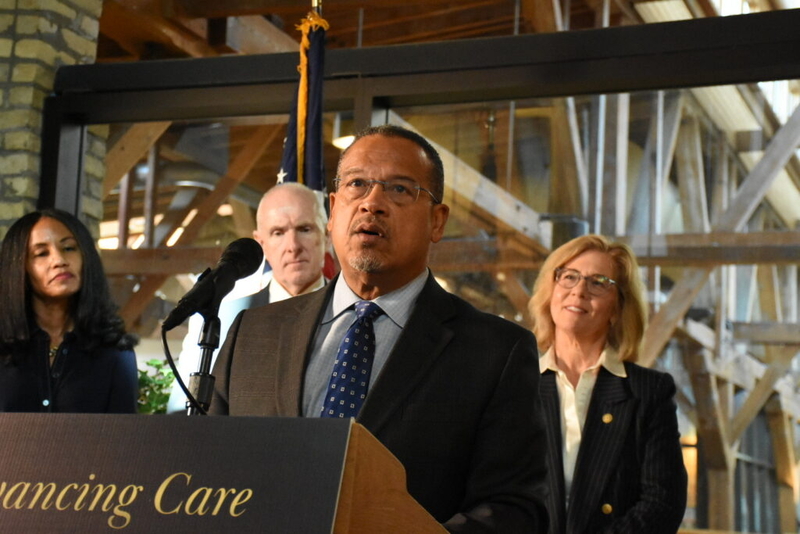
Minnesota Attorney General Keith Ellison speaks at a press conference alongside Sutter Health CEO Warner Thomas and Allina Health CEO Lisa Shannon at Allina's Bandana Square Clinic in St. Paul, Minn., Monday Nov. 16, 2026. (Photo by Alyssa Chen/Minnesota Reformer)
Upper Midwest health giant Allina Health is set to be acquired by Sutter Health, an even larger California system, after the nonprofit health systems signed a 10-year oversight agreement with the Minnesota Attorney General’s Office.
The consolidation, first announced in March, will take place in January. It will create a combined $26 billion system with 39 hospitals serving more than 5 million patients in California, Minnesota and Wisconsin. Under the combined system, Allina will maintain its Minneapolis headquarters and become the Upper Midwest Division of Sutter Health, with Allina CEO Lisa Shannon remaining in leadership of the division. In 2025, Sutter Health had $19.8 billion in revenue, while Allina reported $6 billion in revenue.
The deal reflects a broader trend of healthcare consolidation — hospitals and clinics combining into sprawling health systems. In Minnesota this year, consolidation transactions are being proposed at what Minnesota Assistant Attorney General Erin Conti called a “breakneck pace” during an October state Senate committee hearing.
The Minnesota Attorney General’s Office gave the thumbs up to the acquisition of North Memorial Health by South Dakota-based Sanford Health under another 10-year oversight agreement, and is currently in the process of reviewing a proposed merger between HealthPartners and Essentia, both Minnesota-based health systems.
Substantial evidence has shown that healthcare consolidation has led to higher prices, mainly because larger health systems have more power when negotiating their prices with insurers. Evidence on the effects on quality of care is mixed “at best,” according to a brief from KFF, a health policy research organization.
Sutter, the fourth biggest health system in California by number of staffed patient beds, has previously been accused of driving up costs for Californians through anti-competitive behavior in two lawsuits brought by unions, employers, individuals and California’s attorney general. Sutter denied wrongdoing in the settlements.
The Minnesota Attorney General’s Office was bestowed with expanded regulatory powers over healthcare mergers by the Legislature in 2023. It’s now able to analyze and sue to block hospital mergers if they are against the public’s interest — for example if they increase healthcare costs for patients. The office’s review of the Allina-Sutter deal began in May and has included two community forums, 675 written comments and dozens of third-party witnesses, Attorney General Keith Ellison said at a Monday press conference at Allina Health’s Bandana Square clinic in St. Paul.
“After this thorough review, we have concluded that the integration of Allina and Sutter has met the public interest standard and Minnesota’s healthcare transaction law,” Ellison said.
At the press conference, Shannon said that challenges in the healthcare landscape have led to financial losses for the health system, though Allina officials previously told the Star Tribune that the merger was not a financial rescue.
Allina has had nearly $1 billion in operating losses over the last five years and expects to see a $150 million operating loss for 2026, according to a letter released by the health systems. Changes in federal policy will make the financial challenges more severe, the letter said, echoing repeated warnings from hospitals about healthcare cuts from the federal One Big Beautiful Bill Act.
California health economist: ‘Good luck to Minnesota!’
Sutter became notorious for its anti-competitive business practices in the 2000s and 2010s.
In a 2013 New York Times article, Glenn Melnick, a professor of health economics at the University of Southern California, described Sutter as “a leader — a pioneer — in figuring out how to amass market power to raise prices and decrease competition.”
In October, over a decade later, Melnick explained to the state Senate human services committee how Sutter pioneered “all-or-nothing” contracting with insurers in the early 2000s, through which the health system dominated regions of California and effectively made insurers cover all of Sutter’s clinics and hospitals through their increased bargaining power. Melnick presented his co-authored 2024 study, which found that Sutter’s prices soared 30% after it changed its contracting practices.
Melnick, who said he’s been paying attention to Sutter for over two decades, laughed upon learning the merger will go through.
“Well, good luck to Minnesota!”
“It’s basic, simple economics,” Melnick said in an interview, pointing out Allina Health’s financial challenges. “Somewhere, (Sutter’s) got a financial plan that says it makes sense for us to take over organizations that have financial problems and commit to spending an additional $2.15 billion.”
There’s two explanations, Melnick said: “Either we’re Santa Claus: we want to help the people of Minnesota out, and we’re gonna take from our reserves to help them out. Or, we’ve got in mind a way of pricing services so we can get that money back.”
Melnick warned that hospitals, in general, have learned how to “get control of our healthcare system and generate revenue.”
“If we sit by and let them do it, then they go ahead. We’ve given them permission,” he said.
Melnick said that even health systems joining across state lines, as with Sutter and Allina, have ways to increase their leverage in contract negotiations, since many contracts are negotiated nationally.
After over a decade of litigation in California, Sutter paid settlements of $575 million and $228 million in the two antitrust lawsuits, fractions of what the plaintiffs were estimated to have overpaid — $1.2 billion and $411 million, respectively. The settlements also barred Sutter from some anti-competitive practices in California, including all-or-nothing contracting.
Terms include $2.15 billion investment
In the signed oversight agreement, Sutter agreed to refrain from cutting Allina Health’s core services by more than 10% without explanation to the Attorney General’s Office for five years.
Core services refers to primary care, family medicine and internal medicine; mental health; cardiovascular services; emergency room services; ICU services; and stroke services.
Sutter also committed $2.15 billion to complete Allina’s overhaul of its Abbott Northwestern campus; modernize Allina’s IT systems; and build out an outpatient care network. The $2.15 billion also includes a $150 million investment to bolster rural healthcare.
The agreement, summarized on the attorney general’s website, includes a commitment to maintaining existing labor contracts and Allina’s charity care policies, where people making less than 275% of the federal poverty level get financial assistance; as well as a $50 million investment into workforce training.
The agreement protects some competition in the labor market: It prevents Sutter from enforcing some existing noncompetes for physicians, i.e., physicians can leave Allina to start a private practice as long as they’re in Greater Minnesota and practice a specialty with a local shortage of doctors. Noncompetes were banned in Minnesota in 2023.
No guardrails on price growth
The agreement does not have explicit guardrails to limit price growth, which is the central concern of many health economists when it comes to hospital consolidation.
The attorney general said his office retains full authority to enforce Minnesota’s antitrust laws, which includes a law that forbids health systems from entering into a transaction that substantially lessens competition.
“After many conversations with the California AG, and looking at the differences between Minnesota law and California law, we came to the conclusion that the urgent issues, the important issues, to be in the agreement are in this agreement,” Ellison said.
Conti said that California also has regulatory infrastructure to collect data on pricing that Minnesota lacks.
Regarding anti-competitive contracting, Conti said that an individual contracting practice, such as all-or-nothing contracting, “may not itself be illegal.”
“It’s once you have enough things stacking up to be anti-competitive that it becomes a competition problem, and so it gets enforced under antitrust laws,” she said in an interview.
People can submit complaints to the attorney general’s office, which can investigate possible contracting problems, Conti said.
Lois Quam, a longtime health executive and an advisor to the attorney general, said at the press conference that the agreement will provide lower-cost care options in the form of increased access to ambulatory — i.e., outpatient — care.
Sutter CEO Warner Thomas said Sutter’s services are more expensive than Allina’s because Northern California is more expensive than Minnesota. He waved away the previous lawsuits alleging anti-competitive practices, saying the suits refer to activities that are “almost two decades old,” though the settlement for one covers health insurance premiums paid up to 2021.
As of 2022, Sutter had some of the highest prices in the country for privately insured outpatient services, relative to Medicare prices, according to a RAND study.
Union stamp of approval
A coalition of faith leaders and unions, including those representing Allina doctors and nurses, had advocated for a “community benefits agreement” in the Allina-Sutter transaction that would guarantee protections for workers and patients. The coalition released a statement Monday praising the attorney general and “meaningful wins” in the health systems’ deal.
Jamie Gulley, the president of SEIU Healthcare Minnesota & Iowa, which is part of the community benefits coalition, spoke at the press conference: “Sutter has agreed to address many of our concerns,” he said, listing several terms from the agreement, including labor contract protections and rural healthcare expansion.
Matt Hoffman, an Allina family physician and union organizer with Doctors Council SEIU, explained that the unions didn’t feel the need to include price guardrails in the agreement.
“After working with the attorney general, we think focusing on price controls with one player in the market probably isn’t going to be as effective as looking at things legislatively,” Hoffman said.
The doctors’ union plans to lobby the Legislature to tame price growth in the future, he said.
- 6:28 pmThe story previously misstated the capital investment commitment, which is $2.15 billion.

Saint Paul, MN