With mining, remember: The people who may need the water in 50 years won’t be at the hearing
Oct 31, 2026 | 7:00 am ET
Description
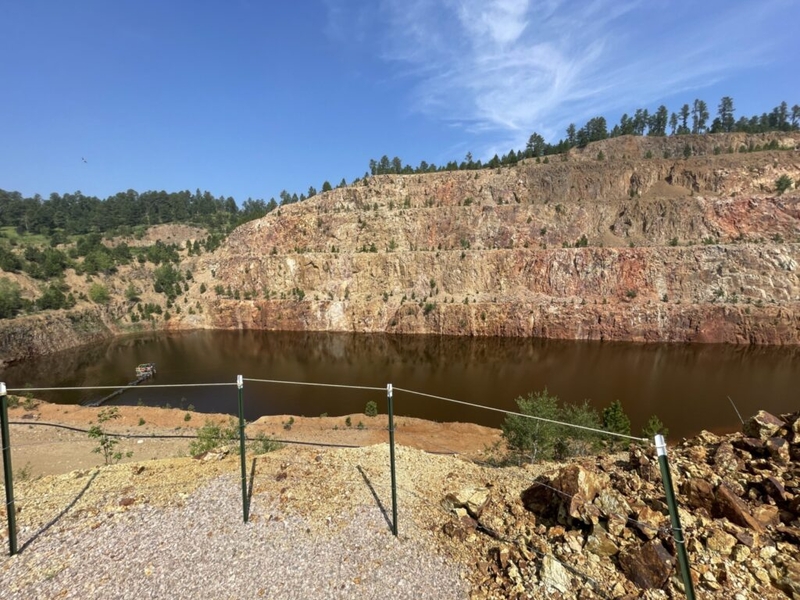
Water polluted by acid rock drainage is stored on July 17, 2023, in the Anchor Hill Pit, to eventually be treated and discharged at the Gilt Edge Mine, an Environmental Protection Agency Superfund cleanup site near Lead, South Dakota. (Photo Seth Tupper/South Dakota Searchlight)
Rapid City residents have packed public meetings debating data centers’ enormous electricity demands and potentially significant water consumption.
Meanwhile, the proposed Dewey–Burdock uranium mine in the southwestern Black Hills is seeking permission to use groundwater to deliberately change its chemistry, potentially threatening a major underground aquifer extending beyond South Dakota’s borders.
The first controversy has attracted considerable public attention, and the second deserves at least as much.
Dewey-Burdock isn’t the only uranium proposal in the vicinity of Edgemont. Another company is pursuing exploratory drilling near Craven Canyon.
South Dakota’s Water Management Board is preparing to consider two water permits for Dewey-Burdock. The state’s chief water rights engineer recommends approving both, partly because of his determination that the project meets the legal definition of a “beneficial use” of water.
Whether the project truly lives up to the beneficial use standard is an open question.
Public comment period opens as company seeks state permits for uranium mine
Dewey-Burdock would use in-situ recovery. Instead of excavating a large open pit, the company would circulate groundwater containing oxygen and carbon dioxide through uranium-bearing sandstone underground.
The altered chemistry dissolves uranium, allowing it to be pumped for processing. Most water would be recirculated, but the process could mobilize naturally occurring contaminants, including radium, arsenic and selenium.
The company proposes to contain the altered water through pumping and pressure controls. Federal permits require monitoring and safeguards.
But what happens when the pumps stop?
The Black Hills Clean Water Alliance and tribal opponents have raised questions about geological faults, fractures and thousands of prior exploration boreholes that could connect aquifers. Groundwater in the uranium-bearing aquifer generally moves southwest toward Wyoming. If contaminated water escapes containment, it could travel beyond the mining area.
Federal regulators maintain that testing and controls can protect groundwater. Opponents question whether the underground geology is sufficiently understood.
The difficulty of restoring groundwater isn’t just speculation by environmental opponents.
The U.S. Geological Survey examined historical restoration records at in-situ uranium mines in Texas. In a subsequent technical review, the Environmental Protection Agency reported that all 22 production areas studied still had at least some water-quality measurements exceeding their original baseline levels after restoration.
That doesn’t mean all 22 aquifers were rendered unusable. But it raises a serious question about what restoration actually accomplishes.
If a mining company is unable to restore water as its permit proposed, it can ask the state to lower the standard. In other words, an aquifer could be declared restored without returning to its original condition.
That’s a definition of “restored” worth thinking about.
South Dakota law defines “beneficial use” as water use that is reasonable and useful to the applicant while also being consistent with the public’s interest in the best utilization of water supplies.
It’s the second half that matters.
Uranium has considerable value. Nuclear power provides reliable electricity without burning fossil fuels, and domestic uranium production can strengthen energy security.
There’s money involved, too.
The company’s own economic assessment projects $70.6 million in state severance, sales and conservation taxes and local property taxes over the mine’s life. That’s enough to get attention from legislators and county commissioners.
Government has a curious relationship with economic development. It welcomes the jobs, celebrates the investment and anticipates the tax collections. Governors attend ribbon cuttings. Nobody shows up to celebrate an aquifer that remains uncontaminated.
Mining’s economic benefits can be calculated and tax money spent. The value of an aquifer that remains clean for future generations is harder to calculate. And the people who may depend on that water 50 years from now won’t have a seat at the hearing.
We’ve seen things go badly before. At the Gilt Edge gold mine near Lead, Brohm Mining went bankrupt in 1999, leaving 150 million gallons of acidic, heavy-metal-contaminated water. The resulting cleanup has cost well over $100 million.
Near Ellsworth Air Force Base, PFAS contamination has affected private drinking-water wells, requiring millions in federal spending to provide replacement water supplies. The full cost of that contamination is unknown.
Neither situation involved in-situ uranium mining. But both demonstrate that environmental consequences can leave the public with costs that weren’t anticipated when those activities began.
The Water Management Board doesn’t regulate every environmental consequence of uranium mining. EPA, the Nuclear Regulatory Commission and state mining regulators have those responsibilities.
The Board must determine whether water is available, existing rights are protected, the use is beneficial and the appropriation serves the public interest within its authority. If the evidence is insufficient, state law allows the board to deny applications or defer a decision for further study.
That’s not hostility toward mining. It recognizes that a natural resource can be valuable for reasons that never appear in a tax projection.
We spend considerable time discussing what valuable minerals might be beneath South Dakota. Perhaps we should devote just as much attention to what we’re willing to leave there.
Uranium can be mined once. Groundwater may be needed forever.

Pierre, SD