Michigan gubernatorial funding over $25M, on pace to resemble state’s most expensive elections
Jan 02, 2026 | 7:00 am ET
Description
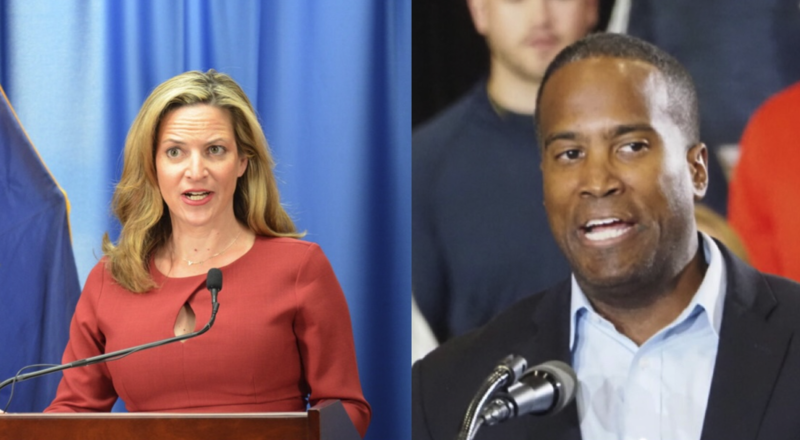
Michigan Secretary of State Jocelyn Benson (left) and U.S. Rep. John James (R-Shelby Twp.). Photos by Ken Coleman and Kyle Davidson
Gov. Gretchen Whitmer’s first bid for the governor’s office in 2018 against Republican stalwart Bill Schuette reached record fundraising and spending, outpacing the previous high in 2006 when Dick Devos’ mega billions gave then-Gov. Jennifer Granholm a literal run for her money.
But the money already raised in the 2026 gubernatorial race shows that it could be on pace to get close to the record-breaking fundraising and spending totals seen in 2006, which saw nearly $80 million in spending, and 2018, which exceeded $90 million.
Year-end 2025 campaign finance reports aren’t due until the end of January, which will detail fundraising between Oct. 1 and Dec. 31 while also wrapping up the contribution and spending totals for the previous year.
But the public campaign finance data available over two quarters of fundraising and spending, up until October, show that donors have given more than $25 million to Michigan’s gubernatorial primary candidates and the lone independent candidate, Mike Duggan, who is already playing like he’s in a general election.
That total is expected to rise sharply as the race moves forward because the race is wide open and would include Duggan, the outgoing mayor of Detroit, who has a penchant for attracting big money due to his strength in his successive mayoral elections.
Assuming the 2025 gubernatorial fundraising and spending amount is at least doubled by the end of the August primary season, and keeps pace to triple that amount by November, it would come close to the 2006 and 2018 totals. The open nature of the race with likely three viable candidates on the ballot could signal another record-breaking year.
Of note, Secretary of State Jocelyn Benson, the top Democrat in the primacy race, has attracted just as many wealthy donor dollars as Duggan and her main Republican rivals, creating a scenario where those same class of high-power donors could be playing all sides in the contest.
Here’s where each of the major candidates stand as the year wraps up, with a look at who has given the most to each of their campaigns.
Jocelyn Benson (D)
Benson is arguably the frontrunner in the Democratic side of the race, and her fundraising totals show why she’s earned that position. She raised $4.75 million up until October and spent just $1.76 million, ending the third quarter with $2.98 million cash on hand.
The state’s campaign finance reporting system, which has been plagued with issues due to systemic changes made in the latter half of Benson’s tenure as secretary of state, allows users to download spreadsheet information to see total contributions to a campaign thus far in a given election cycle — as long as those records contain less than 25,000 entries.
Michigan’s Benson has familial, professional ties to company pushing data center project in Saline
Benson has amassed so many donations that her full contribution analysis report isn’t available for download on the public facing site. That said, what is available shows Benson received large political action committee donations from the Michigan Laborers Political League, the Michigan Legacy PAC, End Citizens United, the Deldin Law PAC, United Food and Commercial Workers Active Ballot Club, Emily’s List Michigan, and the Michigan Regional Council of Carpenters PAC.
Those contributions ranged from $10,000 to $60,000, according to Michigan’s campaign finance system — which notes that the data is reliable but not guaranteed to be completely accurate.
Benson also received the maximum allowed individual contributions from Shadia Turfah, the president of PharmaScript of Michigan, philanthropist Kathy Brzoznowski, Nancy Tellem, the former president of XBox Entertainment Studios, public health advocate Debra Efroymson, Carolyn Cassin, president of Michigan Women Forward, and Lyna Lam, wife of the California tech billionaire Chris Larsen.
Also contributing the maximum individual amount is Stephen Ross, owner of Related Companies, the firm behind a controversial data center proposed in Washtenaw County. Benson’s husband is also a vice president at Related.
Garlin Gilchrist (D)
Gilchrist as the current lieutenant governor is vying to be the heir apparent to Whitmer’s administration. That’s a steep hill to climb: Michigan has a nearly 40-year history of lieutenant governors launching gubernatorial bids and falling short.
Gilchrist calls Gaza, Palestine crisis a genocide at Arab convention, fundraising communications
The second-in-command of the Whitmer administration, however, has forged his own path in the race, being the first to make a public stance that the ongoing Israeli war in Gaza amounted to a genocide against Palestinians, and vowed to not take money from the American Israel Public Affairs Committee, or AIPAC.
Gilchrist raised less than both Benson and Swanson, but he was still able to raise just under $1.13 million up until October, while spending $748,632 and with $378,457 on hand.
The majority of Gilchrist’s campaign contributions came from small dollar donors, but some of his top dollar donations in included max-dollar contributions from Tyrone Sanders, a government consultant with Obsidian Group, Mike Shehadi, the CEO of Pharamascript Inc., Nicole Hamp, a researcher at University of Michigan, and two political action committees — the Rooted in Community Leadership PAC, and the Collective PAC.
Chris Swanson (D)
The sheriff of Genesee County has less name recognition and top-level political experience than his opponents in Benson and Gilchrist, but he has kept up in fundraising, amassing $1.36 million up until October. He did, however, spend $975,997, leaving the campaign with $385,189 cash on hand.
His top donors include Antonio Pollicella, CEO of Team Wellness Center, Phil Hagerman, the CEO of Forum Health LLC, Ryan LaFontaine of LaFontaine Automotive, and Philp Shaltz of Shaltz Automotive, each giving him the maximum amount.
Mike Duggan (I)
The outgoing mayor of Detroit, a former Democrat, thus far has raised $4.38 million, spent more than $1.96 million and had $2.4 million cash on hand going into October.
Union battles at Detroit Medical Center may shadow Duggan’s 2026 bid for Michigan governor
Several news outlets have reported that a not insignificant chunk of his campaign cash has come from Republican donors, including former Michigan Republican Party Chair Ron Weiser, JC Huizenga, Jeff Sakwa and others.
Overall, the majority of Duggan’s contributors donated in the $5,000 (154 individual contributions) and $8,325 (141 individual contributions) categories, the latter being the maximum amount an individual can donate to a single campaign. Another 262 individual contributions came from the $500 range.
Among his top donors are the CEOs of various companies and organizations, like William Wild of the Midwest Independent Retailers Association, Marjory Epstein, the chair of Vesco Oil, Tricia Keith, the CEO of Blue Cross Blue Shield of Michigan, both the CEO and president of Belle Tire, several members of the Penske Corporation, and several members of the Detroit Pistons front office, including Eric Tellem, the team’s vice president of player personnel.
Each of those donors gave the maximum amount to Duggan’s campaign.
John James (R)
Michigan’s John James staffs up gubernatorial election team ahead of 2026 primary season
James bucked his party’s wishes to have him run for reelection in Congress, creating an open race for his seat and inserting himself in a crowded Republican gubernatorial primary. His campaign has positioned him as the frontrunner, and he has the campaign cash to justify some of that thinking despite criticism about him being absent in the race.
The congressman brought in $3.65 million and spent nearly $1.38 million, with more than $2.27 million cash on hand up until October.
Two members of the DeVos family, Pamela DeVos and Dan DeVos, are among his highest contributors, giving $5 million to Mission Michigan, an issues super PAC supporting James’ campaign. Other contributors include various executives in investment firms, technology and industrial companies.
While the big dollars are flowing to James’ campaign, a large majority of his individual direct contributions came from small dollar donors, campaign finance records show.
Aric Nesbitt (R)
One of Michigan’s top Republican legislators, Nesbitt, the state Senate minority leader, has amassed $2.7 million and spent $616,869, with more than $2.1 million on hand up until October. He is one of James’ chief rivals in the race and has been attacking him head on in various debates and messaging.
Nesbitt staffer’s firm works for James campaign, raising ethics flags in GOP governor race
Some of Nesbitt’s largest donors, giving the maximum amount to his campaign, include Carol Van Andel, director of the Van Andel Foundation, and David Van Andel, chair of the Van Andel Institute, both members of the Van Andel family that co-founded Amway with members of the DeVos family.
Also giving the max amount to Nesbitt were Sidney Jansma, the president of Wolverine Gas and Oil, Mark Fazakerley, founder of Eagle Alloy and a major supporter of former GOP gubernatorial nominee Tudor Dixon, Mark Faraj, CEO of KMT Distribution, Ron Boji of the Boji Group, and Chris Yatooma, the husband of Republican secretary of state candidate Monica Yatooma.
Nesbitt also received more than $400,000 from GOPAC, a Virginia-based Republican group the Detroit News reported is funded by some of the nation’s largest companies.
Mike Cox (R)
A former Michigan attorney general during the Granholm and Snyder years, Cox is back to try and take the GOP nomination for governor this year. Like Nesbitt, Cox is also positioning himself as a quasi-foil to James and has similarly attacked his lack of presence in the race in 2025. Cox ended the third quarter raising $4.58 million, with $757,638 spent and more than $3.78 million on hand. That includes $2 million of his own money he loaned to his campaign.
Former Michigan AG Mike Cox announces candidacy for governor
Among Cox’s top donors giving him the maximum amount are various attorneys or members of Michigan law firms. Attorneys Ben Gonek, Manvir Grewal, Todd Flood, David Shea and Michael Stines, and retired attorney Jeffrey Sheehan.
Cox also received max-dollar campaign contributions from Greg Wier, president of Prudential Alarm, and billionaire Peter Karmanos, the owner of the Carolina Hurricanes hockey team and the former CEO of Compuware.
Marking the changing of the political times, Justin Elias, the president of Puff Cannabis, also gave Cox $8,325.
Tom Leonard (R)
Leonard, a former Michigan House speaker and the 2018 GOP nominee for attorney general, entered the race later than some of the other candidates, but he was working to catch up with his fellow primary candidates in fundraising.
He raised $937,023 thus far, spent $227,730 and has $709,293 on hand going into October.
Some of his top donors include those who gave to other campaigns, like Weiser, Yatooma, Boji and Faraj, but also Matthew Moroun, the son of former billionaire businessman Matty Moroun, attorney Jeffrey Ishbia, and James Husanger, the chief risk officer of MSU Federal Credit Union. Each of them gave the maximum amount to Leonard’s campaign.
Ralph Rebandt (R)
A former pastor, Rebandt ran for governor in 2022 and made the ballot after scandal plagued the gubernatorial field that year, as half of the candidates in the crowded field were booted from the ballot due to fraudulent signatures on their nominating petitions. Rebandt ultimately lost that race to Dixon.
Undeterred, Rebandt is back but with sharper focus after running once before. He raised $926,800, spent $46,344 and had $880,455 cash on hand up until October.
Only three individuals gave Rebandt the maximum amount allowed, including Lael Bryant of Ask Services, and Randy Simmons, owner of Simmons Insurance. A large chunk of his campaign cash came from a personal loan, giving himself $799,627 of his total haul thus far.
Lansing, MI