Meet the Michigan climate candidate on Trump’s radar
Sep 25, 2026 | 8:00 am ET

Description
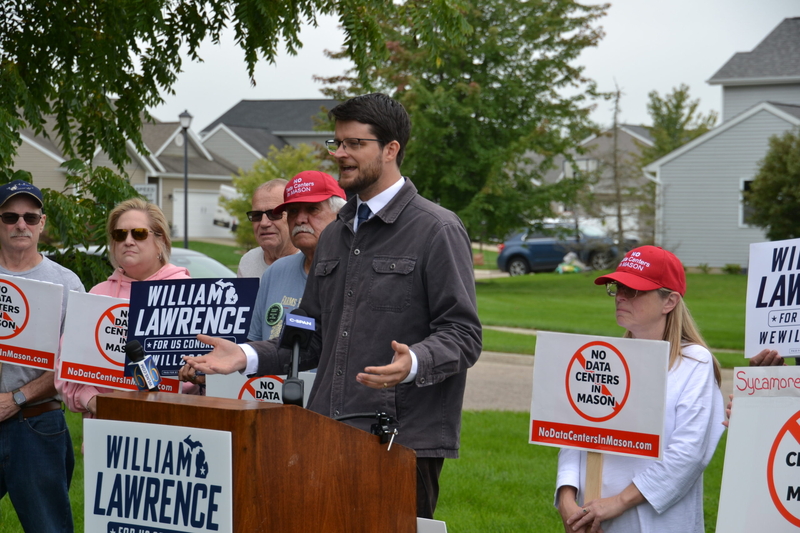
William Lawrence speaks about data centers and artificial intelligence in Mason, Mich., on Sept. 17, 2026. (Photo by Robin Bravender/Michigan Advance)
Less than two months ago, William Lawrence was a relatively unknown progressive climate group co-founder and a dark-horse candidate for Congress running in a Trump district in the middle of Michigan.
But his August victory in the Lansing-area primary — where he capitalized when moderate Democrats split votes — has catapulted Lawrence firmly into the national spotlight. The 36-year-old vying to represent Michigan’s 7th Congressional District is suddenly under heightened scrutiny from the Democratic Party, national news outlets and even President Donald Trump.
The high-profile race, which pits Lawrence against incumbent Republican Rep. Tom Barrett (R-Charlotte), could tip the scales of power in Washington next year. It’s also a microcosm of some of the biggest debates playing out in national politics in the midterms that are likely to carry into the 2028 presidential race. The contest could offer lessons about voters’ opposition to data centers, their willingness to shrug off controversial social media posts and their appetite for left-leaning candidates promising drastic changes in the Trump era.
Michigan’s 7th District is “one of the quintessential swing districts in the entire country,” said Kyle Kondik, managing editor of Sabato’s Crystal Ball at the University of Virginia Center for Politics. It’s been historically competitive, voting narrowly for Joe Biden in 2020 and for Trump in 2024, Kondik said, and it’s “the kind of swing seat that Democrats probably should be winning in a year like this.”
The left is hopeful Lawrence can capitalize on anti-Trump sentiment to win the race. Democrats’ congressional campaign arm recently added Lawrence to its “Red to Blue” program — signaling a boost in support from the national party.
But Kondik and other political analysts still view the race as a toss-up, due in part to Lawrence’s past as an outspoken climate activist and progressive.
“He’s the kind of candidate that I think Republicans are sort of dreaming of running against,” in part due to his track record of saying “a lot of pretty out-there things,” Kondik said. “But it’s also not obvious to me that he’s going to lose. I really think it is still a toss-up.”
Trump attacks
One complication for Lawrence: His controversial social media posts during his years as a progressive activist and climate organizer.
Some of his now-deleted social media posts surfaced in a CNN report this month, including a post from 2021 in support of communal living. “Biggest W of my late 20s was finding a long-term stable co-op house. F*** isolation and the nuclear family domicile,” Lawrence wrote in one of the posts. In another post from 2022, Lawrence wrote that the “nuclear family home is an isolating, individualistic, violent way of organizing society.”
For Republicans, Lawrence’s old posts and his activist record are political red meat.
Days after those old posts resurfaced, Trump blasted Lawrence during a speech at the Republican midterm convention in Dallas. “One of the Democrats’ top congressional candidates is a self-described Marxist who says he hates family households, oh, that’s nice, and wants to destroy the American way of life,” Trump said.
Lawrence told Michigan Advance that he learned about the president’s comments when the House Republicans’ campaign arm tagged him in a clip of the speech on social media. He welcomed the president’s attention. “I thought, ‘Hey, here we are. We’ve arrived,’” he said.
He’s smart and aggressive — I doubt he’s going to Congress just to have a job.
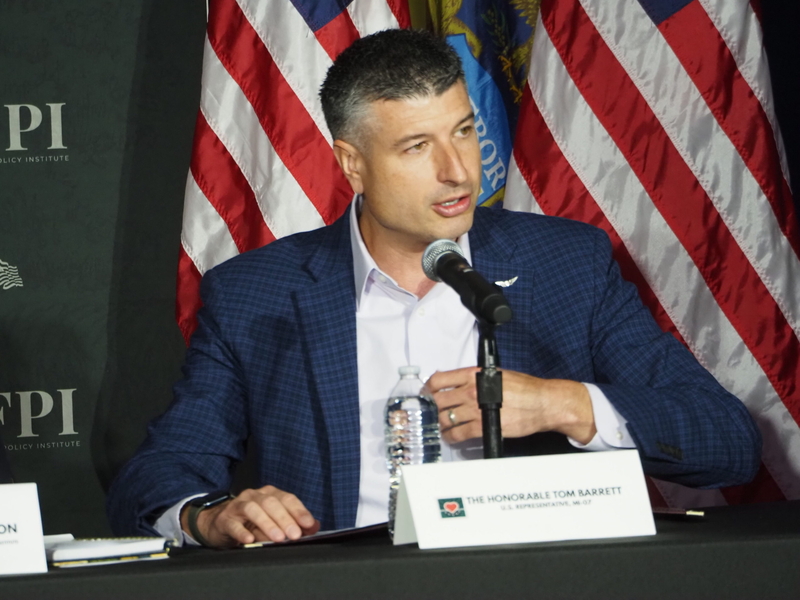
Barrett is also seizing on Lawrence’s old posts. “My wife and I live in a small town in this district and I’m raising a nuclear family — something that my opponent says is a violent way of organizing society,” Barrett told the Advance in a phone interview.
Barrett, a U.S. Army veteran running for his second term representing the district, said Lawrence has been a “radical activist for his entire life as an adult. And you can’t then divorce yourself of that when you decide to run for office in a very, very competitive congressional district. You can’t just say, “Ah, well, don’t pay attention to anything I said.’”
Lawrence addressed the resurfacing of his remarks in an interview earlier this month.
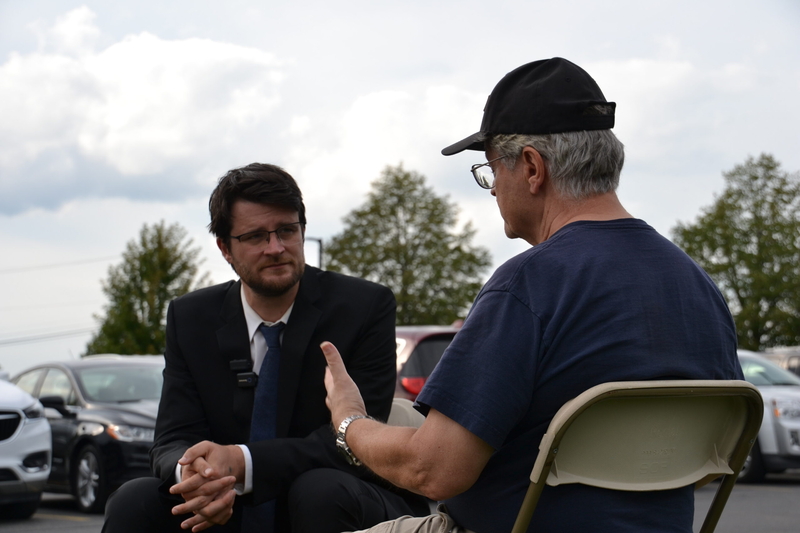
“There’s things that I have said that … I stand by saying them at the time, even though I wouldn’t say them in the same way now,” Lawrence told the Michigan Advance in a parking lot where he sat next to a sign that said “Ask me anything” and took questions from locals.
There’s things that I probably disagreed with even at the time, and it was a moment of frustration. And there’s things that I … changed my mind in response to new information,” he said.
Like others in his generation, Lawrence said, “I’ve just done a lot of time thinking out aloud on the internet. … And I think folks understand that.” He’s changed his approach since then, Lawrence said. “I’m in a different role now, and that requires me to hold myself to a higher standard.”
Lawrence specifically addressed his past comments about marriage during a recent news conference in Mason. “I’ve been happily married for four years,” he told reporters.
Climate roots
Before he was an aspiring congressman, Lawrence was a climate activist who helped launch the youth-led Sunrise Movement.
He worked on a fossil fuel divestment campaign as an undergraduate at Swarthmore College and met up with other students around the country interested in cutting their universities’ ties with oil and gas companies.
That eventually led to the creation of a national network of student divestment organizers and ultimately the co-founding of the youth-led Sunrise Movement in early 2017. That effort injected energy into the environmental movement as young activists staged a sit-in at then-House Speaker Nancy Pelosi’s office in 2018 and went on to prod the Biden administration on climate change.
Lawrence’s links to the climate movement are still strong. Stevie O’Hanlon, another Sunrise co-founder and the group’s former communications director, is managing Lawrence’s campaign.
Sunrise’s current executive director, Aru Shiney-Ajay, traveled to Michigan last Friday to train Michigan State University students and get them fired up for Lawrence’s election.
She sees Lawrence’s political rise coinciding with a new era of climate politics.
“I actually do see climate anxiety spiking among young people again” and data center and AI concerns are “a big part of that,” she said. “I think having Will in power would just be an incredible way to show how movements can go from taking the streets to the halls of Congress.”
Environmental activist and author Bill McKibben has known Lawrence since his undergraduate days. McKibben thinks Lawrence’s climate and activism background could help propel him to victory in the moderate district.
“I think people are plenty ready for fighters — he showed in the primary that that was an asset,” McKibben said in an email. And he thinks Lawrence will be in prime position to shape the national debate on climate and data centers if he wins in November. “He’s smart and aggressive — I doubt he’s going to Congress just to have a job,” McKibben said.
Data center drama
Lawrence’s allies say his roots as a climate activist and affordable housing organizer make him uniquely suited to harness opposition to data centers in his district. Those opponents include the younger university crowd worried about the centers’ climate impacts as well as moderate voters wary of the impacts on the environment, property values and utility costs.
Lawrence is campaigning relentlessly on data centers, calling for a one-year federal moratorium on new construction. He appeared at a Lyon Township board of trustees meeting earlier this month to promote a moratorium to local officials. And he recently unveiled a plan to rein in data centers and artificial intelligence.

Barrett calls Lawrence’s stance on data centers an “absolutist” position.
“I’m taking the approach that local residents ought to have the decision, and that data center developers — along with local elected officials — ought to make that case to the local residents and allow them to decide what’s right for their communities,” he said.
Lawrence is slamming Barrett for voting for Trump’s 2025 One Big Beautiful Bill Act that included tax breaks available to tech companies for data center construction.
Barrett said the law included “broad tax reforms that certainly changed tax policy for all kinds of different things,” and didn’t single out data centers for support.
Barrett touts his own past opposition to direct incentives for Michigan data center developers during his time in the state legislature. And in August, Barrett introduced legislation in Congress to ban the federal government from overriding local zoning decisions about data centers.
“Local opposition to rapid data center expansion is emerging as a critical issue,” said Marty Jordan, an associate professor of political science at Michigan State University.
Lawrence’s “consistent opposition to data center expansion” resonates strongly, Jordan said. “While Barrett has recently advocated for greater local control over these projects, his position is complicated by President Trump’s support for AI data center growth.”
Ultimately, the candidates’ diverging views on data centers and other key policy issues may matter less in November than their party affiliations, said Erin Covey, House editor at The Cook Political Report.
“For most House candidates, people are ultimately going to be voting for you based on the letter that is beside your name,” she said. “So even if they have disagreements with their own party’s nominee, we live in such a polarized era that keeping the other party out of power is always going to be the driving consideration for most people.”
Lansing, MI