Medicare & Medicaid’s 61st birthday not so happy thanks to Trump’s big bill, advocates warn
Jul 31, 2026 | 7:55 am ET
Description
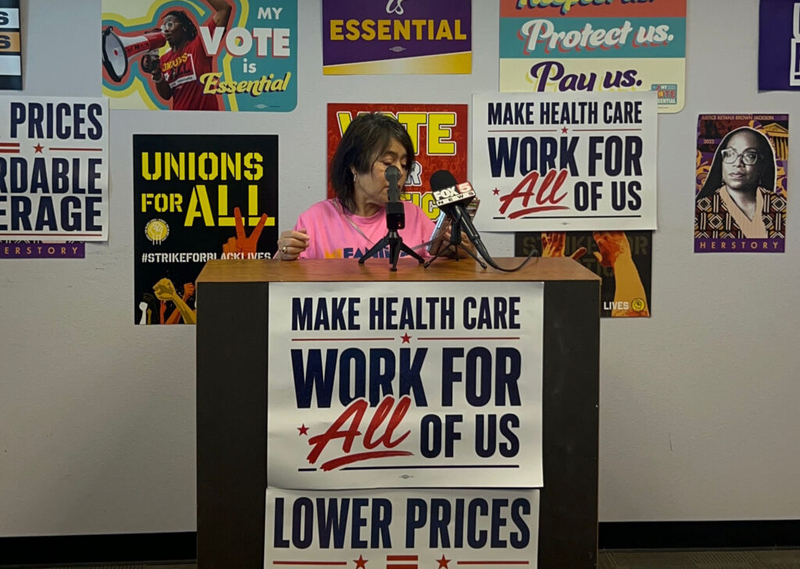
Ivon Meneses speaking during a press conference in Las Vegas Thursday. (Photo courtesy Battle Born Progress)
For 55-year-old Ivon Meneses, Medicaid has become a lifeline to afford treatments for her myriad of health problems including asthma and diabetes, which has come with a slew of medical complications for her.
The federally funded program, which was first signed into law 61 years ago as of Thursday, has been a safety net for Meneses and many others who wouldn’t be able to pay for health care.
“This program is not just a line item in the federal budget,” Meneses said. “It is absolutely the foundation to my daily survival. Medical coverage isn’t an option for me.”
Members of Battle Born Progress, Nevada Chapter of the American Academy of Pediatrics, and SEIU 1107 gathered Thursday to condemn cuts to Medicaid as a result of Donald Trump’s One Big Beautiful Bill Act.
An estimated 70,000 Nevadans will lose medical coverage due to federal rule changes and spending cuts under the legislation, said Shelbie Swartz, executive director of Battle Born Progress, referencing the Nevada Medicaid administrator’s presentation to state legislators earlier this year.
“This isn’t an abstract policy,” Swartz said. “It’s a grandmother rationing insulin, it’s a mother watching her son’s disability coverage hang by a thread, it’s a rural clinic deciding whether it can keep its doors open.”
Health care providers and state legislators have been among those warning about the challenges ahead in Nevada next year when most of the Medicaid cuts in the Trump bill take effect.
Those challenges will likely be compounded as a result of the Trump administration announcing this week it was ending a subsidy designed to help Medicare recipients with out of pocket expenses.
Of the many provisions of the climate, health care and tax law signed by President Joe Biden in 2022, known as the Inflation Reduction Act, capped out of pocket costs of the Medicare Part D prescription drug benefit at $2,000.
Nearly 470,000 Nevadans were enrolled in Medicare Part D in 2025, according to a KFF analysis.
All the changes and disruptions to access to health care show that “Republicans are doubling down on putting profits over people and making it harder for people to get health care,” Meneses said.
Prior to being an organizer for Mi Familie Vota, Meneses worked as a casino porter and was able to get her health care costs covered through employment-related insurance.
In an interview, she said health complications stemming from diabetes have left her disabled and unable to work full time.
Like many working people who have trouble finding health insurance coverage, she turned to Medicaid.
“Latinos are workers and we’ve given so much to this country,” she said during the press conference. “Unfortunately we know that Latinos are overrepresented in industries that do not offer employer-sponsored health insurance. We cannot afford any cuts to these critical important programs.”
The State of Nevada, Tesla, Walmart, and Amazon are among the state’s employers with the most Medicaid recipients, according to a 2026 report.
Meneses said it has become increasingly hard for her to walk, further cutting into her ability to work. As her vision began to fail, she also had surgery on her eyes last month.
Without Medicaid coverage to pay for numerous prescriptions and procedures, “I would face impossible choices paying for housing and getting health care,” Meneses said.
Access to Medicaid for people like Meneses is going to become even more challenging.
A new work requirement authorized under the Big Beautiful Bill and scheduled to start Jan. 1, 2027 will require adults to prove they are working, going to school, or volunteering for at least 80 hours a month to maintain their coverage.
The new rule applies to people aged 19-64 who gain Medicaid coverage through the Affordable Care Act expansion. Beneficiaries will also have to reapply every six months instead of once a year.
An estimated 280,000 Nevadans who benefited from expanded Medicaid coverage are expected to be affected by the change.
The rule is supposed to exempt those deemed “medically frail,” which could include pregnant people, foster youth up to age 26, veterans with total disability, Native Americans, incarcerated people, those in treatment for drug or alcohol use disorder, but state health officials have warned determining eligibility will be extremely complex.
Meneses said she has spoken to a social worker about the new requirements and was told she could also volunteer in lieu of finding work. But even that seems daunting as Meneses struggles to walk.
“I fear I won’t be able to work because my complications are getting worse and worse and worse,” she said. “It’s scary. I still have a teen who is only 13. Imagine losing my vision. Who is going to take care of her?”
Las Vegas, NV