Labor Day report has good news and bad news about Wisconsin workers
Sep 04, 2026 | 4:45 am ET

Description
A construction worker on a road project. Photo courtesy High Road Strategy Center, from the State of Working Wisconsin Report
Wage gains for lower-paid Wisconsin workers have continued in 2026, but a halt in job creation suggests that might not last, says the author of a new report released ahead of Labor Day.
“The State of Working Wisconsin 2026” tells a good news-bad news story for Wisconsin’s workforce, but one that could become less favorable under current conditions.
“For working people in Wisconsin, the Labor Day 2026 picture is mixed,” the report states. “While overall unemployment remains low, the state isn’t adding jobs and Black unemployment is growing. While the median wage has reached an all-time high, surging inflation in 2026 means that wage growth is likely coming to an end.”
The report is a product of the High Road Strategy Center, based at the University of Wisconsin. It was written by Laura Dresser, the center’s associate director, along with Joel Rogers, the director, and Leslie Vasquez. The center was founded 30 years ago as the Center on Wisconsin Strategies (COWS).
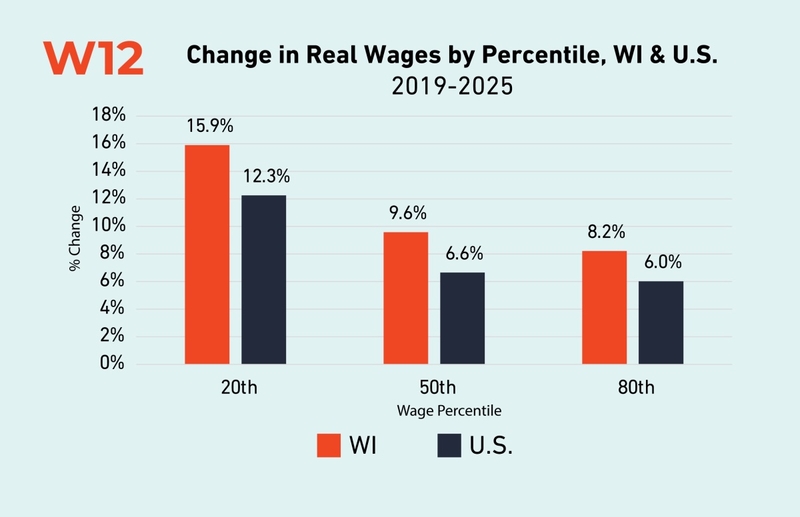
The report’s best news is the continued wage growth, particularly for lower-wage workers, Dresser said in an interview. That has been consistent since about 2018, she said.
Except for a period early in the COVID-19 pandemic, when many businesses cut back and there was a brief, sharp increase in layoffs, the unemployment rate has also been consistently low, and employers have complained about the difficulty in filling jobs.
“Workers have more bargaining power, and they’ve managed to turn that into wage increases,” Dresser said. “That’s much more true in the lower-wage jobs than it is in the higher wage jobs.”
The lowest-paid 20% of workers have made the strongest wage gains, while the wage increases have been the smallest for the workers whose pay puts them in the 80th percentile —those who earn more than 80% of the workforce — she said.
Job growth, however, has slowed down in the last year and a half.
“Since late 2024, Wisconsin’s job market has gone flat,” the report states. From 2020 through most of 2024, Wisconsin’s economy was steadily adding jobs, setting new records.
In November 2024, the state hit a record high of 3,051,000 jobs, according to the report. Since then the total number of jobs has diminished, marking 3,042,900 jobs in July.
“We are not seeing increasing numbers of jobs over the last year and a half,” Dresser said — which, she observed, is parallel to a national trend of “anemic” job growth.
The construction industry remains particularly strong in Wisconsin job growth, according to the report, with jobs growing at twice the rate for construction jobs nationwide in the last six years, according to the report.
Wisconsin leisure and hospital jobs grew 1.6% in that period, while nationally they “barely grew at all,” according to the report. And manufacturing jobs are 4% below what they were in February 2020, prior to the COVID-19 pandemic shutdowns.
“Wisconsin is losing manufacturing jobs and losing them much more rapidly than the national decline,” the report states.
Tariff policies have shifted unpredictably since President Donald Trump returned to the White House in January 2025 owing both to shifting policies in the administration as well as court cases that have overturned some of the administration’s tariffs.
The report cites research from the Economic Policy Institute in Washington, D.C., that concludes the tariff policies have done little to change the nation’s balance of trade with other countries, while reducing both imports and exports.
Wage growth could be coming to an end as well. If unemployment increases, workers may feel less able to seek better pay and working conditions, according to the report.
In 2026, inflation has driven up costs particularly for energy, fuel and utilities. “And national evidence is that inflation is growing faster than wage growth this year — that’s a big warning light that we’ll get thrown off that wage trend we’ve been on,” Dresser said.
While wage gains have been especially strong for Black workers over the last six years in Wisconsin — increasing 17% for Black women and 14% for Black men — the report also sees a persistent inequality along racial lines.
“Unemployment has stayed really low, but in the last year Black unemployment has gone up by a full percentage point while white unemployment has held steady,” Dresser said.
The failure of Wisconsin to raise the state minimum wage — which remains at $7.25 an hour — and the persistence of state laws enacted in the last decade weakening unions for public employees as well as in the private sector are also making it more difficult for workers, according to the report.
“Unions, made up of working people, help increase the power and standards of living of working people,” the report states. And they have been actively organizing in Wisconsin, although the renewed enthusiasm for unions hasn’t yet produced broad gains in membership, which has diminished to 5% of the private sector workforce.
Affordability has become a widespread buzzword in political campaigns for 2026, and the report suggests that can be viewed in more than one way.
“While the question of affordability is generally framed as a problem of the cost of living, the problem is equally or even better understood as a problem of suppressed pay,” the report states. “Raising the minimum wage and making it easier to join a union would both increase paychecks.”

Madison, WI