Kentucky can’t kill its way to life and justice
Oct 12, 2026 | 5:30 am ET
Description
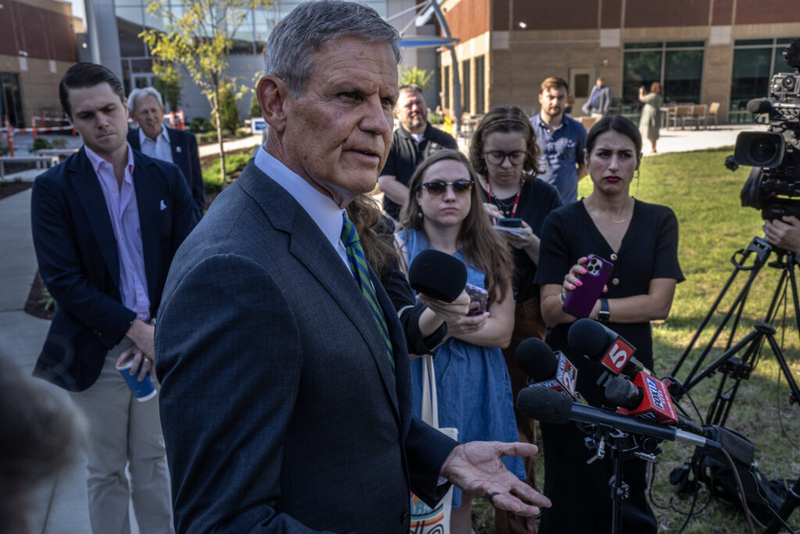
During a Thursday morning press conference, Gov. Bill Lee discussed the failed execution of Christa Pike on Wednesday, Sep. 30, 2026. (Photo: John Partipilo/Tennessee Lookout)
On the night of Sept. 30, Tennessee strapped Christa Pike to a gurney and tried to kill her. More than an hour and two doses of pentobarbital later, witnesses could still hear her breathing. She told the execution team her arm felt like it was about to burst. Her lawyers say she remains hospitalized in critical condition. Four months earlier, Tennessee’s team spent more than an hour trying and failing to place an IV line in Tony Carruthers.
Kentucky is on the same road. Last spring, the General Assembly overrode Gov. Andy Beshear’s veto to pass Senate Bill 251, which lets the Department of Corrections set execution procedures by internal memo instead of through public rulemaking, all to restart executions faster.
I have spoken out against capital punishment for decades, and Tennessee’s debacles only confirm what the evidence has long shown. The death penalty does not work, it is cruel, it betrays the faith many of its supporters profess, and it costs a fortune.
Start with the claim that it deters crime. It does not. In every year from 1990 to 2020, states without the death penalty had lower murder rates than states with it, according to FBI data. Police officers are killed in the line of duty at higher rates in death penalty states, too. When four states paused executions, murder rates did not rise, and in three of them they fell.
Kentucky’s own record settles the question: of more than 10,500 homicides here since 1975, three led to an execution. A punishment carried out 0.03 percent of the time deters no one.
It is also cruel, inhumane and barbaric. Lethal injection was sold as the humane alternative to the electric chair and the gallows. Tennessee has now shown twice in four months what it looks like in practice. Kentucky has no execution drugs on hand, and SB 251 lets the corrections department decide how to obtain and use them by internal memo, without public input. After the Pike failure, Tennessee’s officials insisted they had followed every step of their protocol. That is exactly the problem.
Worse, the system condemns the innocent. Since 1973, at least 203 people sentenced to death in this country have been exonerated, roughly one for every eight executions. Kentucky has its own case. Larry Osborne was 17 when a Whitley County jury sentenced him to death in 1999, making him the youngest person on our death row. The Kentucky Supreme Court threw out his conviction, and a jury acquitted him in 2002. A peer-reviewed study published by the National Academy of Sciences estimated that more than 4 percent of people sentenced to death are likely innocent, and most will never be identified. A wrongly imprisoned person can be freed. An executed one cannot. One wrongful execution is one too many.
Then there is the moral question, which for many Kentuckians, me included, is a question of faith. We worship a God of mercy who holds that no soul is beyond redemption. When the state declares that a person can never be redeemed and must die, it claims a judgment that our faith reserves for God alone. This is not a partisan conviction. Rep. James Tipton, R-Taylorsville, opposed the death penalty during this year’s debate on religious grounds, and the Catholic Church now teaches that capital punishment is inadmissible.
And we pay dearly for all of it. A 2020 analysis by six current and former Kentucky public defenders estimated that the Commonwealth has spent about $440 million on death penalty cases since 1976, roughly $146 million for each of its three executions. Ed Monahan and Ernie Lewis, former heads of Kentucky’s Department of Public Advocacy, have long advocated for reform and abolishment of capital punishment. Mr. Monahan noted that “legislators have a profound lack of understanding of the arbitrariness and capriciousness of Kentucky’s administration of the death penalty.”
A 2011 American Bar Association assessment, by a team that included two retired Kentucky Supreme Court justices, found that about 60 percent of Kentucky’s death sentences had been overturned or commuted. A person sentenced to death here is 14 times more likely to have the sentence reversed than to be executed. Not only are innocents facing death for crimes they did not commit, we pay exorbitantly to fund this cruel injustice.
Gov. Beshear warned that SB 251 would bring more litigation, not less. On Sept. 24, the Kentucky Supreme Court proved him right, rejecting the attorney general’s latest bid to restart executions because the constitutional questions remain unresolved. That money could pay for deputies, addiction treatment and services for crime victims.
I do not dismiss the families of Powell County Sheriff Steve Bennett and Deputy Arthur Briscoe, who have waited more than 30 years. Their grief is real, and their wait is a cruelty of its own. But what has made them wait is the death penalty itself: decades of appeals that exist precisely because the punishment cannot be undone. A sentence of life without parole begins the day it is imposed, and it ends the uncertainty for good.
Kentucky should repeal SB 251, halt executions and replace death sentences with life imprisonment without parole. What happened in Tennessee was not an argument for finding a more efficient way to kill. It was a warning that government should not be killing at all.
Richard Dawahare is a Lexington attorney and advocate.

Frankfort