Kansas professor falsely accused of espionage wants university to pay for firing, harm to reputation
Aug 10, 2026 | 6:00 pm ET
Description
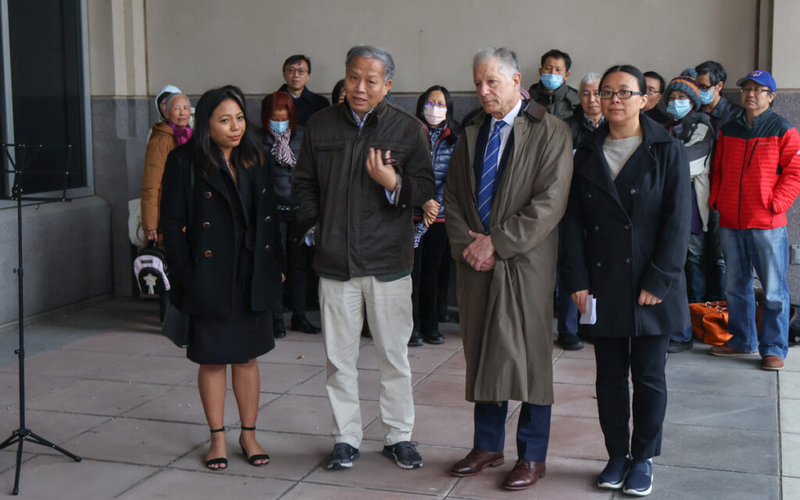
From left, Gisela Perez Kusakawa, executive director of the Asian American Scholar Forum, Haipei Shue, president of United Chinese Americans, Peter Zeidenberg, Franklin Tao’s criminal defense attorney, and Tao’s wife, Hong Peng, appear in 2023 outside of the Robert J. Dole Federal Courthouse in Kansas City, Kansas. They spoke after Tao was sentenced following a criminal convictions of making a false statement, which was eventually overturned. “We will as a community fight for the equal treatment of Chinese Americans going forward,” Shue said. (Photo by Chloe Anderson for Kansas Reflector)
TOPEKA — An anonymous tip accusing a Chinese-American chemist and researcher of espionage spurred the University of Kansas into action, notifying the U.S. Department of Justice and building a case against its own employee, Feng “Franklin” Tao said in a lawsuit.
Tao was a tenured chemical engineering professor at KU in 2019 when he became one of the first professors arrested under the first Trump administration’s “China Initiative,” a DOJ campaign purportedly created to thwart economic espionage and intellectual property theft.
After a federal indictment, a criminal conviction and an acquittal by an appeals court, Tao said in a lawsuit filed July 21 in federal court that the university violated state and federal workplace discrimination protections and caused harm to his reputation and career prospects.
The lawsuit is Tao’s second against KU. He sued in 2025 in an attempt to regain his job and claimed the university discriminated against him. The July lawsuit accused KU of retaliating because of the 2025 discrimination complaints.
Central to the newest lawsuit is KU’s choice to create a temporary faculty review board, made up of non-tenured faculty, that was tasked with wading through charges against Tao.
“By installing non-tenured faculty — whose careers and advancement remain subject to KU’s discretion — KU compromised the very independence the FRB was designed to protect by creating exactly the kind of conflict of interest that the policy was meant to prevent,” his lawsuit said.
Tao objected to the review board’s makeup, but the board dismissed his concerns in March of this year, according to the lawsuit.
It said Tao had been left again “unable to contest the charges against him, unable to secure reinstatement, and indefinitely denied the fair process to which he is entitled.”
KU had not responded to the lawsuit as of Monday. According to the complaint, Tao accepted a non-tenured position in April in Arizona.
Tao asked KU to pay him for lost wages and an unspecified amount for “reputational injury, emotional distress, pain and suffering.”

Topeka, KS