Kansas Legislature’s leaders balk at shrinking their 4.4% salary hike to 1%
Nov 09, 2026 | 1:16 pm ET
Description
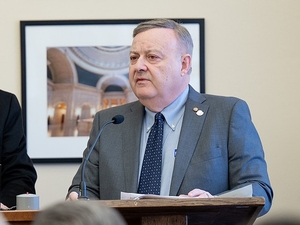
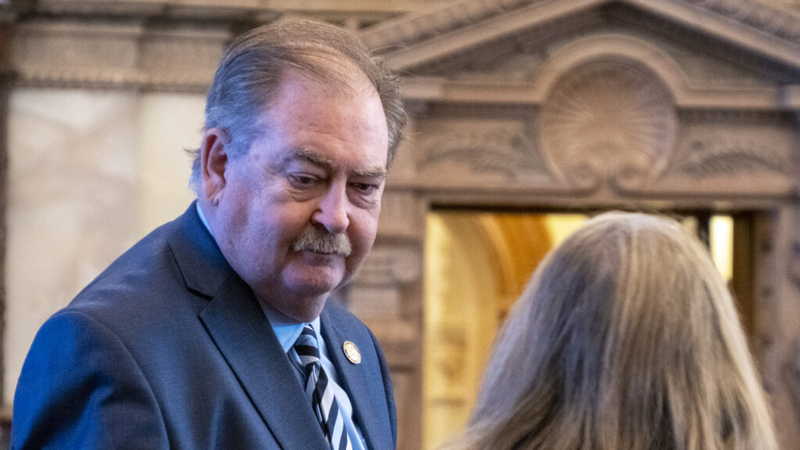
Sen. Tim Shallenburger, a Baxter Springs Republican, attempted to convince other leaders of the Kansas Legislature to support a recommendation the 4.4% raise scheduled for House and Senate members be reduced to the 1% granted other state workers. This image of Shallenburger was taken April 6, 2023, on the Senate floor. (Photo by Sherman Smith/Kansas Reflector)
TOPEKA — Leaders of the Kansas Legislature blocked a proposal to slash to 1% the scheduled pay raise for House and Senate members so their increase matched the percentage they granted to thousands of other state government workers.
The decision by the Legislative Coordinating Council, a bipartisan panel of House and Senate brass, left in place the 4.4% boost in compensation for the state’s 165 legislators.
Senate Vice President Tim Shallenburger, a Baxter Springs Republican, said it would be unfair for the Legislature to reward itself a raise more than four times greater than what the 2026 Legislature allocated for rank-and-file employees. His proposal to limit the raise for legislators to 1% was rejected by the LCC on a 3-3 vote with two members absent.
“I have a little heartburn recommending a 4% pay increase for legislators,” Shallenburger told his LCC colleagues. “I think we should send this signal that we think that if 1% is good enough for employees, it’s good enough for us.”
Voting for the motion were Shallenburger, Senate Majority Leader Chase Blasi, R-Wichita, and House Minority Leader Brandon Woodard, D-Lenexa. The LCC members against the motion were House Speaker Dan Hawkins, R-Wichita, House Speaker Pro Tempore Blake Carpenter, R-Derby, and House Majority Leader Chris Croft, R-Overland Park. Senate President Ty Masterson, R-Andover, and Senate Minority Leader Dinah Sykes, D-Lenexa, were absent.
Carpenter, who voted against the proposal, said he was torn between the idea of bringing equivalency to taxpayer-funded raises for legislative and executive branch employees and endorsing a recommendation that might not be compliant with state law.
“I think there are a lot of individuals within our bodies that agree with the principle overall,” he said. “My fear, though, is that we’re getting ready to take action that we don’t know all the legal ramifications and consequences of.”
Under the defeated proposal, the LCC would strike from the state budget the funding required to make legislative salary adjustments above 1%. The LCC would further recommended the House and Senate take up a bill affirming reduction of the legislative salary enhancements due to take effect in January. It would be up to the 2027 Legislature to make a final decision.
Gordon Self, who leads the Legislature’s Office of the Revisor of Statutes, told the LCC on Friday that he was skeptical the council had authority to tinker with legislative compensation.
“On the spot, I can make a strong argument that you can’t,” Self said. “That would be a question that would need to be fully addressed as we move forward.”
In April, Democratic Gov. Laura Kelly attempted to use her veto power to persuade the 2026 Legislature to improve upon the pay raise granted executive branch employees. She had advocated for a 2.5% pay hike for these workers, but the Legislature approved a 1% increase.
Kelly’s tactic was to veto the Legislature’s entire operating and salary budget in pursuit of a compromise, but the House and Senate overrode her veto.
Kelly’s veto was denounced by Carpenter as the work of a “dictator,” while Blasi said the governor was operating as if she were a “queen.”
Members of the Legislature receive about $58,000 annually in the form of salary and per diem compensation. They benefit from $6,000 per year allocated for official mailing privileges. And, they can participate in a retirement program that calculated benefits as if they were were employees making $90,000 per year.
The 2023 Legislature adopted a bill creating the Kansas Legislative Compensation Committee. The commission was responsible for drafting a plan that would improve legislative salaries. After multiple meetings, the commission proposed base raises for House and Senate members of more than 90%. The commission also developed a system allowing for annual adjustments to legislative wages based on a rolling three-year average of Kansas personal income.
The 2024 Legislature wasn’t required to vote in favor of the commission’s recommendations for the plan to be implemented. The House and Senate could, however, vote to reject the plan. No action was taken by the Legislature, so the new compensation system was automatically adopted.
Meanwhile, raises for about 35,000 Kansas executive branch employees remained at the whim of politicians in the form of appropriations bills considered by the House, Senate and governor.
Topeka, KS