Kansas gubernatorial candidates questioned on property tax, data centers, goals
Aug 28, 2026 | 2:01 pm ET
Description
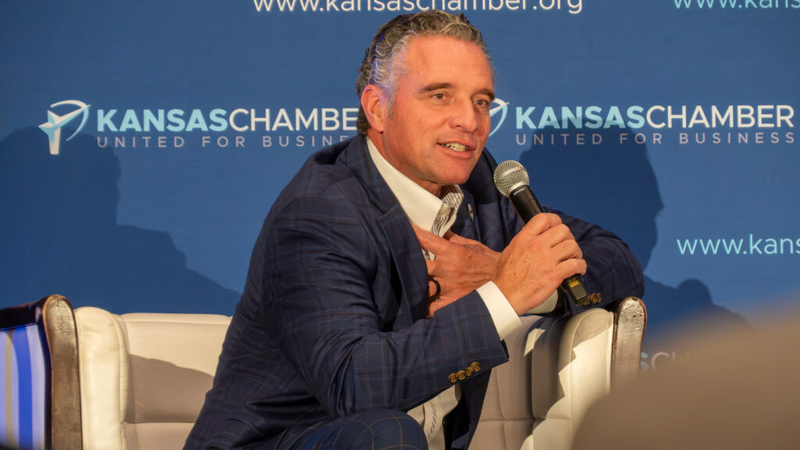
Senate President Ty Masterson spoke to the Kansas Chamber Aug. 27,2026, in Olathe about his vision for Kansas should he win the upcoming gubenatorial election. (Photo by Anna Kaminski/Kansas Reflector)
OLATHE — Candidates for governor fielded business and economic questions Thursday, exchanging barbs about the “property tax crisis,” encouraging economic growth and steps to filling workforce needs.
The Kansas Chamber hosted the forum, giving candidates seven minutes to answer questions asked by Eric Stafford, chamber president and CEO.
Senate President Ty Masterson, an Andover Republican running for governor, said everywhere he has been in the state, property taxes are the No. 1 issue.
“I have a neighbor that he’s spending more than double the property tax alone than he had been for his entire mortgage, interest, insurance taxes combined, losing his home,” Masterson said. “At the same time, that’s putting such a load on our young people to afford housing, and homeownership is the underpinning of the middle class of any country. Our first-time average homeowner is now close to 40, and that’s just not acceptable.”
Television campaign ads against Master’s opponent, Sen. Cindy Holscher, an Overland Park Democrat, attack her votes against legislation that would have capped annual increases in local property taxes.
Holscher called many of those bills “gimmicks.”
“They squeeze the balloon, they shuffle the responsibility somewhere else, and it makes it harder for our local levels to raise the revenue they need for their critical services,” Holscher said.
Holscher said property taxes can best be affected by fixing the Legislature’s failure to fully fund special education, which forces property taxes up to fill the gap, and examining exemptions given to corporations that shift the tax burden to homeowners.
“Special education hasn’t been fully funded since 2011,” she said. “We’re federally mandated to fund it. When we don’t do that, that burden gets shifted to the local level.”
Data centers and energy
Asked how to balance rising energy costs and economic development with the desire of data centers and other large energy users to locate in Kansas, Masterson said the Legislature took steps two years ago to address energy and security concerns.
The Kansas Corporation Commission, which regulates utilities, created a large load tariff to create guardrails around energy, he said. Also the bill included a “China element.”
“We are in a cold war with China over AI technology, and that is the real thing that we can’t afford to lose,” he said. “It really comes down to the guardrails. It’s this simple: They pay their their way on energy or the answer’s no. They don’t overconsume water or inappropriately use the land or the answer’s no.”
Holscher is a proponent of moratoriums on data center development.
“People are asking for reasonable parameters to ensure that their utility rates aren’t going up and to ensure that their water isn’t being depleted,” she said. “Those are reasonable, and that’s good for all of us to make sure that those protections are there.”
Holscher said she also wants assurances that the jobs building data centers go to Kansas workers, who are then able to “fuel the economy” with better wages.
Workforce availability
Kansas employers are concerned about workforce availability, Stafford said, asking Holscher and Masterson to explain what they’d do to attract and prepare workers.
Holscher praised Kansas’ education system but said the state loses many of its “best and brightest” to jobs in other states.
“I believe the estimates are that when a student attends college in another state, 55 to 60% of those students, upon graduation, will stay in that state,” she said.
Holscher said Arkansas and Colorado created tuition programs for college, which keep students in state, and that partnering with the trades would be important, too.
Masterson said Kansas has an education and literacy crisis, with three out of four fourth graders not able to read at grade level.
“That is your future workforce,” he said. “I want to bring Mississippi America to Kansas. For those that don’t know, Mississippi was 49th in the country in literacy for decades. They’re now nine.”
Masterson said once the state focuses on literacy, the jobs are there for students. In addition, he wants to “re-value” the trades.
“We need — it’s not just business owners, attorneys — we need the guys and the gals that can actually make things,” he said.
Vision and goals
Masterson said the government’s role in the state is “constraint.”
“There’s no money that spends easier than other people’s money, and that’s at every level of government,” he said. “You need outside constraints on the state. I’d love to see a taxpayer bill arise in the state of Kansas, constraining the state, and we need to pass those constraints on local government, allowing for reasonable growth.”
Holscher said she’s focused on economic development, looking to grow big and small businesses.
“What we’re seeing across the state and across the nation is an affordability crisis,” she said. “What I think about is the fact that you’ve got to make sure that people, young people, are able to meet those economic milestones, things like being able to buy a house, to start a family, buy that new car. So my focus is on making sure that we are doing what we can to help those families to make it easier so that they’re not struggling.”
Divisiveness is a problem, too, she said.
“My focus is not going to be on culture wars because people don’t want to stay in a state or come to a state where there’s so much divisiveness,” she said. “We can work together. We can make great things happen.”

Topeka, KS