Kansas Democrats face political consequences for embracing public uprising against data centers
Aug 24, 2026 | 11:53 am ET
Description
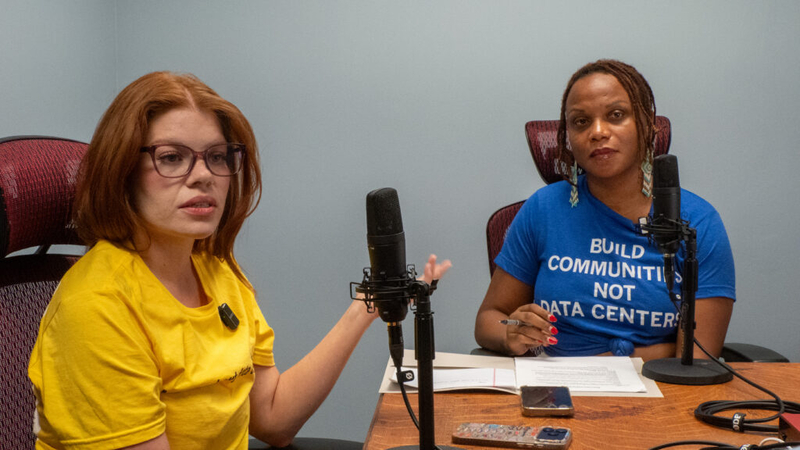
Reps. Alexis Simmons, left, and Brooklynne Mosley, right, appear for recording of the Kansas Reflector Podcast on Aug. 12, 2026, in Topeka. The two represent Topeka and Lawrence respectively, and they are part of a bipartisan coalition of lawmakers opposed to hyperscale data center construction. (Photo by Anna Kaminski/Kansas Reflector)
TOPEKA — Rep. Brooklynne Mosley never gets a clear answer when she asks proponents of data centers how closely they want to live near one.
That’s because “everyone thinks it’s going to be in someone else’s backyard,” she said.
Across the state, fights are erupting in communities where residents’ concerns about water and electricity usage, noise and air pollution, and the threat of artificial intelligence are met with promises of construction jobs and lucrative property tax collections.
Mosley, a Lawrence Democrat, and Rep. Alexis Simmons, a Topeka Democrat, appeared on the Kansas Reflector podcast to talk about why they embrace the grassroots uprising against data centers — and the political consequences for doing so.
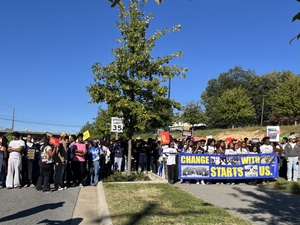
“Basically the people are creating a picket line around data centers, and they’re actually self-mobilizing,” Mosley said. “They’re working long days, and then they’re going to their city commission meetings, and they’re pushing back on this. So I’m seeing one of the biggest grassroots movements that I’ve seen in a long time.”
A year ago, Mosley supported legislation that exempts construction materials used to build data centers from the state sales tax. The bipartisan law sparked interest from companies looking for a place to build the hyperscale data centers that drive artificial intelligence.
Mosley and Simmons now support temporary moratoriums that would allow the Legislature to consider policies that range from improving government transparency to ensuring the companies that operate data centers pay for their environmental costs.
“It seems wise to me to slow down to account for those struggles and problems that other counties, other states are facing so that we can preempt them with our policies here in Kansas,” Simmons said. “If the demand is really so high, we can wait a year.”
According to the Data Center Map, which launched in 2007, there are already 39 data centers in Kansas, including 26 in Kansas City, Kansas.
Data centers operate servers that process, store and transmit information. They are built for various uses, but the recent boom in development is driven by artificial intelligence.
The largest data centers, called hyperscale, can consume as much electricity as a small city, said Ayse Coskun, a Boston University professor and chief scientist at Emerald AI, at a news briefing hosted by SciLine.
The Pew Research Center in a report last fall said the country’s data centers consumed about 17 billion gallons of water in 2023. By 2028, hyperscale data centers alone were expected to consume up to 33 billion gallons of water.
Local government officials, developers and unions in Kansas have defended data center deals — typically negotiated in secret — by promising economic development.
The Working Kansas Alliance, which describes itself as a coalition of union and non-union groups, deployed a marketing campaign called “Let’s cut the B.S.” in which it downplays water usage and other concerns.
In the political world, traditional union concerns such as collective bargaining rights, prevailing wage, worker safety and retirement benefits have taken a back seat as union leaders fixate on data centers, even though there is no guarantee they will be built with union labor.
The SMART Transportation Division Kansas State Legislative Board, which represents 6,000 workers, broke from decades of precedent to endorse the Republican candidate for governor, Senate President Ty Masterson, after Democratic state Sen. Cindy Holscher proposed a temporary moratorium on building data centers.

The Kansas AFL-CIO refused to endorse Mosley and Simmons this year, even though they have perfect ratings on the Kansas AFL-CIO report card, which scores 67 votes over the past two years.
“I’ll be honest. I didn’t see that one coming,” Simmons said. “We’d gotten the message that they didn’t like our advocacy, but Rep. Mosley and I were two of four lawmakers in the Kansas House to receive a 100% on the AFL-CIO legislative scorecard that measures how we voted on all kinds of different things, which is evidence that I would say we’re good allies of the working people, but also notably, data centers were not included in that scorecard.”
Mosley voted for and Simmons against Senate Bill 98 in 2025. That’s the bill that provides a sales tax exemption for data centers that include a $250 million investment and guarantee 20 permanent jobs. A spokesman for the Kansas Department of Commerce said four companies have applied for the sales tax exemption and that the projects are still under review.
“I definitely empathize with the fact that their jobs are hard to come by,” Mosley said. “And I feel like it’s very upsetting that people are having to choose between building out something that may potentially be harmful to our environment, to our communities, for the sake of a job.”
Topeka, KS